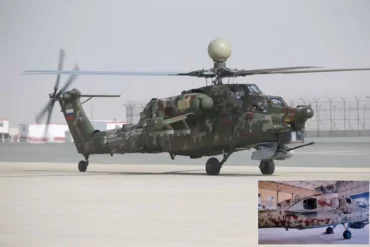
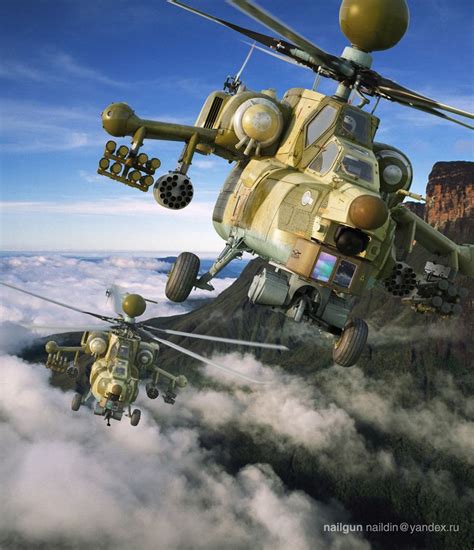
Iran has reportedly begun receiving up to six Mi-28NE Night Hunter attack helicopters from Russia under a €500 million arms agreement, marking a significant development in Tehran’s effort to restore and modernize its rotary-wing strike capacity after last year’s regional hostilities. According to leaked documentation cited by international media outlets, the aircraft were delivered in January 2026, with at least one example already observed flying over Tehran. The reported transfer forms part of a broader military package that includes Verba MANPADS and associated night-vision systems, indicating a coordinated effort to reinforce Iran’s low-altitude defense architecture.
The delivery comes less than a year after Iran’s air defense and aviation assets suffered measurable degradation during a 12-day confrontation with Israel, a conflict that briefly drew in U.S. forces and exposed vulnerabilities in Iran’s layered air defense network. In that context, the arrival of the Mi-28NE, a purpose-built two-seat attack helicopter optimized for day-night combat operations, represents both a tactical upgrade and a political signal. It demonstrates deepening military alignment between Moscow and Tehran at a time when both governments face sustained Western pressure.
Western observers have linked multiple Il-76 heavy transport flights between Mineralnye Vody in Russia and Iranian air bases to the transfer. Open-source flight tracking and satellite imagery suggest repeated cargo sorties into Karaj and other facilities in late December and early January. While neither Moscow nor Tehran has formally confirmed the transaction, imagery circulating across defense analysis platforms points toward an initial batch sufficient to establish a small operational detachment, potentially forming the nucleus of a future squadron.
The Mi-28NE Night Hunter: Design and Operational Profile
The Mi-28NE is the export variant of Russia’s Mi-28 family, designed explicitly as a dedicated attack platform rather than a multi-role transport derivative. Powered by twin turboshaft engines in the 2,200 horsepower class, the helicopter has a maximum takeoff weight approaching 12 tonnes and a top speed in excess of 300 km/h. Its ferry range extends to approximately 1,000 kilometers under optimal conditions, although its practical combat radius is shorter and aligned with tactical strike missions.
Survivability has been a defining feature of the Night Hunter’s design philosophy. The cockpit is heavily armored to withstand small-arms fire and shrapnel, fuel tanks are protected and self-sealing, and redundant flight-control systems enhance resilience under combat damage. Integrated defensive aids typically include chaff and flare dispensers, infrared countermeasures, and radar warning receivers. These features collectively allow the aircraft to conduct nap-of-the-earth operations, flying at very low altitude to minimize exposure to radar detection.
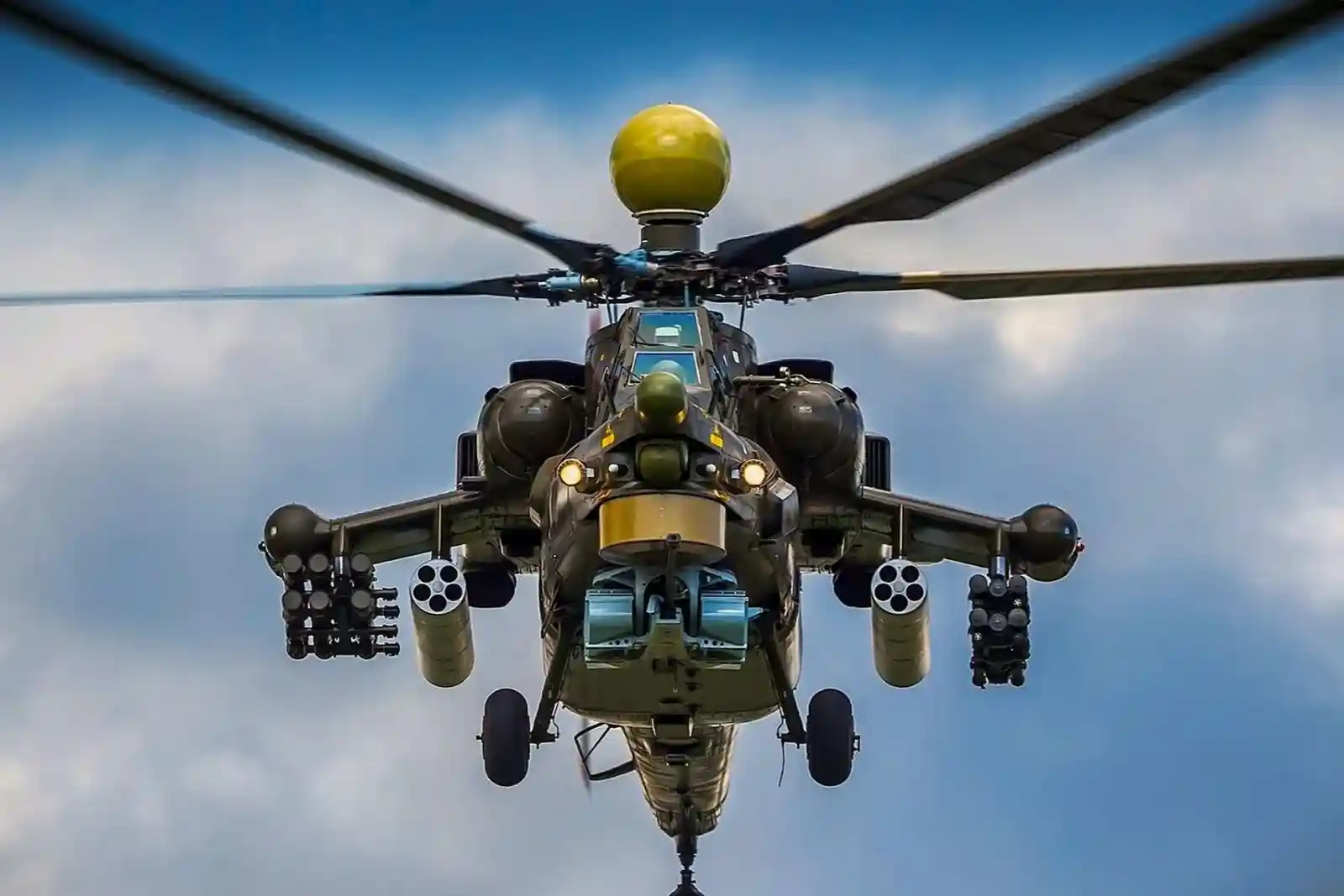
Sensor architecture is central to the Mi-28NE’s effectiveness. The platform integrates electro-optical targeting systems, laser rangefinders, thermal imaging devices, and in some configurations, a mast-mounted radar above the main rotor. This sensor suite enables detection and engagement of armored vehicles, fortified positions, and low-flying aircraft in degraded visibility and nighttime conditions, offering Iran a substantial leap beyond its aging AH-1 Cobra fleet.
Armament and Strike Capability
The primary armament of the Mi-28NE is the 30 mm 2A42 autocannon, mounted in a chin turret with approximately 250 ready rounds. The cannon can be slaved to the gunner’s sight or helmet-mounted cueing system, allowing rapid target acquisition and engagement across a wide arc. Its high rate of fire and armor-piercing capability provide both anti-vehicle and limited counter-air functionality.
Four underwing hardpoints enable a payload of up to 2,300 kilograms. Typical configurations include Ataka or Vikhr anti-tank guided missiles (ATGMs), capable of penetrating advanced armor protected by explosive reactive systems. The helicopter can carry up to 16 such missiles, providing substantial stand-off strike capacity. Additional load-outs may include 80 mm and 122 mm unguided rocket pods for area suppression, as well as Igla-V short-range air-to-air missiles for self-defense against helicopters or drones.
This combination grants Iran, for the first time, a modern platform capable of delivering precision anti-armor fires, conducting close air support, and defending itself against aerial threats within the same sortie profile. In operational terms, even a limited fleet of six aircraft significantly increases the responsiveness and lethality of Iran’s ground-support aviation element.
Integration with Iran’s Low-Altitude Defense Network
The Mi-28NE deliveries reportedly coincide with transfers of Verba MANPADS, suggesting a broader strategy to reinforce Iran’s low-altitude air defense layer. In a potential operational scenario, dispersed MANPADS teams could deny hostile aircraft freedom of maneuver below medium altitude, while Mi-28s conduct mobile anti-armor or counter-assault missions from concealed positions.
Such integration complicates adversary planning. Attack helicopters operating in terrain-masked profiles can “pop up” briefly to launch guided missiles from several kilometers away before retreating below radar coverage. If combined with unmanned reconnaissance platforms already fielded by Iran, the helicopters could receive targeting data from forward drones, enabling coordinated engagements without prolonged exposure.
From a regional security perspective, this raises the cost of ground incursions or special operations near critical Iranian infrastructure. Strategic sites, including nuclear facilities and coastal installations along the Persian Gulf, could be defended by a responsive rotary-wing strike element capable of precision engagement at short notice.
Emerging Missile and Counter-Drone Enhancements
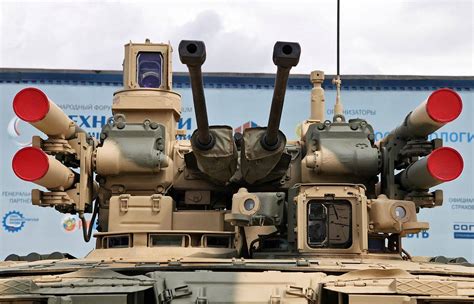
Recent Russian modernization programs for the Mi-28 family highlight potential future enhancements that could eventually reach export customers. The upgraded Khrizantema-M missile system, reported to offer engagement ranges approaching 10 kilometers with dual guidance channels, expands the effective stand-off envelope of rotary-wing strike platforms. Integration of such munitions would allow helicopter crews to engage armored targets beyond the typical reach of many portable air defense systems.
In parallel, Russian defense industry developments include a 30×165 mm programmable airburst round for the 2A42 cannon. Designed to detonate at a calculated point along a target’s trajectory, the munition creates a fragmentation cloud optimized for defeating small unmanned aerial vehicles and loitering munitions. If fielded on Iranian Mi-28NEs, this capability would transform each helicopter into a localized counter-drone node, capable of protecting itself and accompanying formations from aerial surveillance or attack.
The tactical implication is significant. Instead of expending expensive surface-to-air missiles against small quadcopters, helicopters could employ short, precisely timed cannon bursts to neutralize threats within a 2–4 kilometer envelope. In environments saturated with inexpensive UAVs, such adaptability enhances survivability and operational endurance.
Strategic and Geopolitical Implications
The reported transfer marks the first post-Soviet Russian combat aircraft delivery to Iran, symbolizing a deepening defense partnership that extends beyond air defense systems and unmanned platforms. Moscow has relied heavily on Iranian-supplied drones and missiles in Ukraine, while Tehran now appears positioned to benefit from Russian combat experience and hardware refinements.
For U.S. and allied planners focused on the CENTCOM theater, the introduction of modern Russian attack helicopters into Iran’s inventory adds complexity to contingency scenarios. Even a small fleet can influence tactical calculations, particularly in narrow geographic corridors such as the Strait of Hormuz or along sensitive land borders. The combination of precision ATGMs, potential counter-UAV ammunition, and layered MANPADS coverage strengthens Iran’s integrated low-altitude strike and defense network.
Nevertheless, scale remains a limiting factor. Six aircraft, even if fully operational, do not constitute a large force. Effective employment will depend on crew training, maintenance infrastructure, spare parts availability, and integration into Iran’s command-and-control systems under persistent sanctions. Initial deployments are likely to be concentrated at key bases, making operational patterns susceptible to intelligence monitoring.
Operational Outlook
In the near term, the Mi-28NE detachment is expected to focus on defensive missions, including protection of strategic facilities and rapid-response support to ground units. Over time, expanded procurement or additional modernization packages could broaden the fleet’s role. The true impact of this acquisition lies less in numbers than in capability density: a single modern attack helicopter equipped with advanced sensors and precision-guided munitions represents a qualitative shift compared to legacy platforms.
The introduction of the Mi-28NE Night Hunter into Iranian service reshapes the geometry of low-altitude warfare in the region. It reflects lessons drawn from contemporary high-intensity conflicts and signals a measured but tangible reinforcement of Tehran’s rotary strike arsenal. While it does not overturn the broader balance of power, it introduces new tactical variables that regional actors must account for in future operational planning.