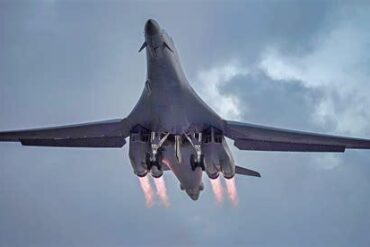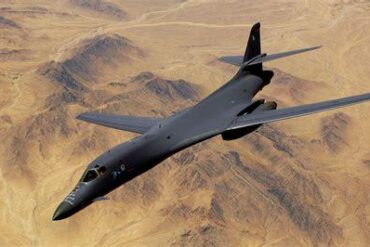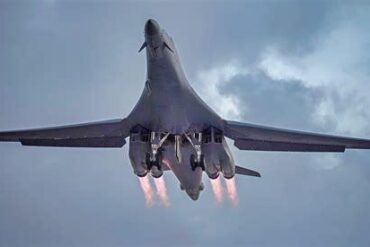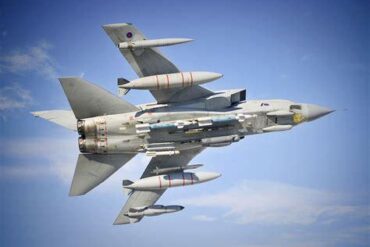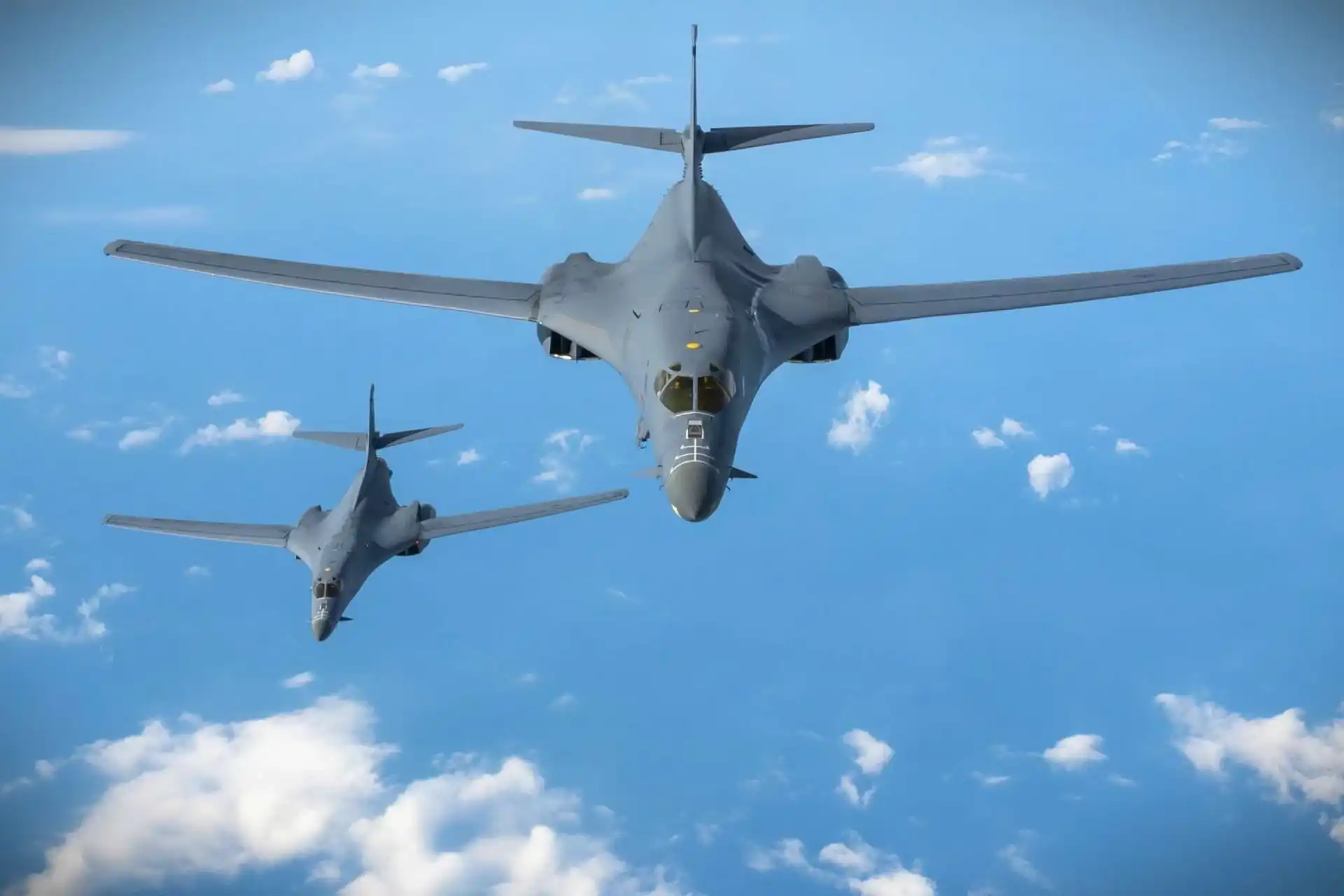
The arrival of U.S. Air Force B-1B Lancer strategic bombers at RAF Fairford in the United Kingdom marks a significant development in the rapidly evolving military situation surrounding Iran. On March 7, 2026, several of the long-range heavy bombers landed at the Gloucestershire air base, a location historically used as a forward operating hub for American bomber forces. Their deployment signals a clear shift in operational posture as Washington prepares for the possibility of expanded large-scale strike operations across the Middle East.
Defense analysts view the move as more than a routine bomber rotation. Forward positioning of aircraft capable of delivering massive volumes of precision-guided munitions suggests that the United States is building the infrastructure required for sustained conventional strike missions should tensions escalate further. With their exceptional range, payload capacity, and mission flexibility, B-1B bombers provide commanders with a powerful instrument for projecting airpower across thousands of kilometers.
Strategic Deployment of B-1B Bombers to RAF Fairford
RAF Fairford has long played a pivotal role in U.S. long-range bomber operations in Europe. The base’s location in western England places it within operational reach of the Middle East while remaining securely embedded inside NATO territory. This geographical advantage allows American forces to deploy heavy bombers forward without relying exclusively on bases in the Gulf region, where political sensitivities or security concerns may complicate operations.
The arrival of B-1B aircraft therefore carries strategic meaning beyond the immediate operational environment. It demonstrates that the United States retains the ability to rapidly reposition strategic strike assets across continents when a crisis demands it. For military planners, the United Kingdom serves as a reliable launch point for missions extending into Europe, North Africa, and the Middle East.
Reports indicate that the bombers arrived as part of a broader set of preparations connected to the escalating confrontation with Iran. By placing these aircraft within striking distance of Iranian territory, the United States effectively expands its menu of military options. In strategic signaling terms, such deployments serve both operational and psychological purposes. They reinforce the credibility of potential military action while demonstrating readiness for a prolonged air campaign if necessary.
The B-1B Lancer: A Heavyweight of Conventional Strike Warfare
The B-1B Lancer occupies a unique niche in the U.S. Air Force bomber fleet. Originally conceived during the Cold War as a high-speed nuclear delivery platform, the aircraft later transitioned to a conventional-only mission profile. Today it stands as one of the most capable heavy bombers for delivering large volumes of precision weapons over long distances.
A defining feature of the aircraft is its variable-sweep wing design, which allows pilots to adjust the wing angle for different flight regimes. Wings swept back provide high-speed performance, while extended wings improve efficiency during long-range cruising. This aerodynamic versatility enables the B-1B to combine speed, endurance, and heavy payload capacity within a single airframe.
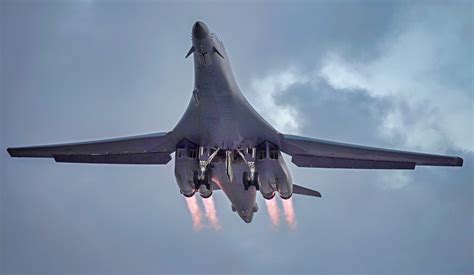
The bomber’s internal weapons bays can carry an impressive assortment of ordnance, enabling it to strike multiple targets during a single mission. In modern combat operations, the aircraft has proven particularly effective when commanders need to maintain persistent pressure across a large operational theater.
Its combat record reflects that versatility. Over the past three decades, B-1B bombers have been extensively used in conflicts ranging from Afghanistan and Iraq to Syria, where their ability to remain airborne for extended periods made them valuable for close air support and dynamic targeting missions.
Weapons Arsenal and Long-Range Strike Capability
The B-1B’s operational value is largely defined by its exceptional payload capacity, which allows it to carry a diverse range of conventional munitions. This flexibility transforms the bomber into a highly adaptable strike platform capable of engaging targets across multiple domains.
Among the weapons commonly integrated with the aircraft are Joint Direct Attack Munitions (JDAM) and Laser JDAM variants, both designed for precise strikes against fixed targets such as bunkers, command facilities, and logistical hubs. These weapons rely on satellite guidance and laser designation to deliver high accuracy even under challenging battlefield conditions.
Another critical capability lies in the bomber’s compatibility with AGM-158 Joint Air-to-Surface Standoff Missiles (JASSM) and the extended-range JASSM-ER variant. These cruise missiles enable the aircraft to engage heavily defended targets from significant distances, reducing exposure to enemy air defenses.
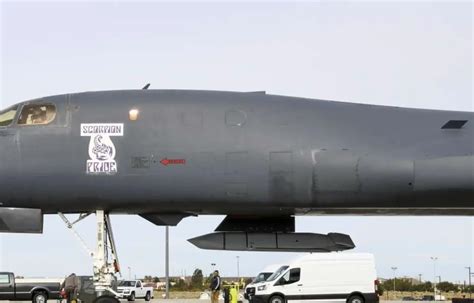
The aircraft can also deploy the AGM-158C Long Range Anti-Ship Missile (LRASM), giving it a potent maritime strike role. In a potential conflict involving Iran, this capability would be particularly relevant in the Persian Gulf and surrounding waters, where naval forces and shipping routes represent strategic assets.
Taken together, these weapon systems transform the B-1B into what military planners often describe as a high-capacity conventional arsenal aircraft, capable of delivering large numbers of precision weapons across multiple targets in a single sortie.
Operational Role in a Potential Iran Conflict
In the context of rising tensions with Iran, the B-1B would likely operate as part of a larger coordinated strike architecture rather than as a lone penetrating bomber. Unlike stealth platforms such as the B-2 Spirit, the Lancer does not possess low-observable characteristics designed for penetrating dense air defense networks.
Instead, its strengths lie in standoff attack and sustained strike operations. Missions would likely involve launching cruise missiles from extended distances or striking targets after enemy defenses have been weakened by electronic warfare and suppression-of-enemy-air-defense operations.
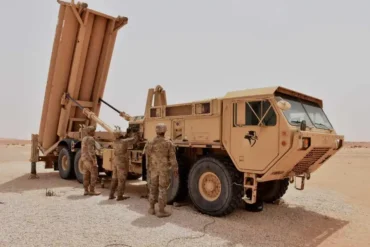
Iran maintains a layered air defense system that includes domestically produced missile systems as well as Russian-origin platforms. While this network varies in capability across the country, it would still require careful planning by U.S. forces. In such a scenario, B-1B bombers could deliver large volumes of precision munitions against strategic targets including:
- Missile infrastructure and launch facilities
- Air defense command centers
- Military logistics depots
- Airbases and aircraft shelters
- Revolutionary Guard installations
- Naval assets operating in the Gulf
The aircraft’s ability to strike numerous targets during a single mission makes it especially valuable during the opening and middle phases of an air campaign, when commanders aim to rapidly degrade an adversary’s military infrastructure.
Strategic Signaling and Alliance Implications
Deploying B-1B bombers to the United Kingdom also carries a strong geopolitical message. For Iran, the presence of long-range strike aircraft within operational range serves as a clear warning that the United States possesses the capability to escalate its military response quickly.
At the same time, the deployment reassures allies that Washington remains committed to maintaining a credible power-projection capability across multiple regions. NATO partners, particularly the United Kingdom, play an essential role in enabling this strategy by hosting infrastructure capable of supporting heavy bomber operations.
RAF Fairford has repeatedly served as a staging point for U.S. bomber missions into Europe, Africa, and the Middle East. Its runways, storage facilities, and support infrastructure are specifically designed to handle large strategic aircraft, making it one of the few locations outside the United States capable of supporting sustained bomber activity.
A Potential Prelude to Expanded Military Operations
The presence of B-1B bombers in Britain does not automatically guarantee that large-scale strikes will occur. Military deployments often function as deterrent signals intended to influence adversary calculations without requiring immediate combat action.
Yet the scale and nature of the aircraft involved indicate that U.S. planners are preparing for more than symbolic gestures. Heavy bombers provide a capability uniquely suited to high-volume precision bombardment, something tactical fighter aircraft alone cannot deliver on the same scale.
If tensions continue to escalate, the aircraft stationed at RAF Fairford could rapidly begin flying long-range strike missions into the Middle East, supported by aerial refueling tankers and intelligence-surveillance platforms. Such operations would represent a significant expansion of military pressure on Iran.
The forward deployment therefore represents both a strategic signal and a practical step in operational preparation. When heavy bombers appear at forward bases, it often means planners are positioning the pieces of a much larger chessboard.
In that sense, the arrival of B-1B Lancers in the United Kingdom may mark the opening stage of a potentially broader and more sustained phase of air operations, one capable of reshaping the strategic balance in the region if the crisis deepens.