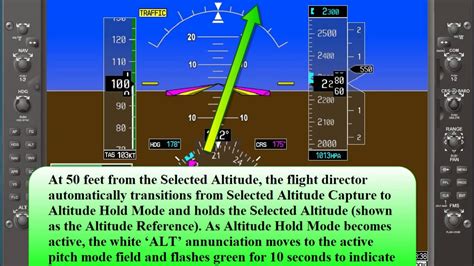
Selected altitude is one of the key data items transmitted through Mode S enhanced surveillance. It gives air traffic controllers (ATC) valuable insight into what level an aircraft is currently targeting, based on what the pilot has set in the cockpit.
The way this data appears on screen can vary across systems. In most cases, the selected altitude is visible in the aircraft’s track label. Sometimes it’s shown as a separate field. Other times, it might be hidden under another value like the cleared level and made visible by toggling with a mouse click. If there’s a mismatch between the selected altitude and the cleared level, the system usually highlights this with a visual warning—such as a color change—to grab the controller’s attention.
This feature offers several safety advantages. One major benefit is the reduced risk of a level bust. If a pilot accidentally sets the wrong level, the mismatch warning can alert the controller early enough to take action. For instance, let’s say a controller clears an aircraft to descend from FL370 to FL290. If the pilot mistakenly enters FL190 instead, the system would show the inconsistency. The controller could then issue a quick correction before the aircraft descends too far.
Without selected altitude data, that error might not be caught until the aircraft has passed the correct level, potentially resulting in a loss of separation or entry into restricted airspace. In the case of aircraft ASB0409, which began descending to FL190 instead of FL290, the system issued visual alerts—including color and symbols—to signal the mistake in real time.
Selected altitude data is also helpful when there’s a call-sign confusion. Imagine two aircraft—ASB0409 and ASB977—are both starting their descent. If ASB977 mistakenly follows an instruction meant for ASB0409, the system will show two mismatch warnings. One appears for the aircraft that was cleared but hasn’t acted yet, and another for the aircraft that began descending without the proper clearance. This gives controllers an added chance to correct the issue before separation is compromised.
In general, having this data enhances situational awareness for controllers. Let’s say a descending aircraft is handed off to a new sector, but there’s no electronic handover in place. If the controller notices a change in the selected altitude, they can assume the aircraft has received new instructions from the next unit. For arriving traffic, a mismatch between the estimated and selected level may suggest that a coordination message hasn’t been exchanged—or that something was missed. In such cases, this subtle warning can prompt further checking.
Selected altitude can also support safety nets like Short Term Conflict Alert (STCA) and Minimum Safe Altitude Warning (MSAW). STCA, for example, may be temporarily silenced if the aircraft is climbing or descending toward a known cleared level. But if there’s a mismatch between the selected and cleared level, the system might lift that silence. That’s because it becomes unclear what the aircraft will actually do next, which could be risky.
Despite its benefits, selected altitude information isn’t foolproof. It should not be treated as a guaranteed solution to all level bust scenarios. Sometimes there simply isn’t enough time to react, even when a mismatch is detected. A level bust can occur just seconds after the wrong altitude setting appears.
That’s why it’s essential for controllers to listen closely to pilot readbacks. The selected altitude might be correct, but if the pilot misunderstood or misheard the clearance, trouble can still follow. In 2016, a loss of separation occurred even though the aircraft had the correct selected level. Equipment issues can also lead to temporary wrong data, adding another layer of complexity.
It’s also possible for a mismatch to exist between what the pilot reads back and what’s shown as the selected altitude. In some cases, the aircraft may still follow the intended level correctly, but this isn’t something controllers should assume. Active listening and clarification are always necessary.
For inbound aircraft, relying only on the selected level can lead to surprises. If there’s a mismatch with the received estimate, the accepting controller might expect one thing while the aircraft is set for something else. That’s why coordination with the upstream controller is important. If coordination isn’t possible, having a backup plan helps manage any differences that arise.
When a mismatch does appear between the selected and cleared level, controllers should use clear and direct communication. A standard phrase might be: “[CALLSIGN], CHECK SELECTED LEVEL, CLEARED LEVEL IS [level].” This keeps instructions simple and minimizes confusion.
In summary, selected altitude data is a useful tool that enhances both safety and situational awareness. But like any tool, it has its limits. Controllers should treat it as one of many resources—not a replacement for standard procedures like listening to readbacks or coordinating with other units. When used correctly, it supports safer and smoother air traffic operations.