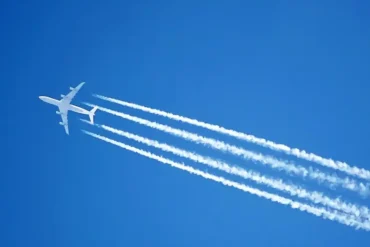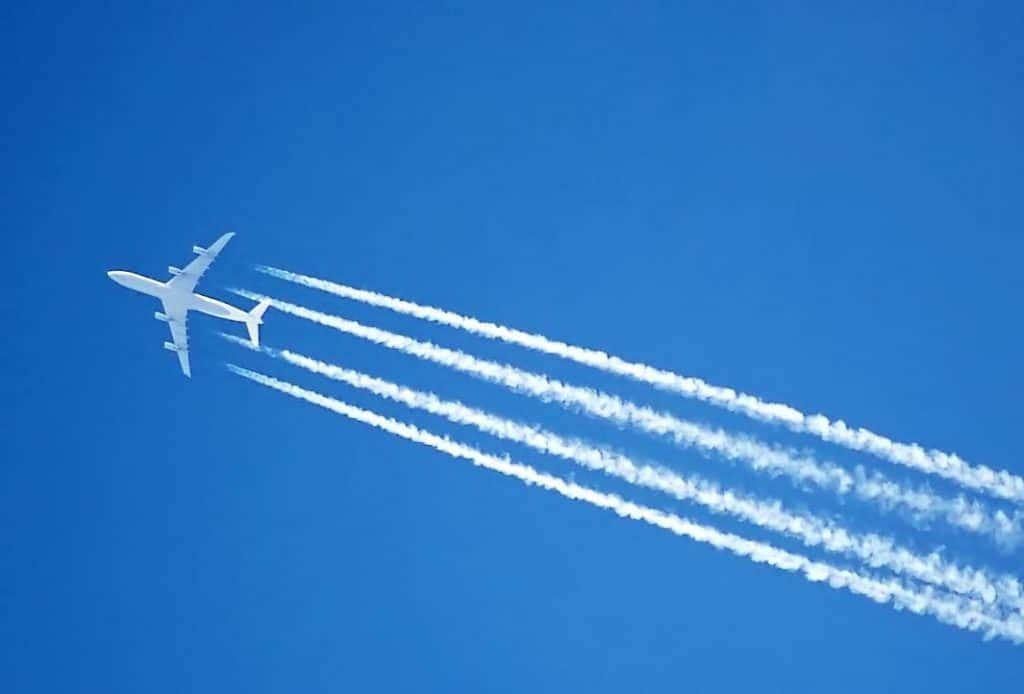
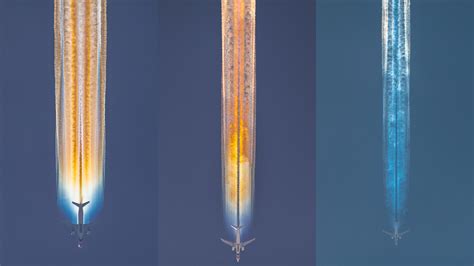
Look up on a clear afternoon, and the sky becomes a canvas of contrasts: one commercial jet leaves a thick, dazzling white streak, stretching across the horizon, while another nearby aircraft traverses the same path without leaving any visible trace. The sight is not a matter of chance, nor does it indicate hidden mechanical secrets. Instead, it is a direct interplay of atmospheric physics, engine emissions, and the delicate thresholds of microclimates at cruising altitudes. Contrails, short for condensation trails, are not smoke, nor residues of unburnt fuel—they are clouds, albeit artificial, composed entirely of ice crystals formed when engine exhaust interacts with a specific set of atmospheric conditions.
Contrails form when exhaust gases, primarily water vapor, expelled by jet engines meet air that is both frigid and saturated with moisture. The water vapor condenses onto tiny soot particles present in the exhaust, instantly freezing into ice crystals that manifest as the visible streaks in the sky. However, this phenomenon is far more selective than it appears from the ground. Air temperature, humidity, altitude, and even slight variations in air pressure all dictate whether a jet will carve a permanent icy path or slip silently through the sky. The visible trail is essentially the atmosphere’s signature, revealing the precise physical conditions at a particular layer of the upper troposphere.
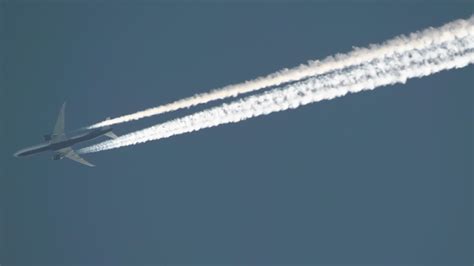
One might reasonably wonder why two aircraft flying seemingly identical routes can display starkly different visual footprints. The explanation lies in the microstructure of the air mass they traverse. Standard air traffic control ensures vertical separation of at least 2,000 feet for planes traveling in the same direction, and 1,000 feet for opposing traffic. These margins, however, are enough to place one aircraft inside a thin, moisture-rich layer where contrails flourish, while another glides through dry air, leaving nothing behind. Atmospheric scientists often reference the Appleman chart, a tool developed in 1953 by military meteorologist Herbert Appleman, which precisely maps the temperature, pressure, and humidity thresholds necessary for contrail formation. Even a minor altitude adjustment—sometimes a few hundred feet—is sufficient to transition a flight from a visible ice cloud zone into a realm of invisibility.
The Atmospheric Mechanics Behind Contrail Formation
Contrail formation is not merely an artifact of engine output but a delicate ballet of environmental conditions and aerodynamics. Temperature plays a primary role; typically, air must drop below -40°F (-40°C) for water vapor to freeze instantaneously. Humidity with respect to ice, however, determines how long these trails persist. In ice-supersaturated regions, the ambient moisture clings to soot particles from the engine, allowing contrails to form dense, cirrus-like clouds that can linger for hours.
Aerodynamic contrails add another layer of complexity. Unlike exhaust-induced trails, these form from the rapid pressure drop over curved wings or propeller blades, causing local temperatures to plummet and condense surrounding moisture into ephemeral vapor. These transient lines often vanish almost immediately, making them much less visually impactful than the persistent exhaust contrails but equally dependent on the exact atmospheric context.
| Flight Level Altitude | Ambient Temperature Standard | Humidity Level Threshold | Contrail Formation Likelihood |
|---|---|---|---|
| 28,000 feet (8,534 m) | -41°F (-40.5°C) | Low (<40%) | Minimal, instant dissipation |
| 34,000 feet (10,363 m) | -62°F (-52.2°C) | Moderate (50–60%) | Brief exhaust trails |
| 39,000 feet (11,887 m) | -70°F (-56.6°C) | High (>100%) | Persistent cirrus clouds |
These values highlight how dynamic contrail formation is. An aircraft slicing through an 800-foot-thick supersaturated ribbon may leave a vivid, expanding trail, yet a shift of just 1,000 feet higher or lower can move it into dry air, erasing the contrail entirely. Such fleeting variations underline the illusion of randomness from a ground observer’s perspective.
Contrail Formation in the Era of Modern Engines
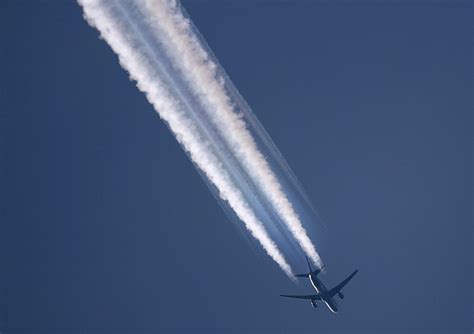
Contrary to intuition, newer, fuel-efficient aircraft are often more likely to leave visible contrails than older models. Ultra-high-bypass turbofan engines, common in contemporary jets, expel cooler exhaust gases that reach condensation thresholds at lower and warmer altitudes than their predecessors. This paradoxically increases the likelihood of persistent contrail formation, even though these engines burn less fuel and emit fewer overall particulates. The efficiency of modern engines modifies the delicate balance between propulsion output and atmospheric conditions, demonstrating that technological advancement in aviation does not linearly correlate with contrail reduction.
In practical terms, this effect explains why observers often see a new-generation airliner leaving a striking trail while an older aircraft nearby passes without leaving a mark. The difference is not just technological but also microclimatic, with the latter jet possibly flying through a dry, low-humidity corridor.
Predictive Artificial Intelligence and Contrail Mitigation
The aviation industry is now transitioning from passive observation to proactive management of contrail formation. Collaborations between major carriers and tech innovators like Google Research have demonstrated that integrating predictive AI into flight planning can reduce contrail formation by more than 60%. By mapping ice-supersaturated regions in near real-time, flight dispatchers can adjust altitudes with remarkable precision, mitigating the climate impact of persistent ice clouds without significant disruption to flight schedules.
A comprehensive trial involving 2,400 transatlantic flights revealed that minor altitude adjustments—often around 1,000 feet—were sufficient to avoid supersaturated layers. The result was a 69% reduction in climatological warming contributions from contrails, highlighting how small tactical decisions can yield substantial environmental dividends. Nevertheless, operational constraints, airspace saturation, and pilot workload limit the full application of these AI-driven strategies, illustrating the delicate balance between theoretical optimization and practical feasibility.
Distinguishing Contrails from Chemtrails
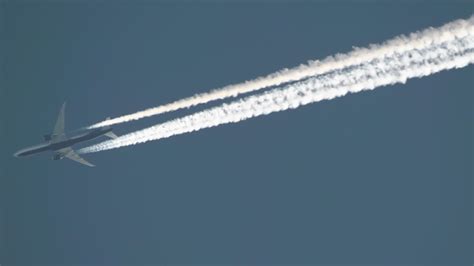
Public fascination often veers into misinformation, with the “chemtrail” theory suggesting deliberate chemical spraying from aircraft. Scientific evaluation and government guidance, including studies from the UK, confirm that contrails are purely a byproduct of engine emissions interacting with high-altitude atmospheric conditions. The distinction is crucial: exhaust contrails rely on soot particles and fuel combustion, whereas aerodynamic contrails arise solely from pressure-induced condensation. Recognizing these mechanisms dispels myths and emphasizes that visible trails are natural and predictable phenomena rather than secretive environmental interventions.
Environmental Implications of Contrail Formation
Contrail management is more than an aesthetic concern; it carries significant environmental weight. Upper-atmosphere ice clouds contribute to global warming by trapping outgoing longwave radiation. Interestingly, the time of day affects their climatic impact: daytime contrails can reflect incoming solar energy, producing a slight cooling effect, whereas nighttime trails function purely as thermal blankets, exacerbating heat retention. As a result, AI-based routing must account for diurnal variations to prioritize contrail avoidance during night operations.
Moreover, contrail mitigation involves trade-offs. Deviating from fuel-optimal flight paths can increase carbon dioxide emissions, potentially offsetting the climate benefits gained from reduced ice cloud formation. Airlines must calculate break-even points where altitude or lateral adjustments minimize net climate forcing without imposing prohibitive fuel penalties. The adoption of sustainable aviation fuel, which reduces soot particles by up to 70%, further contributes to the gradual decoupling of contrail formation from traditional hydrocarbon combustion. Looking forward, hydrogen-powered aircraft could transform baseline contrail dynamics entirely, as their combustion produces substantially more water vapor than conventional fuels.
Contrails as a Dynamic Operational Variable
The presence or absence of a contrail is no longer just a visual curiosity. It has become an operational metric that airlines can manipulate through tactical altitude adjustments, flight planning, and fuel management. Observing a clear sky behind a jet increasingly signals sophisticated algorithmic intervention rather than mere luck. As aviation continues to pursue decarbonization, the role of contrails in climate management is becoming more prominent, illustrating that minor operational tweaks can yield outsized environmental benefits.
Even as AI and sustainable fuels advance, the formation of contrails remains subject to the whims of the upper troposphere. Two identical airliners flying mere hundreds of feet apart can produce completely different outcomes depending on localized humidity and temperature. This ongoing variability underscores the intricate link between aircraft technology, atmospheric physics, and climate stewardship.
The Future of Contrail Management
The path forward involves a combination of predictive analytics, sustainable fuels, and innovative propulsion technologies. Airlines are experimenting with algorithmic flight routing that anticipates ice-supersaturated zones, while research into hydrogen-powered engines and ultra-low-soot combustion promises to redefine contrail formation thresholds. The interplay between atmospheric science, engineering innovation, and AI-driven operational planning is steadily transforming contrails from a passive byproduct into a controllable environmental variable.
Ultimately, contrails serve as a striking reminder of the delicate relationship between aviation and the atmosphere. They reveal the microscopic sensitivities of air mass conditions, the unintended consequences of technological advancements, and the emerging potential to harmonize flight operations with climate mitigation goals. The visible trails behind aircraft are no longer mere curiosities—they are measurable indicators of how humanity navigates the complex physics of the skies while striving for sustainable air travel.
In conclusion, contrail formation is a highly nuanced phenomenon governed by the convergence of engine exhaust characteristics, aerodynamic effects, and highly specific atmospheric conditions. The difference between a sky streaked with ice clouds and one of pristine blue can be attributed to subtle variations in altitude, humidity, and temperature. Modern aviation, equipped with predictive AI and greener propulsion technology, is gradually turning this once-passive environmental occurrence into a carefully managed operational factor, marking a pivotal evolution in the intersection of aviation efficiency and climate responsibility.