The McDonnell Douglas F-4 Phantom II is one of those rare military aircraft that seems to exist outside the normal laws of obsolescence. Designed in an era when slide rules ruled aerospace engineering and radar-guided missiles were still experimental, the Phantom has not only survived but continued to operate meaningfully well into the 21st century. Its persistence is not driven by sentimentality or museum nostalgia, but by a combination of engineering foresight, operational adaptability, and strategic economics that modern air forces still find difficult to replace outright.
At first glance, the idea of a Cold War fighter sharing airspace with fifth-generation stealth aircraft appears contradictory. The Phantom is large, smoky, radar-visible, and brutally loud. Yet those apparent disadvantages conceal a deeper truth: air combat and airpower are not defined by stealth alone. Many missions still demand payload, range, speed, reliability, and upgrade flexibility, areas where the F-4 continues to excel when properly modernized.
What truly separates the Phantom from other retired legends is not that it was once great, but that it was designed with enough structural and systems margin to become something else entirely. Over decades, the aircraft repeatedly reinvented itself, moving from fleet defense interceptor to multirole strike fighter, reconnaissance platform, electronic warfare specialist, and finally a precision strike asset in smaller but strategically important air forces.
Its continued operation today tells a larger story about how military aviation evolves—and why some aircraft never quite leave the stage.
The Phantom’s origins explain much of its longevity. Conceived at a time when speed, altitude, and missile combat were expected to dominate future wars, the F-4 was built big, powerful, and uncompromising. That excess, initially criticized, became the very reason it could adapt long after its contemporaries disappeared.
By the time the Phantom entered widespread service, it was already pushing the boundaries of what a carrier-capable aircraft could be. That overbuilt philosophy created an airframe with room to grow, structurally and technologically, for decades.
Born from Fleet Defense Ambitions: The Phantom’s Foundational Strength
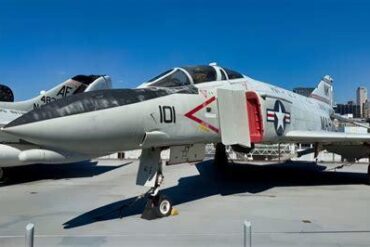
The F-4 Phantom II first flew in May 1958, answering a US Navy requirement for a long-range, high-speed interceptor capable of defending carrier strike groups against bomber threats. From the outset, it was unapologetically powerful. Twin General Electric J79 turbojets gave it exceptional thrust, while a large wing and fuselage allowed for significant fuel and weapons carriage.
Unlike many fighters of its generation, the Phantom was designed around systems integration rather than pilot workload alone. Its two-seat cockpit, with a dedicated radar intercept officer, proved invaluable as missions grew more complex. This design choice later allowed the aircraft to absorb increasingly sophisticated avionics without overwhelming a single pilot, a limitation that curtailed the upgrade potential of many lighter fighters.
Combat experience in Vietnam reshaped the Phantom’s reputation. Initially built without an internal gun, the aircraft adapted rapidly as dogfighting realities reasserted themselves. Gun pods, improved missiles, revised tactics, and eventually internal cannons on later variants transformed the Phantom into a formidable air superiority fighter while preserving its strike capability.
By the end of the 1960s, the F-4 was no longer just an interceptor. It had become a true multirole platform, capable of transitioning between air combat, ground attack, reconnaissance, and suppression of enemy air defenses with minimal structural changes.
Between 1958 and 1981, more than 5,000 Phantoms were produced, serving not only the United States but a wide range of allied nations. That massive production run created a global ecosystem of parts, maintenance knowledge, and upgrade pathways that still benefits operators today.
A Global Workhorse: How International Operators Extended the Phantom’s Life
One of the strongest reasons the F-4 Phantom refuses to fade away lies in how different air forces tailored it to their specific strategic needs. Instead of treating retirement as inevitable, several nations viewed the Phantom as a foundation rather than a finished product.
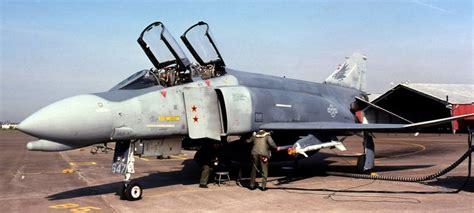
The United States established the blueprint. Across the US Navy, Marine Corps, and Air Force, the Phantom evolved into specialized variants such as the RF-4 reconnaissance aircraft and the F-4G Wild Weasel, one of the most effective SEAD platforms of its era. These adaptations demonstrated the airframe’s capacity to host radically different mission systems without fundamental redesign.
In Europe, the United Kingdom heavily modified the Phantom for its own requirements, fitting Rolls-Royce Spey engines to improve low-level performance and carrier suitability. West Germany, Japan, and South Korea relied on the Phantom as a primary air defense asset throughout the Cold War, integrating domestic avionics and weapons that extended its relevance well into the 1990s and beyond.
Israel pushed the platform even further. Through continuous local upgrades, Israeli Phantoms became precision strike and reconnaissance tools that influenced later Western modernization programs. Their success reinforced the idea that the Phantom’s real strength lay not in its original configuration, but in its upgrade elasticity.
Iran, Greece, and Turkey each took this philosophy in different directions, using the Phantom to fill capability gaps created by geopolitics, budgets, or procurement delays. In each case, the aircraft survived not because nothing better existed, but because nothing else offered the same balance of cost, payload, and proven reliability.
Greece’s F-4 Phantom II AUP: Precision Strike from a Classic Airframe
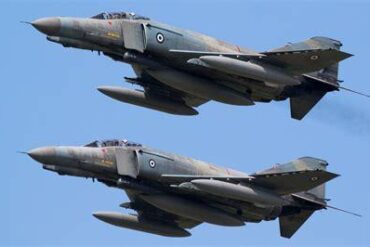
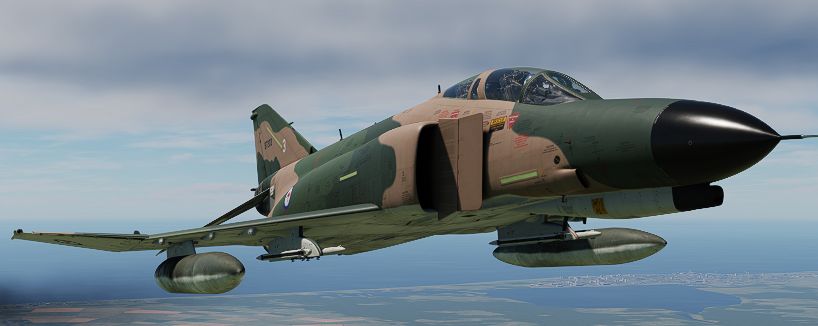
Greece stands as one of the most visible modern Phantom operators, not merely preserving the aircraft but actively modernizing it. The Hellenic Air Force’s Peace Icarus 2000 program transformed aging F-4E airframes into highly capable strike platforms suited to the complex operational environment of the Aegean.
The upgrade replaced legacy radar with the AN/APG-65GR, comparable to early F/A-18 Hornets, and introduced modular mission computers, modern cockpit displays, and advanced navigation systems. These changes fundamentally altered how Greek Phantoms fight, enabling the use of precision-guided munitions and beyond-visual-range air-to-air missiles such as the AIM-120 AMRAAM.
Equipped with Litening II targeting pods, the F-4E AUP can deliver accurate strikes from altitude, reducing exposure to air defenses while exploiting the Phantom’s natural strength: heavy payload capacity. Maritime strike missions remain particularly relevant, as the aircraft can carry substantial ordnance over long distances without relying on tanker support.
Operationally, Greece uses the Phantom intelligently. Rather than assigning it air superiority tasks better suited to newer fighters, the F-4 complements F-16Vs and Rafales by absorbing demanding strike missions. This layered force structure maximizes combat power while controlling costs, proving that older aircraft can remain indispensable when used strategically.
Turkey’s F-4E 2020 Terminator: Strategic Depth through Modernization
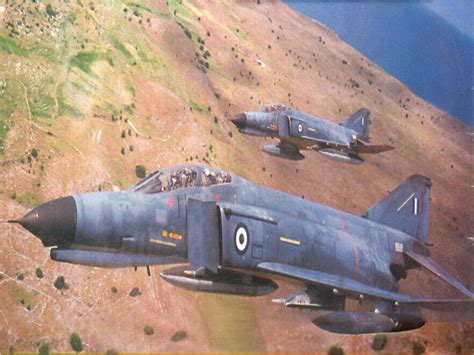
Turkey’s approach to the Phantom is even more ambitious. The F-4E 2020 “Terminator” upgrade represents one of the most comprehensive modernization efforts ever applied to the type. Developed with Israeli assistance, the program transformed the Phantom into a long-range precision strike and reconnaissance platform suited for modern warfare.
The Terminator features advanced HOTAS controls, a new head-up display, upgraded electronic warfare systems, and the EL/M-2032 multimode radar. Structural reinforcements extended airframe life, while weapons integration allowed the carriage of standoff munitions such as the AGM-142 Popeye and AGM-65 Maverick.
What makes Turkey’s Phantoms particularly relevant is their continued interoperability. Participation in NATO exercises, including recent multinational deployments, demonstrates that upgraded F-4s can still operate effectively alongside modern fighters in complex air campaigns.
For Ankara, the Phantom also serves a political and strategic purpose. By sustaining a capable strike fleet independent of delayed or uncertain procurement programs, Turkey maintains operational autonomy. In this context, the Phantom is not a relic but a hedge against strategic vulnerability.
Iran’s F-4 Phantom Fleet: Engineering Resilience under Sanctions
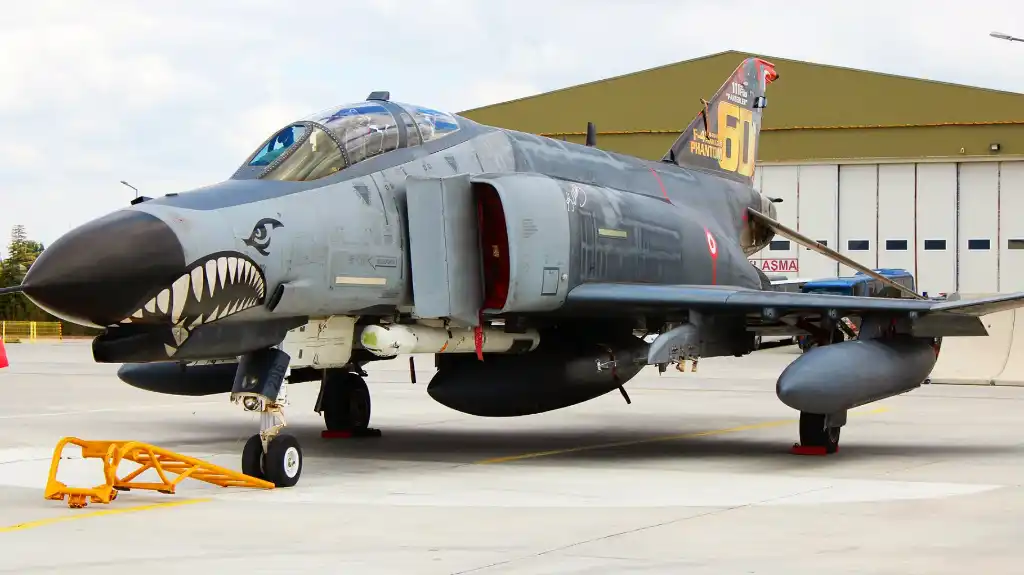
Iran’s continued operation of the F-4 Phantom may be the most striking example of the aircraft’s resilience. Despite decades of sanctions, limited access to original spare parts, and sustained operational stress, the Islamic Republic of Iran Air Force continues to fly F-4D and F-4E variants in strike and reconnaissance roles.
The technical challenge alone is extraordinary. Without factory support, Iran has reportedly developed indigenous overhaul capabilities for critical engine components, including turbine blades and afterburner sections of the J79. While performance margins are likely reduced, the aircraft remain sufficiently capable for regional missions requiring speed, range, and payload.
Historically, Iranian Phantoms were central to national airpower. During the Iran–Iraq War, they conducted deep strikes against infrastructure and airbases, participated in large-scale opening operations, and played a major role in maritime attack missions during the Tanker War. That legacy continues to shape how the aircraft is viewed within Iran’s defense structure.
Today, the Phantom’s role is less about constant combat and more about deterrence, signaling, and operational continuity. Exercises, patrols, and occasional deployments demonstrate capability without risking newer or more limited assets.
Why the F-4 Phantom II Still Makes Strategic Sense
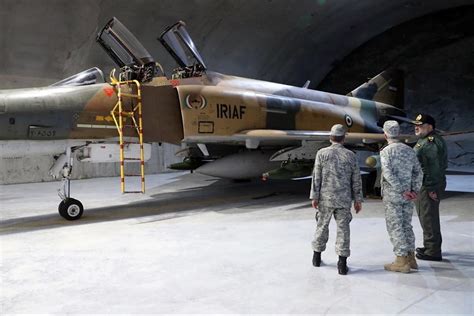
The F-4 Phantom’s refusal to retire is not an accident. It is the result of an aircraft designed with excess capacity, upgraded intelligently, and employed realistically. Its strengths—speed, payload, range, and structural robustness—remain relevant in missions where stealth is unnecessary or impractical.
Equally important is cost. For many air forces, upgrading existing Phantoms delivers credible capability at a fraction of the price of acquiring and sustaining next-generation fighters. When paired with modern avionics and weapons, the Phantom becomes a force multiplier rather than a liability.
In an era obsessed with technological novelty, the Phantom stands as a reminder that airpower is ultimately about effects, not aesthetics. As long as nations require a proven, flexible, and economically viable strike platform, the F-4 Phantom II will continue to fly—not as a museum piece, but as an active participant in modern military aviation.