United Airlines flight attendants are once again standing in the public eye, picketing outside corporate offices, rallying in uniform, and broadcasting a clear message of frustration. Nearly unanimous strike authorization votes suggest a workforce ready to escalate. Yet planes continue to depart on schedule, cabins remain staffed, and no lawful strike materializes. The disconnect between worker intent and real-world action is not accidental. It is the direct result of a federal labor structure that places airline employees in a uniquely restrictive legal position.
At the center of this stalemate is the Railway Labor Act, a statute that governs airline and railroad labor relations and sharply limits when collective action can legally occur. Unlike most private-sector workers, flight attendants cannot strike simply because negotiations fail or contracts lapse. Their ability to withhold labor is tightly regulated, delayed, and often neutralized by procedural barriers that prioritize uninterrupted transportation over rapid dispute resolution.
The result is a prolonged state of limbo where negotiations stretch on for years, public demonstrations substitute for strikes, and economic pressure remains largely theoretical. To understand why United flight attendants can vote to strike but cannot actually walk out, it is necessary to unpack how this law operates in practice.
The Chicago Picket That Stopped Short of a Strike
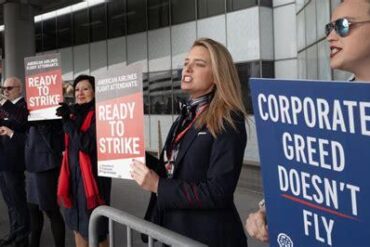
United flight attendants recently gathered in downtown Chicago for an informational picket outside the airline’s headquarters. The action followed a strike authorization vote with overwhelming approval, signaling deep dissatisfaction with stalled contract talks and rising cost-of-living pressures. The demonstration was loud, visible, and deliberate—but legally limited.
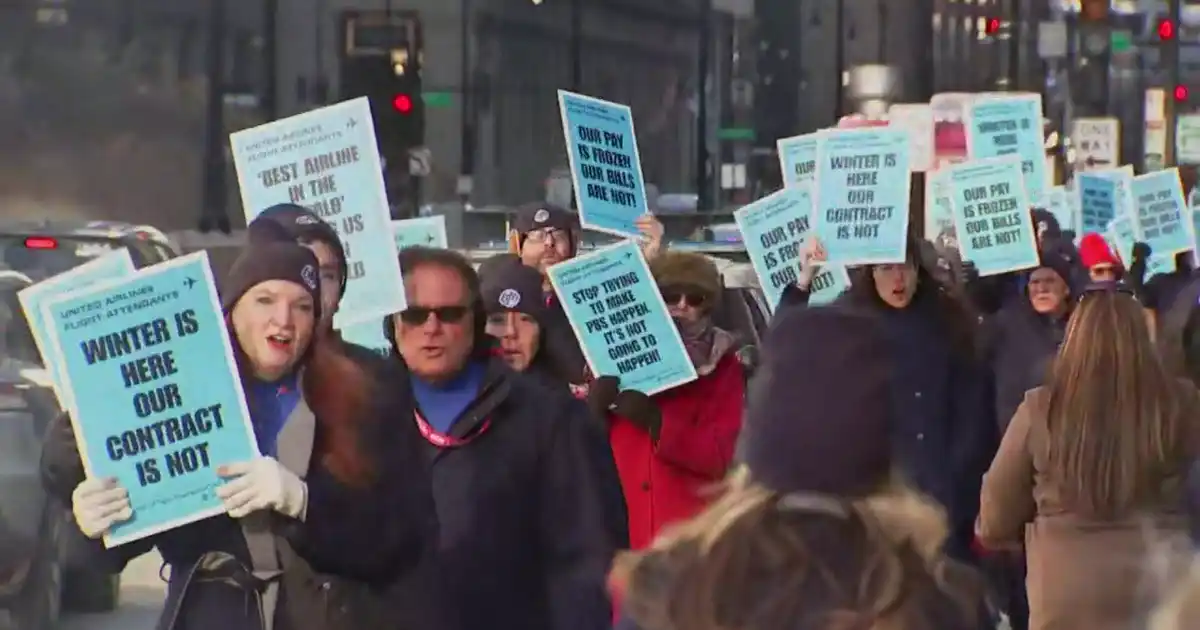
Informational picketing is one of the few pressure tools allowed under current law. It draws public attention without disrupting service, which is precisely why it has become a recurring tactic across the airline industry. The picket was not a sign of hesitation. It was evidence of constraint.
Flight attendants have openly stated that many are struggling to afford housing and basic necessities despite working full schedules. Those conditions fuel organizing energy, but federal law, not worker resolve, determines how far that energy can legally go.
How the Railway Labor Act Freezes Contracts in Place
Under the Railway Labor Act, airline labor agreements do not expire in the traditional sense. Instead, they become amendable, meaning every existing term remains enforceable while negotiations continue. Wages, work rules, and benefits stay frozen, even as inflation rises and corporate profits fluctuate.
When direct negotiations stall, disputes are automatically routed into mediation overseen by the National Mediation Board. Crucially, this mediation has no fixed endpoint. It can last months or years, and neither side can legally exit on its own.
Even a successful strike authorization vote carries no immediate legal power. It is symbolic leverage, not a trigger. Only the National Mediation Board can formally release both parties from mediation, and that release is rare.
Why Strike Authorization Votes Don’t Equal Strikes
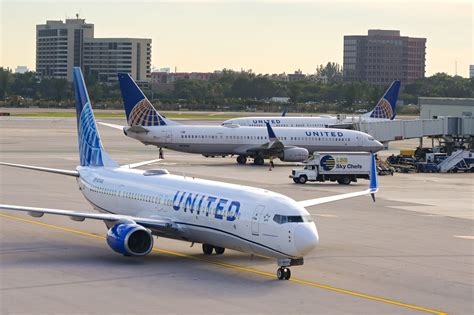
Once mediation ends—if it ends at all—a mandatory 30-day cooling-off period begins. During that window, flight attendants must continue flying, and airlines must continue operating. Any work stoppage before the process fully concludes would be considered illegal and subject to severe penalties.
Even after the cooling-off period, the federal government retains additional tools to intervene. Presidential Emergency Boards can be convened, and Congress can step in to impose terms. These layers of intervention mean that a lawful airline strike in the United States is not just difficult—it is structurally discouraged.
This is why airline unions across the industry frequently report overwhelming strike votes that never result in walkouts. The legal path is narrow, slow, and often closed before workers reach the end.
A Law Built for Stability, Not Speed
The Railway Labor Act was enacted nearly a century ago with a clear goal: prevent sudden disruptions to national transportation networks. At the time, railroads and airlines were considered critical infrastructure with few alternatives.
That logic still governs today, but critics argue it now disproportionately benefits employers. By delaying meaningful economic pressure, the law allows airlines to continue operating under outdated contracts while labor costs remain controlled.
In contrast, aviation workers in many other countries can strike after significantly shorter notice periods. In the United States, public visibility campaigns have become substitutes for traditional strike leverage.
What This Means for United and the Industry Ahead
For United Airlines, the current standoff illustrates a broader industry pattern. As airlines expand fleets, post record revenues, and consolidate market power, labor groups are pushing harder for contracts that reflect modern economic realities.
Unable to strike, unions turn to coordinated demonstrations, media outreach, and symbolic actions designed to influence public opinion and investor perception. These strategies keep pressure alive without violating federal law.
For flight attendants, the situation is a legal holding pattern. They can organize, vote, protest, and speak—but they cannot lawfully strike until every procedural gate opens. Until then, planes will keep flying, negotiations will inch forward, and the gap between worker frustration and actionable power will remain firmly enforced by statute.
In the end, United flight attendants are not restrained by hesitation or division. They are restrained by design.