
Connecting airports are the hidden machinery of the US aviation network. They may not always attract the same attention as the country’s largest destination airports, but their real importance is revealed by how many travelers use them without actually visiting the cities they serve. A passenger flying from a small regional airport to Europe, for example, may pass through a major hub without ever leaving the terminal. That transfer can be the reason an otherwise marginal route remains commercially viable.
The busiest connecting hubs in the United States therefore cannot be identified simply by counting total passengers. Airports with enormous local populations can process millions of travelers who begin or end their journeys there. A connecting hub has a different role: it gathers passengers from many origins, sorts them into carefully timed flight banks, and sends them toward destinations that could not support nonstop service from every individual market. The result is an intricate network built around geography, airline strategy, aircraft availability, and connection timing.
Some of America’s most recognizable airports perform this function, but several of the most transfer-dependent facilities can be surprisingly easy to overlook. Their cities may not have the international profile of New York or Miami, yet their terminals can be filled with passengers moving between completely different parts of the country. The following ten airports illustrate how much of US aviation depends on connecting traffic, with the ranking emphasizing the proportion of passengers traveling through rather than simply the size of the local market.
10. Newark Liberty International Airport: United’s New York Gateway

Newark Liberty International Airport occupies a complicated position within the US hub system. Serving the enormous New York metropolitan area, it naturally has a substantial local passenger base, but it is also one of United Airlines’ most important connecting airports. More than 49 million passengers pass through Newark annually, giving the airport enough scale to support a broad domestic and international schedule.
United’s presence is particularly significant. The airline controls approximately 68% of the airport’s flight capacity and occupies Terminal C, creating a concentrated operating environment for both domestic connections and international departures. Newark offers nonstop flights to dozens of international destinations, allowing United to feed transatlantic services with passengers arriving from cities across the United States.
Newark’s connecting role is somewhat different from that of airports such as Charlotte or Detroit. Its enormous local market means that a larger proportion of travelers are originating or terminating their journeys in the New York area. Nevertheless, United’s connecting banks remain essential for linking secondary US markets with long-haul international services. The airport’s location inside the heavily congested Northeast airspace also limits how aggressively it can operate as a pure transfer hub.
9. Seattle-Tacoma International Airport: The Pacific Northwest Connector
Seattle–Tacoma International Airport is widely associated with Seattle’s technology economy, but its aviation role extends far beyond the Puget Sound region. With more than 52.7 million annual passengers, Seattle-Tacoma is a major gateway for the Pacific Northwest and a strategically important transfer point for Alaska, the western United States, Hawaii, and Asia.
Alaska Airlines and its regional affiliate Horizon Air account for more than half of the airport’s passenger capacity, while Delta Air Lines maintains a substantial operation of its own. Together, their schedules create a dense network connecting smaller western communities to Seattle before passengers continue toward other domestic or international destinations.

Approximately 70% of Seattle’s passengers originate or terminate locally, meaning the connecting share is smaller than at the country’s most transfer-dependent fortress hubs. Yet the remaining traffic represents millions of passengers. Seattle is particularly important for communities in Alaska, some of which are thousands of miles from the Lower 48. For those travelers, Seattle can function as the critical bridge between remote regional markets and the broader US aviation system.
8. Miami International Airport: America’s Gateway to Latin America
Miami International Airport has an international reputation that can obscure its importance as a connecting airport. With roughly 55.3 million annual passengers, Miami is one of America’s largest gateways, particularly for traffic moving between the United States, Latin America, the Caribbean, and Europe.
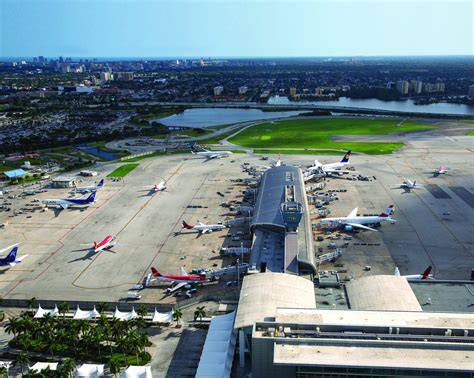
American Airlines has built an exceptionally powerful operation at Miami, controlling more than half of passenger traffic and concentrating major connecting activity in Concourse D. The carrier can combine domestic feeder flights with an extensive international network, allowing passengers from US cities to connect efficiently onto services serving Central and South America, the Caribbean, and beyond.
Miami’s geography makes it fundamentally different from a central US hub. It is not positioned to distribute traffic evenly across the country. Instead, its value comes from its location at the southeastern edge of the United States. About 55% of passengers are local origin-and-destination travelers, while the remainder use the airport as a transfer point. Its connecting traffic is therefore heavily shaped by international geography rather than conventional coast-to-coast domestic flows.
7. Phoenix Sky Harbor International Airport: A Sunbelt Transfer Engine
Phoenix Sky Harbor International Airport handles more than 51.6 million passengers annually, making it one of the largest airports in the United States. Its size is partly explained by Phoenix’s growing local market, but its role within American Airlines’ network is equally important.
American holds about 40% of the airport’s capacity and operates extensive flight banks through Terminal 4. Those schedules connect western cities with destinations across the central and eastern United States, creating a useful alternative to more congested northern routes. Southwest Airlines also maintains a massive operating base at Phoenix, adding substantial frequency and network depth.
Connecting passengers account for roughly 35% to 40% of Phoenix’s total traffic, a meaningful share for an airport serving such a large metropolitan area. Its position in the Southwest gives airlines another way to move passengers between regions without depending entirely on airports closer to the nation’s most congested coastal corridors.

The desert location may initially seem unusual for a major transfer center, but that geography is part of its strength. Phoenix provides a practical staging point for east-west traffic, particularly when airlines want to build schedules around southern US connections.
6. Houston George Bush Intercontinental Airport: United’s Mid-Continent Stronghold
George Bush Intercontinental Airport is one of United Airlines’ most strategically important hubs. Serving Houston, the airport handles more than 48 million passengers every year and offers nonstop service to more than 200 destinations.
United controls nearly 60% of flight operations at the airport and operates connecting banks across its extensive terminal complex. The airline uses Houston to gather passengers from throughout the United States before sending them onward to Central America, South America, and other international markets. This makes the airport particularly important for United’s Latin American network.
Houston also benefits from its position as a major US business center. Energy-sector travel creates strong local demand, while the airport’s central location allows United to combine corporate traffic with connecting passengers. A traveler from a smaller Midwestern or Western city can therefore reach an international destination through Houston without needing to travel through a coastal gateway.

The airport’s importance is easy to underestimate because Houston itself is the destination for many travelers. Behind that local traffic, however, lies a substantial transfer operation that helps sustain one of the country’s broadest international networks.
5. Philadelphia International Airport: American’s Alternative Northeast Hub
Philadelphia International Airport occupies a distinctive place in the Northeast. With more than 30 million annual passengers, it is considerably smaller than Newark, but its connecting role within American Airlines’ network is substantial.
American controls approximately 67% of passenger capacity and operates coordinated flight banks across the airport’s seven terminals. Regional flights can feed passengers from smaller markets into long-haul services bound for Europe, including major destinations such as London, Rome, and Dublin.
Philadelphia’s appeal as a connecting airport is closely connected to its position outside New York’s most congested airspace. That can provide airlines with operational advantages when building schedules around international departures and arrivals. Passengers connecting through Philadelphia can also avoid the complexity associated with transferring through some of the larger New York-area airports.

The airport’s growing route network demonstrates why total passenger numbers alone do not tell the complete story. Philadelphia may not dominate national airport rankings, but within American’s Northeast network it can function as a highly effective bridge between regional US markets and transatlantic destinations.
4. Salt Lake City International Airport: Delta’s Mountain West Workhorse
Salt Lake City International Airport is one of the clearest examples of an airport whose importance extends far beyond its local metropolitan population. Located only about five miles from downtown Salt Lake City, the airport is the principal Delta Air Lines hub in the Mountain West and a major transfer point between the western United States and the Midwest and East Coast.
Delta controls roughly 70% of capacity at Salt Lake City. During the first quarter of 2026, the airline operated 21,242 flights and offered approximately 2.79 million seats from the airport. Those numbers underline how heavily the airline depends on the facility to distribute passengers throughout its domestic network.
Roughly six in ten travelers passing through Salt Lake City are connecting passengers, making the airport far more transfer-dependent than its local population alone would suggest. Delta’s schedule is structured around banks that bring regional passengers into the airport before distributing them onto longer domestic routes.
The modernized terminal is particularly useful for this model. Fast connections matter when hundreds of passengers are arriving on multiple regional flights and need to move toward another bank of departures. Salt Lake City’s geography also gives Delta a central western staging point without requiring every passenger to travel through a coastal airport.
3. Minneapolis–St. Paul International Airport: Delta’s Upper Midwest Fortress
Minneapolis–Saint Paul International Airport ranks among the most transfer-dependent major airports in the country. The facility handles substantial local traffic, but its network function is even more significant. Delta Air Lines and its regional partners Endeavor Air and SkyWest Airlines account for approximately 71% of passenger traffic.
Delta provided about 3.55 million seats across 26,946 departures from Minneapolis–St. Paul during the first quarter of 2026. Its schedule connects communities across the Upper Midwest with destinations throughout the United States while also supporting international services to cities including London, Paris, Amsterdam, Rome, and Copenhagen.

Approximately 60% to 65% of passengers are connecting travelers, placing MSP firmly among America’s major transfer engines. Its geographic position is central to that strategy. Delta can collect passengers from smaller Midwestern markets and redistribute them toward the East Coast, West Coast, Sunbelt, and international destinations.
The airport’s operational reliability is another important factor. For a hub airline, a missed connection can disrupt an entire sequence of flights, so dependable operations are especially valuable when an airport is designed around dense connecting banks.
2. Detroit Metropolitan Airport: Delta’s Midwest Connection Machine
Detroit Metropolitan Wayne County Airport is Delta’s second-largest hub network and one of the most distinctive connecting airports in the United States. Located in Romulus, Michigan, the airport links the Midwest with the East Coast and supports extensive transatlantic and transpacific services.
Detroit’s scale is striking when compared with the size of its immediate local market. Passenger traffic climbed to more than 23.34 million two-way travelers in the 12 months ending April 2026, representing a 2.2% increase. Much of the airport’s strength comes from its ability to collect passengers from a broad domestic network and funnel them into international and transcontinental services.
The McNamara Terminal is particularly suited to the connecting model. Its approximately two-mile linear layout includes an elevated express tram designed to move passengers through the enormous facility. That infrastructure reflects the airport’s fundamental purpose: moving large numbers of people between flight banks efficiently.

Detroit’s position as a major Delta hub also has historical roots. Delta’s 2008 merger with Northwest Airlines transformed the airport into an important component of the carrier’s national and international network. Today, its combination of domestic feeder routes and long-haul services makes it one of the most significant transfer points in the Midwest.
1. Charlotte Douglas International Airport: America’s Overlooked Connecting Giant
Charlotte Douglas International Airport stands out because its enormous transfer operation is easy to overlook. Charlotte is not usually the first city that comes to mind when people think about America’s largest international gateways, yet the airport is one of the most connection-dependent major hubs in the country.
American Airlines controls nearly 90% of passenger traffic at Charlotte and operates approximately 646 daily departures. More than 53 million passengers pass through the airport annually, while its five concourses handle a constant stream of travelers moving between regional, domestic, and international flights.
The defining statistic is its connecting share. Approximately 70% of passengers passing through Charlotte never leave the terminal complex, meaning only around 30% originate or terminate their journeys locally. That makes Charlotte fundamentally different from airports where enormous passenger totals are driven primarily by the size of the surrounding metropolitan area.

American uses Charlotte to aggregate passengers from smaller Southeastern markets and redistribute them toward major cities throughout the United States. The hub is especially effective because of its position in the growing Sunbelt and its ability to combine short regional flights with longer domestic services.
Charlotte therefore illustrates the central lesson behind the country’s busiest connecting hubs: airport size and connecting importance are not the same thing. An airport can process tens of millions of passengers while functioning primarily as a local gateway, while another facility can derive much of its strategic value from passengers who are simply changing planes.
Why Connecting Hubs Matter to the US Aviation Network
The ten airports reveal several different models of hub aviation. Newark and Miami combine enormous local markets with international transfer roles. Seattle and Phoenix connect broad domestic regions with powerful airline networks. Houston and Philadelphia specialize in funneling domestic passengers toward international routes, while Salt Lake City, Minneapolis–St. Paul, Detroit, and Charlotte rely particularly heavily on structured connecting banks.
For airlines, the economics are straightforward but demanding. A nonstop route between two smaller cities may not generate enough passengers to operate frequently. A hub solves that problem by combining passengers from many origins onto the same aircraft. The resulting network can support hundreds of city pairs that would otherwise have little or no nonstop service.
That is why the US aviation hub system remains so important despite the growth of point-to-point flying. Behind many apparently simple itineraries is an airport designed to synchronize arrivals, departures, gates, aircraft, crews, and passengers within tightly controlled windows.
The next time a boarding pass shows a connection in Charlotte, Detroit, Minneapolis, Salt Lake City, Houston, Philadelphia, Phoenix, Miami, Seattle, or Newark, the layover may look like an interruption. In reality, it is evidence of the enormous network operating behind the journey. These airports are not merely places where travelers change planes. They are the transfer engines that allow America’s airlines to turn hundreds of individual routes into nationwide and global networks.