An airport’s scale is often measured by passenger numbers, runway count, or total land area, but gate capacity offers a different way to understand how much traffic a terminal complex can actually handle. Passenger boarding gates are the critical connection between aircraft and terminal infrastructure, allowing travelers to board and disembark through jet bridges without relying on remote bus operations. For major connecting hubs, having hundreds of active gates can make the difference between smooth aircraft rotations and severe congestion during peak departure banks.
The world’s largest airports by gate count are therefore not necessarily the same airports that lead every other aviation ranking. Their importance comes from how efficiently they combine terminal space, taxiways, concourses, automated transit systems, and airline operations. A high gate count also has a direct effect on passengers. More contact gates can reduce the need for remote stands, shorten aircraft turnaround procedures, and give airlines greater flexibility when several flights arrive or depart within minutes of one another.
This ranking focuses specifically on active passenger boarding gates connected directly to terminal infrastructure. Remote aircraft parking positions that require passengers to travel by apron bus are excluded unless they are formally designated as primary passenger gate facilities. Using that definition, five enormous U.S. airports stand above the rest, ranging from Los Angeles International Airport’s sprawling multi-terminal arrangement to Chicago O’Hare International Airport’s 199-gate complex.
5. Los Angeles International Airport — 161 Gates
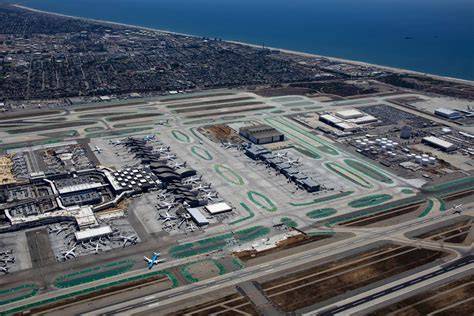
Los Angeles International Airport (LAX) occupies fifth place with 161 active passenger boarding gates spread across nine passenger terminals. Covering roughly 3,500 acres along the Southern California coast, LAX is one of the world’s most recognizable international aviation gateways and an especially important hub for flights across the Pacific. Its position between dense Los Angeles neighborhoods and the Pacific Ocean has forced the airport to make efficient use of its existing footprint rather than simply expanding outward.
The airport’s unusual terminal arrangement is one reason its gate capacity is so significant. Rather than operating as a single enormous terminal building, LAX consists of multiple facilities arranged around a central U-shaped road system. Four parallel runways support the airport’s enormous aircraft movements, while the passenger terminals handle a mixture of domestic, international, regional, and long-haul operations.
A major element of LAX’s recent modernization has been the expansion of the Tom Bradley International Terminal. The West Gates facility added 15 contact gates that can accommodate larger aircraft, with passengers reaching the gates through an underground tunnel. This expansion has increased the airport’s ability to handle international traffic without relying as heavily on remote aircraft positions.
Another important feature is the airside connectivity between terminals. Post-security walkways allow passengers to move between the terminal buildings without repeatedly passing through security screening. That is particularly valuable at an airport where airlines from different alliances and operating groups use separate terminal facilities.
LAX also has a distinctive operational challenge because it is not dominated by one single airline in the way some U.S. mega-hubs are. American Airlines, Delta Air Lines, United Airlines, and Alaska Airlines all maintain substantial operations, while numerous international carriers use the airport for transpacific and transcontinental services. With 161 gates serving such a broad airline mix, efficient gate utilization and rapid aircraft turns are essential.
4. Dallas/Fort Worth International Airport — 168 Gates
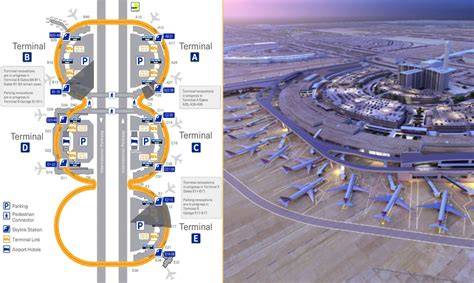
Dallas/Fort Worth International Airport (DFW) moves into fourth place with 168 active passenger boarding gates. Its enormous physical footprint, covering about 17,183 acres between Dallas and Fort Worth, gives the airport a major advantage over more geographically constrained urban facilities. DFW was designed from the beginning around a highly structured terminal concept, with five main passenger buildings designated Terminals A through E.
The airport’s semicircular terminal configuration remains one of its defining characteristics. The original design was intended to make automobile access and parking convenient, allowing passengers to reach their departure facilities without crossing an enormous central terminal building. Over time, the same layout has also provided a flexible foundation for the airport’s massive connecting operation.
DFW is particularly important because it functions as the principal mega-hub for American Airlines. Thousands of connecting passengers can pass through the airport during tightly concentrated departure and arrival periods. With 168 gates distributed among five terminal complexes, the airport needs an equally efficient way to move passengers between them.
That role is filled by Skylink, the automated people-mover system operating within the secure airside environment. The system connects the terminal areas and allows passengers to transfer between gates without leaving the sterile zone. A passenger can therefore make a relatively fast connection between distant concourses without having to return to a central landside terminal.
DFW has also demonstrated how modern construction techniques can add gate capacity without requiring a complete reconstruction of an existing terminal. New contact gates, including the four-gate High-C expansion, have been incorporated into the airport’s broader development strategy. Some components were assembled away from the final location before being moved into position, reducing the disruption normally associated with major terminal construction.
The airport’s airfield design is equally important. Peripheral end-around taxiways allow aircraft to move around runway ends rather than crossing active runways in certain situations. That helps preserve aircraft movement efficiency as thousands of flights cycle through the 168-gate terminal system.
3. Denver International Airport — 172 Gates
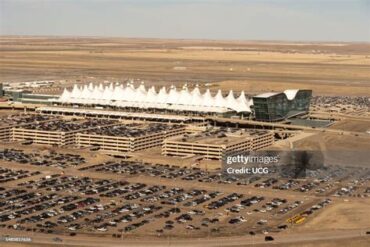
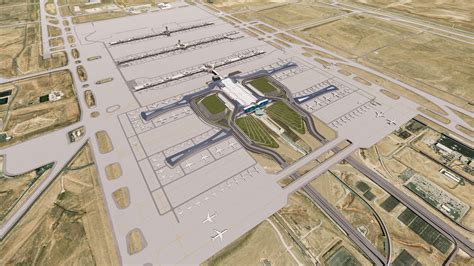
With 172 active passenger boarding gates, Denver International Airport (DEN) ranks third among the world’s largest airports by gate count. Its physical scale is extraordinary, covering approximately 33,531 acres across the Colorado plains. Unlike older airports that evolved through decades of additions, Denver was planned around a large-scale midfield terminal and concourse concept that left substantial room for future expansion.
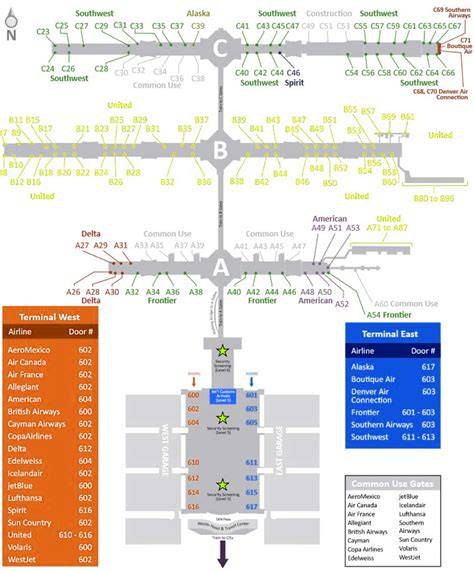
The airport’s iconic Jeppesen Terminal contains the principal check-in and baggage facilities, while passengers travel underground to the parallel concourses. Concourses A, B, and C form the operational heart of the airport, creating a long linear arrangement designed for high-volume aircraft movements.
Denver’s geography creates a unique operational consideration. At an elevation of 5,434 feet, the airport operates in significantly thinner air than many major U.S. hubs. During hot weather, reduced air density can affect aircraft performance, potentially requiring longer takeoff rolls. The airport therefore needs substantial taxiway spacing, large aircraft operating areas, and efficient gate infrastructure to support its high volume of traffic.
Concourse B is particularly important to United Airlines, which operates a major hub at Denver. It contains more than 70 contact gates and forms the center of United’s extensive connecting operation. Concourse C is heavily associated with Southwest Airlines, while Concourse A serves international flights and a variety of other airline operations.
Denver’s recent growth has pushed its gate capacity even higher. A major concourse expansion program added 39 new contact gates across the airport’s three concourses. Some of these facilities include dual-jetway positions intended to make the concourses more capable of handling wide-body international aircraft. Elevated outdoor passenger areas have also become part of the expanded terminal environment.
Perhaps the biggest advantage of DEN is the land available for future development. Unlike airports hemmed in by mature urban neighborhoods, Denver’s original master plan preserved room for additional concourses and supporting infrastructure. That means its 172 gates may represent only one stage in the airport’s much longer growth story.
2. Hartsfield-Jackson Atlanta International Airport — 192 Gates
Hartsfield-Jackson Atlanta International Airport (ATL) takes second place with 192 active passenger boarding gates, making it one of the most concentrated examples of high-capacity airport design anywhere in the world. The airport covers roughly 4,700 acres south of downtown Atlanta and has been engineered around the needs of enormous volumes of connecting passengers.
The airport’s seven parallel concourses are designated T, A, B, C, D, E, and F. Rather than forcing passengers to walk between distant terminal areas, Atlanta places its passenger transportation system underground. The Plane Train runs through a dedicated subterranean corridor beneath the concourses, creating a rapid connection between the different parts of the airport.
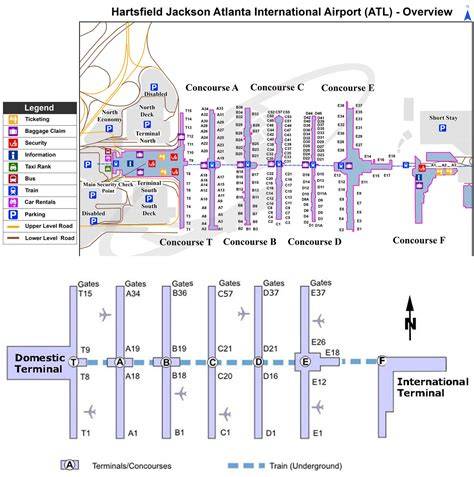
The Plane Train operates on a roughly three-mile loop and allows travelers to move across the enormous gate complex in a relatively short period. That efficiency is critical because Delta Air Lines maintains its largest hub operation at Atlanta. Hundreds of arrivals and departures are carefully coordinated throughout the day, creating waves of connecting passengers that can quickly overwhelm an inefficient terminal layout.
The airport’s 192 gates are not simply a collection of individual boarding positions. They form part of a carefully integrated system involving parallel concourses, multiple runways, taxiways, baggage infrastructure, and rapid passenger transportation. Concourses A, B, C, and T are heavily associated with Delta’s extensive domestic operation, while Concourse E and Concourse F provide facilities for international traffic and wide-body aircraft.
Five parallel runways help support the airport’s enormous aircraft volume. Additional taxiway infrastructure, including end-around taxiways, allows aircraft to move between runways and terminal areas while minimizing conflicts with other operations. The result is a design optimized less for architectural spectacle than for high-frequency aircraft movement and rapid connections.
1. Chicago O’Hare International Airport — 199 Gates
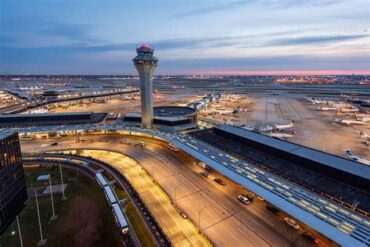
At the top of the ranking is Chicago O’Hare International Airport (ORD) with 199 active passenger boarding gates. That gives O’Hare the highest contact-gate count among the five airports examined here and places it at the center of one of the most complex airline networks in North America.
O’Hare covers more than 7,200 acres on Chicago’s northwest side and operates four major passenger terminals: Terminals 1, 2, 3, and 5. Its infrastructure reflects decades of development, producing a mixture of older finger piers, modernized concourses, linear terminal areas, and international facilities.
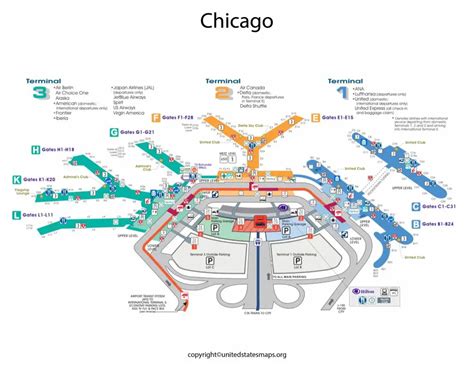
What makes O’Hare particularly interesting is its position as a dual mega-carrier hub. United Airlines operates a massive network from Terminals 1 and 2, while American Airlines maintains a major hub centered on Terminal 3. United uses approximately 91 gates across its principal terminal facilities, while American occupies around 66 gates in Terminal 3. Terminal 5 serves as the airport’s principal international gateway and includes about 30 gates along Concourse M.
The passenger-transfer infrastructure is just as important as the raw number of gates. Between Concourses B and C, United passengers can use the famous underground light tunnel, helping travelers make connections between separate concourse areas. At an airport handling enormous numbers of domestic and international passengers, even a relatively short connection can become challenging if the terminal layout forces unnecessary detours.
O’Hare is also undergoing a major transformation intended to prepare the airport for future demand. The redevelopment program includes replacing the existing Terminal 2 with a new O’Hare Global Terminal, alongside satellite concourse development and additional modern gate facilities. The objective is not merely to make the airport look newer. Expanding modern contact-gate capacity gives airlines more opportunities to park aircraft directly at passenger boarding bridges instead of relying on remote positions or holding aircraft during periods of congestion.
Why Gate Count Matters at the World’s Largest Airports
The difference between 161 gates at LAX and 199 gates at O’Hare may look relatively small on paper, but the operational impact can be substantial. Each additional contact gate represents another potential aircraft position, another opportunity to process passengers directly through terminal infrastructure, and another piece of capacity available during the busiest periods of the day.
Gate count also reveals why airport design matters as much as airport size. Denver has enormous amounts of land available for expansion, while Atlanta uses an exceptionally efficient parallel-concourse system. Dallas/Fort Worth relies on semicircular terminal modules and automated transportation, while O’Hare combines multiple terminal generations around the operations of two dominant hub airlines. Los Angeles, meanwhile, has had to maximize capacity within a constrained coastal and urban environment.
These airports demonstrate that gate capacity is not simply a number. It is part of a much larger system involving aircraft turnaround times, taxiway design, runway utilization, baggage handling, passenger connections, airline scheduling, and terminal transportation. The five leaders each use a different combination of infrastructure to transform hundreds of individual gates into functioning global aviation hubs.
As passenger demand continues to evolve, the ranking could eventually change. Major airport redevelopment programs are adding gates, rebuilding terminals, and introducing new satellite facilities. For travelers, however, the significance of these enormous gate counts remains remarkably practical: when an airport can provide more aircraft with direct access to terminal facilities, it has more tools available to keep the world’s busiest flight schedules moving.