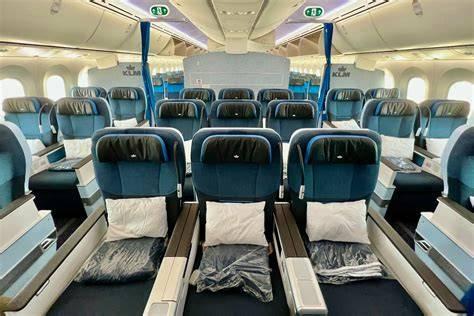
Boeing’s 787 Dreamliner was never designed as a faster airliner. At the beginning of the program in the early 2000s, the manufacturer made a deliberate strategic bet that the next competitive frontier in long-haul aviation would not be speed but human physiology. For decades, commercial aircraft engineering had been organized around mechanical efficiency: range, fuel burn per seat-mile, payload and engine thrust. The Dreamliner shifted that baseline. Its designers treated the passenger’s body — blood oxygen saturation, mucosal hydration, visual horizon access, vestibular response to turbulence — as measurable engineering targets rather than unavoidable side effects of flying at 40,000 feet. The result is a cabin environment described by four numbers that most passengers never see: a 6,000-foot cabin altitude, a 9.06 psi pressure differential, 25% relative humidity and windows 65% larger than industry norms.
Why Lowering The Cabin Altitude Quietly Changed Blood Oxygen Levels
On conventional aluminum airframes such as the Boeing 767 or the Airbus A330, cabin altitude at a typical cruise of 40,000 feet is capped at approximately 8,000 feet above sea level. Boeing pushed the Dreamliner’s ceiling down to roughly 6,000 feet, and doing so required a maximum structural pressure differential of about 9.06 psi instead of the 8.11 psi common on legacy aluminum jets. That difference of nearly one full pound per square inch sounds trivial until it is multiplied across thousands of pressurization cycles. Medical research, including a landmark study published in the New England Journal of Medicine, found that after three to nine hours at a simulated 8,000-foot cabin altitude, blood oxygen saturation dropped an average of 4.4 percentage points from ground-level baselines. That decline is what produces the familiar triad of long-haul misery: headaches, cognitive sluggishness and muscle aches. At 6,000 feet, the 787 keeps saturation considerably closer to sea-level norms for the entire crossing.
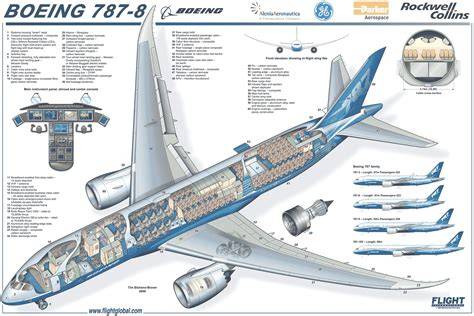
Holding 9.06 psi without accelerating structural fatigue is the harder half of the problem. Riveted aluminum fuselages expand and contract with every pressurization cycle, and repeated hoop stress makes high differentials a primary driver of metal fatigue and cracking. The Dreamliner answers this with carbon fiber reinforced polymer (CFRP) composites across roughly 50% of the airframe by weight, including the one-piece barrel sections of the main fuselage. Carbon fiber’s tensile strength and fatigue tolerance allow the hull to absorb higher internal pressure stresses without the cumulative degradation that limits metal designs, which is precisely why Boeing could raise the differential at all.
The Bleedless Engine Design That Unlocked Real Humidity
Relative humidity is the second hidden variable, and it is governed by a plumbing decision rather than a comfort feature. Conventional jetliners supply cabin air using bleed air extracted from the engine compressor stages. Air at 35,000 feet holds almost no moisture, and aluminum fuselages are vulnerable to corrosion from condensation — the phenomenon engineers call cabin rain — so those aircraft deliberately hold humidity below 10%. The physiological cost is mucosal dehydration, dry eyes and elevated fatigue across transoceanic sectors. The 787 removes the constraint entirely. Its bleedless architecture uses dedicated, electrically driven compressors to draw fresh outside air into the environmental control system, while the composite hull is immune to rust and moisture corrosion. Boeing therefore fits active humidifiers that raise relative humidity to 15% to 25%. The same architecture improves air purity: disconnecting the cabin supply from the engine oil seals removes any pathway for synthetic oil fumes to reach the passenger deck when seals wear.
Windows That Block Sunlight Without Blocking The Horizon
The Dreamliner’s most conspicuous signature is its window, measuring 10.7 by 18.4 inches and up to 65% larger than standard airliner glazing — roughly matching the vertical viewing dimension of the Douglas DC-8. The size and placement are functional, not decorative: passengers in middle seats retain a direct line of sight to the horizon, a reference cue that helps the vestibular system reconcile what the inner ear feels with what the eyes report. Instead of plastic pull-down shades, the 787 uses electrochromic dimming supplied by Gentex, with an electrified gel layer of light-absorbing particles that align across five opacity levels under small electric currents. The darkest setting blocks more than 99.99% of visible light and thermal infrared energy, keeping the cabin cool in direct sun, while flight attendants can centrally override individual settings through the Cabin Services System (CSS) panel to undim every window for takeoff, landing and emergencies.
Smooth Ride Technology And The Wing That Acts As A Leaf Spring
Turbulence remains one of the leading causes of passenger anxiety and motion sickness, and the 787 attacks it before the airframe feels anything. Flush-mounted pressure sensors in the nose cone detect incoming vertical gusts milliseconds ahead of the lifting surfaces, and the flight control computers translate those pressure differentials instantly into counteracting surface movements. Layered underneath is the airframe itself: long, high-aspect-ratio CFRP wings with raked wingtips bend upward under aerodynamic load like enormous organic leaf springs, spreading gust energy across the wing spar rather than delivering sharp G-force spikes to the fuselage. The system adds symmetric micro-deflections of the trailing-edge flaperons, ailerons and elevators to dump or generate lift in real time. Cabin geography still matters — riders over the wing box near the center of gravity feel the most stability, while the aft cabin sits on a longer moment arm — but jarring bumps become low-amplitude undulations.
The 215-Inch Cross-Section And The 8-Abreast Intent That Faded
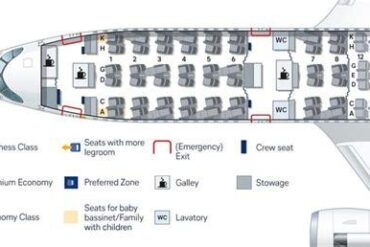
Every atmospheric advantage above collides with one stubborn dimension: economy seat width. Boeing designed the 787’s interior cross-section at roughly 215 inches (546 cm) around an 8-abreast 2-4-2 layout, which would have delivered about 18.5 inches of shoulder room per seat — genuinely generous for long-haul. Only a handful of carriers, most notably All Nippon Airways (ANA) and Japan Airlines (JAL), kept that arrangement. As airline economics shifted toward higher-density yield, most operators moved to 9-abreast 3-3-3, which squeezes individual seats to between 17.0 and 17.3 inches.
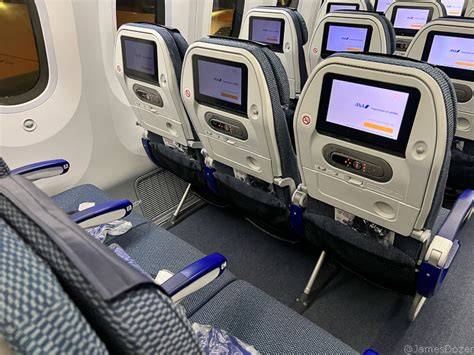
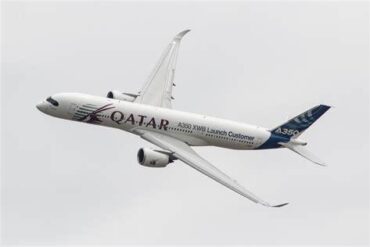
The contrast with the Airbus A350 XWB is instructive rather than accusatory. The A350’s wider 221-inch cross-section comfortably accommodates 18-inch seats at nine abreast, so a traveler comparing the two platforms is really choosing between the Dreamliner’s physiological engineering — lower cabin altitude, active humidification, predictive ride smoothing — and a few tenths of an inch of lateral space. The Dreamliner’s comfort ledger is therefore not uniform. It is superb in the air and uneven at the armrest.
What The 787’s Hidden Math Means For Long-Haul Travelers
The commercial record suggests the arithmetic works. Passengers cannot perceive a pressure differential of 9.06 psi or trace the path of an electric compressor, yet their bodies register the difference on arrival: less dehydration, less foggy thinking, fewer hours lost to jet lag. The Dreamliner demonstrated that advanced materials and electrically driven systems could be aimed at human physiology rather than merely at fuel burn, and that proof reshaped how rival manufacturers talked about cabin health. Its lasting lesson is a study in aviation compromise. Nine-abreast economy layouts take their toll at the elbow, but the cleaner air, higher cabin pressure and smoother ride remain the benchmark against which long-haul comfort is still measured.