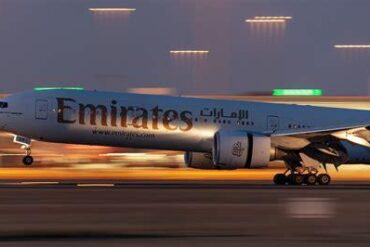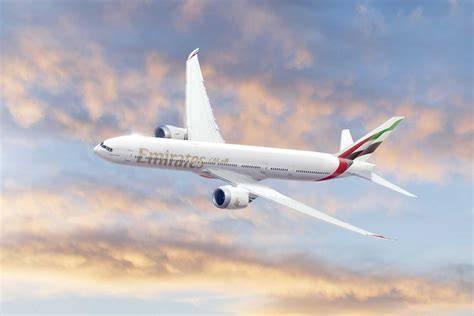
Emirates enters 2026 holding a position no other airline can credibly challenge: it operates the largest Boeing 777 fleet on earth, and the margin is not close. According to Planespotters.net, the Dubai-based carrier flies 145 Triple Sevens, a total that splits across the 777-200LR, 777-300ER and 777F while the older 777-300 has now left the fleet entirely. The figure is roughly 25 aircraft clear of the next largest operator and more than double the size of several entire national fleets. It is also the single biggest aircraft family at Emirates itself, standing well ahead of the Airbus A380 on 116 airframes and dwarfing the rest of the carrier’s long-haul inventory. What makes the number remarkable is the direction of travel: Emirates is not winding down its 777 operation. It is preparing to grow it to a scale the widebody market has never seen.
Emirates’ Active 777-300ER, 777-200LR and 777F Fleet in 2026
The current Emirates 777 passenger fleet numbers 142 jets with an average age of 12.5 years, a surprisingly youthful figure given that the 777-300ER has been in Boeing’s catalogue since the mid-1990s. The dominant variant is the 777-300ER, with 117 airframes averaging 13.3 years old, of which 114 are active and three parked. The type slots neatly between two extremes: the A380 handles the highest-capacity, premium-heavy hub-to-hub routes where slot access is scarce, while the less numerous 777-200LR covers thinner long-haul missions that cannot justify a larger jet. Only ten 777-200LRs remain active at an average of 18.4 years, making them the senior members of the fleet and increasingly the most likely candidates for retirement as 777X deliveries approach.
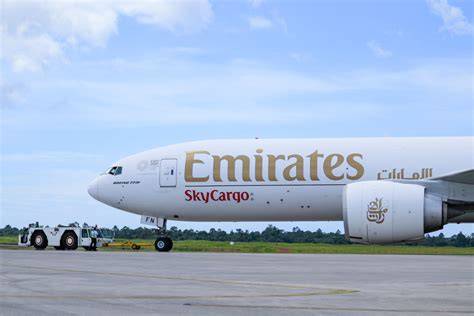
The 777-300ER is also the most popular variant Boeing ever built, with 837 delivered since the 777 family entered service in 1994 — almost double the tally of the 777-200ER, according to Simple Flying. Emirates bought into that standard while pushing the aircraft harder than anyone else, deploying it on dense regional sectors and ultra-long-haul services alike. Outside the passenger operation, Emirates flies 18 Boeing 777Fs averaging just 3.9 years, and those young freighters pull the fleet-wide average down sharply. The first cargo 777 arrived in May 2022 and went straight into service, flying from Everett to Hong Kong rather than returning to Dubai. “Today, we are delighted to announce an investment of $1 billion to further expand our freighter capacity,” said Sheikh Ahmed bin Saeed Al Maktoum, chairman and CEO of Emirates. “This underscores our commitment to supporting our customers’ requirements, and reflects our confidence in our future growth.”
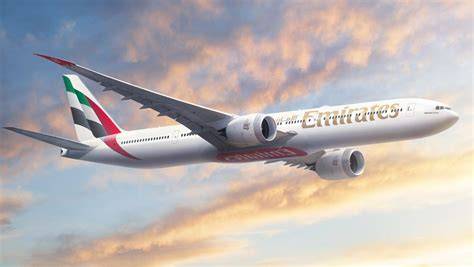
Busiest Boeing 777 Routes Across South Asia, Africa and the Gulf
Emirates’ 777-300ER network is built around volume, and nowhere is that clearer than in South Asia. The busiest 777-300ER route of the year was Dubai International Airport (DXB) to New Delhi Indira Gandhi International Airport (DEL), flown four times daily. Male-Velana International Airport (MLE) ranked second, served between three and four times a day across 1,444 flights in the year. India dominated the wider schedule: Chennai and Hyderabad together logged 1,095 flights, exactly matching the total to Manila’s Ninoy Aquino International Airport. Beyond Asia, the 777-300ER carried the flag into Africa and Southeast Asia, with 765 flights to Johannesburg’s O. R. Tambo International and 730 each to Cape Town International and Jakarta’s Soekarno–Hatta International.
The aircraft is just as central to short, high-yield regional flying. The third-busiest 777-300ER route in 2025 was the run from Dubai to King Khalid International Airport (RUH) in Riyadh, with 1,177 departures, ahead of 952 flights to Kuwait International Airport (KWI) and a similar volume to King Fahd International Airport (DMM) in Dammam. This mix of long-haul trunk routes and densely packed two-hour Gulf sectors explains why Emirates can absorb so many 777-300ERs without surplus capacity: the type is flexible enough to serve as the workhorse everywhere the A380 is too large and the 777-200LR is too small.
How Emirates Built the World’s Biggest 777 Fleet Since 1992
The relationship began in 1992, when Emirates placed its first 777 order for seven twin-jets with options on seven more, a decision the airline framed as “a vote of confidence for the industry [that was] hard hit by the first Gulf War.” The first 777 arrived in 1997 and deliveries continued into the new millennium with the 777-200, 777-300 and 777-300ER. The earliest airframes tell the story of the type’s reach: A6-EMG entered service on 11 April 1997 and left for VIM Airlines in 2017 as VP-BSN, A6-EMK flew with the carrier until February 2018 before joining Air Peace as 5N-BVE, and A6-EMM and A6-EMN both departed in 2018 for flyGlobal as 9M-FSL and 9M-FSM.
The next decisive moment came in 2005 with an order for 42 new 777s worth $9.7 billion at the time — equivalent to roughly $16.7 billion today, and the largest 777 order any airline had placed. “We’re honored that Emirates has again chosen the 777 and will now use the entire 777 family as a cornerstone of its fleet operations,” said Alan Mulally, then president and CEO of Boeing Commercial Airplanes. He added that Emirates “is renowned for its quality and excellence,” and that Boeing was “excited to see how the airline and its passengers will benefit from the superior economics, comfort and utility of the 777 models ordered today.” Two decades later, that cornerstone status has only deepened.
The 270-Aircraft 777X Order That Extends Emirates’ 777 Leadership
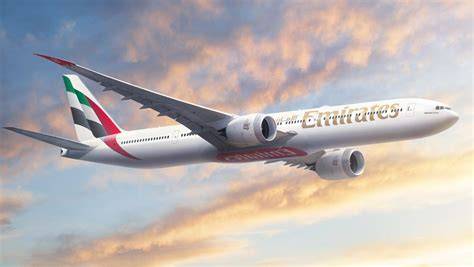
Emirates’ future dominance rests on an order book that no competitor can match. In 2013 the carrier committed to 150 jets, comprising 115 777-9s and 35 777-8s, valued at $56 billion at list prices, with options on 50 more. At the 2023 Dubai Airshow it added another 90 aircraft — 55 777-9s and 35 777-8s — bringing the firm commitment to 205 and making Emirates by far the world’s largest 777X customer. “These additional aircraft will enable Emirates to connect even more cities, supporting the Dubai economic agenda D33,” said Sheikh Ahmed bin Saeed Al Maktoum. The total now stands at 270 777X planes on order, and that figure could still rise: Emirates is weighing whether to convert its 35 Boeing 787-9 commitments into additional 777X airframes. “The option of converting to the 777X remains on the table,” Adel Al Redha said. “Everything is possible, and we will discuss everything in this regard with the manufacturer.”
The 777X will progressively replace the A380 at the top of the Emirates network, and its arrival will push the carrier’s 777 count beyond anything seen in commercial aviation. Clearing the existing backlog alone is expected to take Boeing until at least 2038, and further orders would extend that timeline. The scale of the commitment is precisely why the delivery delays matter so much: Emirates has had to keep older aircraft in service longer than planned to protect capacity, and every slipped milestone compounds the pressure on a fleet that already carries 142 passenger Triple Sevens.
Why Emirates Refused Boeing’s Pre-Built 777X Aircraft
Frustration with the 777X programme has hardened into something more consequential. At a media roundtable at the 2026 Farnborough International Airshow, Emirates President Tim Clark said the airline would refuse to accept the “ten or 11” oldest 777X airframes. “In the end, they have been standing on their wheels with their engines, of course, for some time,” Clark explained, per Aviation Express. “We last saw them a few years ago, parked outside Renton, all greened up, and you know, looking very sad.” Those jets require extensive rework to be brought up to current build standard, and taking them would mean absorbing aircraft that have spent years exposed to the elements rather than entering service as intended.
Boeing has already begun writing off the consequences. In July it decided to scrap a pre-built 777X — airframe WH007, line number 1611, completed in July 2019 and the seventh 777-9 ever built — which had already been partially painted in Emirates colours and was disassembled in summer 2025. With each completed 777-9 carrying a list price of $442 million, the revenue implications are severe even before manufacturing costs are considered. Some carriers will likely accept older airframes to jump the queue, but Boeing must absorb substantial reworking costs without disclosing the per-aircraft figure. For Emirates, the calculation is straightforward: it will wait for aircraft built to specification rather than inherit grounded inventory, and in the meantime its existing 777 fleet — the largest in the world — continues to do the work.