For more than three decades, the widebody freighter segment has been one of aviation’s most one-sided contests. Boeing built an unassailable fortress out of the 747F, the 767F and the 777F, selling thousands of aircraft to the world’s cargo carriers and cementing relationships that stretched across generations of fleet planners. Airbus, for all its success in the passenger market, never found a credible answer. The A330-200F, its only purpose-built freighter, limped through its production life with just 38 orders, a number so modest that it effectively confirmed Boeing’s grip rather than challenging it. That long asymmetry is now under genuine pressure. The Airbus A350F, a clean sheet widebody freighter developed from the ground up around the A350 platform, has quietly assembled an order book that has overtaken Boeing’s next-generation 777-8F, and on September 29 the first flight-test aircraft lifted off from Toulouse to begin the certification campaign that will decide whether Airbus can convert commercial momentum into a durable presence in air cargo.
Boeing’s Decades-Long Stronghold on Large Widebody Freighters
Boeing’s dominance in large freighters was never the product of a single aircraft. It was built incrementally, aircraft by aircraft, customer by customer, until the manufacturer’s cargo portfolio became the default choice for any airline serious about heavy freight. The 747F became synonymous with intercontinental cargo, its distinctive hump and cavernous main deck allowing operators to move outsized industrial equipment, machinery and palletised goods across oceans at a scale no competitor could match. The 767F carved out the medium widebody niche, becoming a fixture on transatlantic and regional cargo networks, while the 777F established itself as the benchmark twin-engine freighter, pairing a 103.7-tonne payload with the range and economics that made twin-engine transpacific and transatlantic cargo operations viable. Together, these three families gave Boeing an offering that covered nearly every mission profile a cargo airline could need, and that breadth proved far more valuable than any single specification advantage.
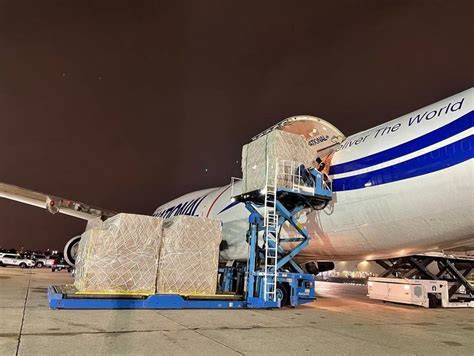
The structural advantage Boeing derived from this portfolio went well beyond the aircraft themselves. Because the 767 and 747 airframes were produced in such volume for passenger service, a vast pool of used aircraft became available for passenger-to-freighter conversion, allowing operators to add cargo capacity at a fraction of the cost of a factory-built freighter. Conversions retain much of the original airframe, engines and avionics, and although they still demand substantial structural modification, cargo door installation and recertification work, the economics are compelling for carriers that cannot justify a new-build aircraft. That conversion ecosystem created a second, parallel market that Boeing effectively controlled, and it reinforced the manufacturer’s grip on maintenance networks, spare parts inventories and crew training pipelines. Airbus, without a comparable installed base of convertible widebodies, had no answer to this dynamic. The A330-200F was a derivative of a passenger aircraft that had sold respectably but never in the numbers required to seed a conversion market, and its dedicated freighter never accumulated the customer base needed to sustain a competitive support ecosystem.
Why the A350F Is a Fundamentally Different Proposition
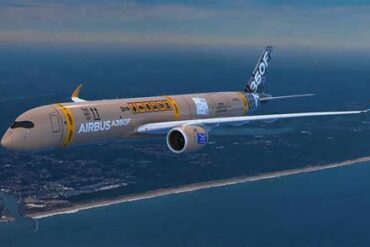
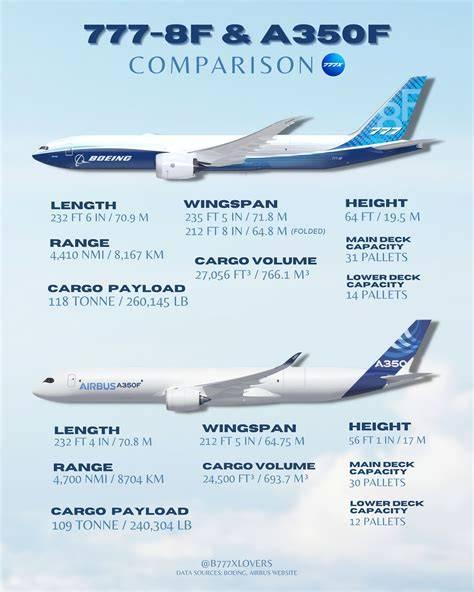
Airbus’s decision to develop the A350F as a clean sheet freighter rather than another A330 derivative represents the most consequential strategic shift in its cargo ambitions. Instead of stretching an ageing platform, the manufacturer designed the aircraft around the requirements of modern cargo operators from the outset, drawing on the A350’s composite-intensive airframe, its advanced Trent XWB engines and its mature systems architecture. The result is an aircraft with a maximum payload of 111 tonnes, comfortably above the 777F’s 103.7 tonnes, and a range of approximately 8,700 kilometres at maximum payload. Those figures alone would make the A350F competitive, but the design choices behind them reveal where Airbus believes it can win.
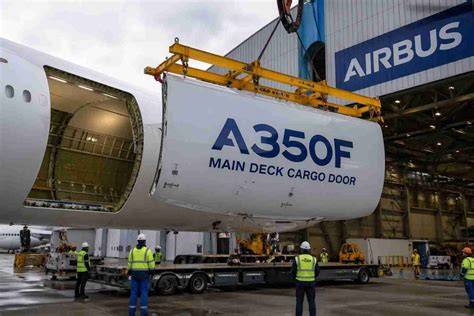
The most visible differentiator is the main-deck cargo door, which measures 4.3 metres across and which Airbus describes as the largest in its class. That extra width is not a marketing flourish. It allows operators to load oversized shipments, including complete aircraft engines, that would otherwise require specialised handling or an alternative aircraft, and it shortens turnaround times by giving ground crews more room to manoeuvre pallets and containers into position. The cargo floor layout has been optimised in parallel, giving loadmasters greater flexibility in pallet positioning and weight distribution, which matters enormously on routes where freight density varies sharply between sectors. Airbus also claims 11 percent more cargo volume than its comparator, a figure that translates directly into revenue potential on long-haul routes where volume, rather than weight, is the binding constraint.
Efficiency is the second pillar of the A350F’s case. More than 70 percent of the airframe is built from advanced materials, including composites and titanium, producing a structure light enough that Airbus cites a maximum take-off weight up to 46 tonnes lower than the current 777F. That weight advantage feeds directly into fuel burn, and the manufacturer claims reductions in fuel consumption and associated carbon dioxide emissions of up to 40 percent compared with older-generation freighters. For cargo operators facing tightening emissions rules in Europe and increasing pressure from customers to demonstrate decarbonisation progress, those numbers carry real commercial weight. Airbus has also leaned heavily on commonality with the passenger A350 family, pointing to 100 percent shared engine spares and tooling, 99 percent shared airframe tooling and 98 percent shared spares. For an airline already flying A350s, that translates into streamlined maintenance, smaller spare-parts inventories and far lower transition costs than adopting an entirely new type.
How the A350F Stacks Up Against the 777F and 777-8F
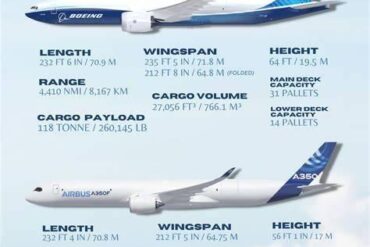
| Specification | Airbus A350F | Boeing 777F | Boeing 777-8F |
|---|---|---|---|
| Maximum payload | 111 tonnes (244,713 lb) | 103.7 tonnes (227,076 lb) | 118 tonnes (260,145 lb) |
| Main deck cargo door width | 4.3 m (14.1 ft) | 3.65 m (11.9 ft) | 3.73 m (12.2 ft) |
| Status | Flight testing | In service | Development |
| Expected entry into service | 2027 | 2009 | 2029 |
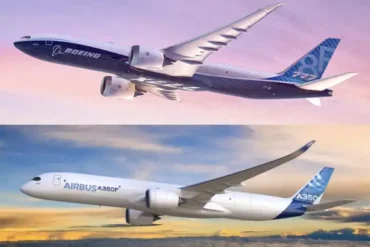
The table makes the competitive geometry clear. Against the aircraft it will face on the ramp from 2027, the A350F offers roughly seven tonnes more payload, a substantially wider door and a generational leap in fuel efficiency. Against the 777-8F, the picture is more nuanced. Boeing’s future freighter carries up to 118 tonnes, approximately seven tonnes more than the A350F, and that extra capacity will appeal to operators that prioritise maximum payload, particularly at slot-constrained airports where adding another departure is difficult or impossible. Every performance figure in the table, however, originates with the manufacturers themselves. The A350F’s efficiency claims and the 777-8F’s payload advantage will only be validated once each aircraft accumulates real commercial flying hours, and the gap between brochure performance and operational reality has historically been wide enough to warrant scepticism.
The Order Book Story Behind Airbus’s Early Commercial Momentum
The most striking evidence that Airbus has finally cracked the freighter market lies in the order figures. By the end of August 2026, the A350F had accumulated 115 firm orders, including 34 secured during the first eight months of the year, an increase of roughly 42 percent from the 81 orders on the books at the start of 2026. That number has already dwarfed the 38 orders the A330-200F attracted across its entire production programme, and it gives Airbus a 34-aircraft lead over Boeing’s 81 net orders for the 777-8F through July 2026. The speed of the accumulation matters as much as the total, because it shows that cargo operators are no longer treating Airbus as a fallback option to be considered only when Boeing cannot deliver.
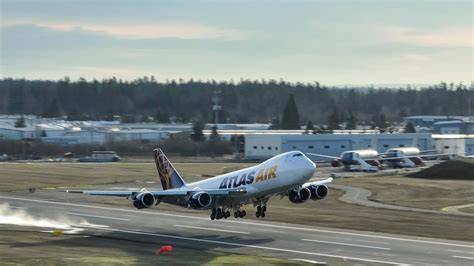
No customer illustrates the shift more clearly than Atlas Air. The New York-based cargo operator, historically a Boeing-only airline with a fleet of approximately 93 aircraft, ordered 20 A350Fs in March 2026, making it the type’s largest customer, with deliveries scheduled between 2029 and 2034 to support long-term fleet expansion and the gradual retirement of its ageing 747-400 freighters. That decision is remarkable precisely because Atlas Air represents the archetype of the deeply entrenched Boeing customer, and its willingness to introduce a new type signals that the A350F’s combination of payload, efficiency and availability has overcome the considerable inertia that protects incumbent fleets. Air China Cargo, Etihad Airways, STARLUX Airlines and AviLease each ordered 10 aircraft, while Silk Way West Airlines of Azerbaijan ordered two A350Fs alongside two 777-8Fs, demonstrating that some operators are hedging by committing to both platforms rather than choosing a single supplier.
Boeing’s Counterattack and the Depth of Its Incumbent Advantage
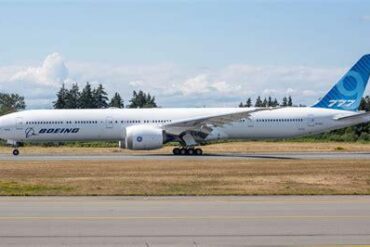
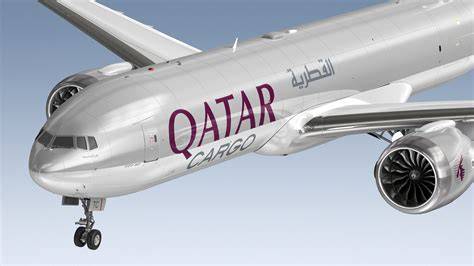
Yet the order comparison tells only part of the story, and Boeing’s position remains far stronger than a simple count of next-generation commitments would suggest. The 777F is a mature, in-service aircraft with a substantial operational footprint, and an exemption from US emissions requirements allows Boeing to continue producing up to 35 additional aircraft beyond 2027 while the 777-8F proceeds through development. That exemption effectively guarantees Boeing a production bridge into the late 2020s, ensuring that customers needing aircraft sooner than the A350F can deliver do not have to look elsewhere. The 777-8F itself, expected to carry up to 118 tonnes, has already secured commitments from Qatar Airways Cargo with 34 orders, Cargolux with 10, and China Airlines and Korean Air with eight each, giving Boeing a solid foundation among the world’s most established cargo carriers.
Boeing’s deeper advantage lies in the installed base. Atlas Air may have ordered A350Fs, but it still operates an almost entirely Boeing fleet, and FedEx Express, one of the largest cargo airlines on the planet, flies approximately 477 aircraft, including around 300 Boeing jets. Those fleets represent decades of accumulated investment in maintenance infrastructure, spare parts depots, crew training and operational procedures, and switching manufacturers imposes costs that extend well beyond the purchase price of the aircraft. A cargo airline that has optimised its network, its maintenance schedules and its pilot pipelines around Boeing types faces a genuine operational disruption when it introduces a competing platform, and that friction will slow the pace of any transition regardless of how compelling the A350F’s specifications appear. Airbus’s early lead in orders is real, but it does not mean the manufacturer has overtaken Boeing in the wider freighter market.
Why Time May Be Airbus’s Most Powerful Weapon
Timing may prove more decisive than payload or efficiency. Boeing’s 777-8F is now expected to enter service in 2029 or later, two years after the A350F’s targeted certification and first deliveries in the second half of 2027. Cargo airlines cannot indefinitely postpone the replacement of ageing aircraft while waiting for a more capable model to arrive, and the economics of an ageing 747-400 freighter deteriorate every year as fuel burn, maintenance costs and emissions penalties accumulate. If Airbus achieves its schedule, it will have a two-year window during which the A350F is the only new-generation large freighter available, and that window is precisely the reason Atlas Air chose Airbus over Boeing. The manufacturer that can deliver when capacity is needed will win orders from operators whose fleet planning calendars are dictated by retirement dates rather than by specification spreadsheets.
The A350F Flight Test Campaign and the Road to 2027 Certification
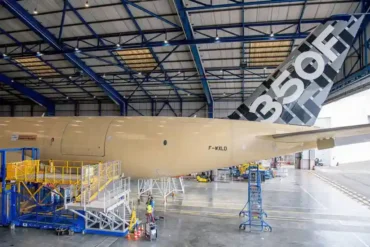
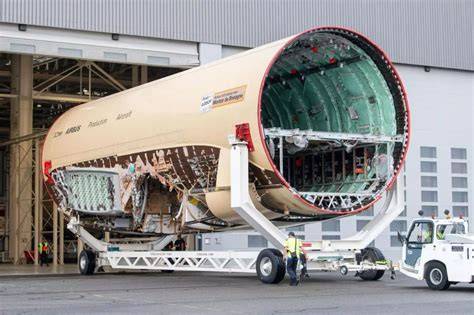
The programme’s progress so far supports Airbus’s confidence. On September 29, the first flight-test aircraft, MSN700, departed Toulouse with five Airbus test personnel aboard for a maiden flight lasting four hours and ten minutes, during which the aircraft reached an altitude of 25,000 feet and an indicated airspeed of 340 knots. That sortie marked the start of an intensive certification campaign expected to last more than nine months, and the second test aircraft, MSN701, is already progressing through final assembly as Airbus prepares to expand its flight-test activities ahead of the planned 2027 certification and first deliveries. The pace of the campaign will determine whether the A350F’s commercial lead becomes a structural advantage or a fleeting one.
Entering service first, however, does not guarantee long-term commercial success. Airbus must still complete certification, demonstrate that the aircraft’s promised operational capabilities hold up in the hands of airlines, and establish a production and delivery schedule reliable enough to convince customers that their fleet plans will not be held hostage to industrial bottlenecks. Any certification setback would narrow the advantage over Boeing, while further delays to the 777-8F would strengthen it. The next few years will therefore determine whether the A350F’s early momentum represents a genuine shift in the large-freighter market or a temporary gap that Boeing’s eventual response will close.
What a Real Duopoly Would Mean for Cargo Airlines
The significance of the A350F is not that it will necessarily replace Boeing as the dominant freighter manufacturer, at least not soon. It is that the aircraft has created the conditions for genuine competition in a segment that has lacked it for a generation. A credible second option gives cargo airlines more choice, stronger negotiating leverage and access to aircraft offerings that are pushed harder on efficiency, payload and availability than a near-monopoly would ever require. Boeing’s response to the A350F, including the continuation of 777F production beyond 2027 and the acceleration of the 777-8F, is already evidence of that dynamic at work. The large-freighter market could conceivably shift from Boeing’s entrenched dominance towards a more balanced duopoly in which both manufacturers compete vigorously for every major fleet order.
For cargo operators, the most meaningful change may not be which manufacturer ultimately prevails but the simple fact that, for the first time in decades, a serious alternative exists when the next major fleet investment decision comes around. The A350F’s promised performance still rests largely on Airbus projections and marketing rather than proven commercial operations, and its enduring success will depend on meeting the 2027 delivery target, ramping production quickly and continuing to grow its order book. Equally important will be Boeing’s ability to bring the 777-8F into service without further significant delays. If Airbus converts its early commercial momentum into reliable deliveries and competitive operating performance, the freighter market will become far more interesting than it has been for a very long time, and airline fleet planners will finally have the leverage that competition alone can provide.