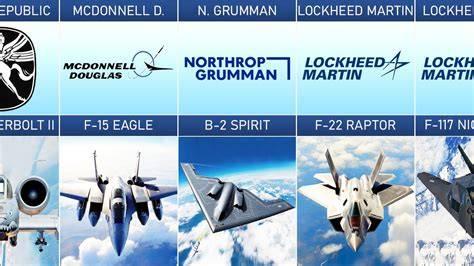
The United States Air Force was formally born in 1947, when the aviation branch that had served as a division of the U.S. Army — the United States Army Air Forces — broke away to become an independent service. Since that moment, the branch has operated an extraordinary roster of aircraft, from lumbering transports like the C-5M Super Galaxy to helicopters, tiltrotors, bombers, and an ever-expanding family of jet fighters. Today the USAF continues to dominate global air power with a fleet of impressive machines, and at the heart of that fleet sit the fighter jets that define American air superiority. Modern fighters are typically multirole platforms that drop bombs and attack ground targets as readily as they hunt enemy aircraft, which is why aircraft such as the legendary A-10 Thunderbolt II are classified as attack aircraft rather than fighters. Even so, the USAF has flown an enormous number of genuinely excellent fighters since its inception, and a select handful stand head and shoulders above the rest. The jets that led the way over Korea, Vietnam, Operation Desert Storm, and the conflicts of the 21st century all played their part, and these five represent the best that the USAF has ever operated — machines celebrated for their maneuverability, speed, lethality, and the sheer weight of their records.
North American F-86 Sabre
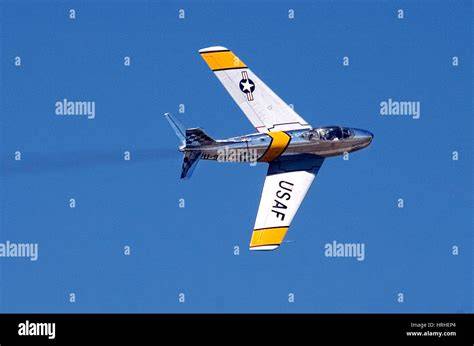
The North American F-86 Sabre began flying for the USAF in 1949, making it only the second jet fighter the service ever piloted, following the Lockheed P-80 Shooting Star. Its defining feature was a swept wing, a design that transformed high-speed jet flight and gave the Sabre an edge that earlier straight-wing designs simply could not match. Production was staggering: 9,615 airframes rolled out before manufacturing ended in the 1950s, making the F-86 the most produced Western fighter jet of all time — no other Western fighter has ever approached those numbers. The Sabre is best remembered for the way it ruled the skies over the Korean War, which was also its first taste of combat. That conflict opened with North Korea fielding Soviet-made MiG-15s, a formidable adversary that outclassed early American jets in several respects. When the two types collided in the air, however, the F-86 proved more than capable of handling the enemy fighter. Across the conflict, Sabre pilots were credited with downing 792 MiG-15s while losing just 78 of their own aircraft, an astonishing kill ratio of 8.7:1 — and earlier reporting credited the jet with an even more remarkable 10:1. Either figure is outstanding for any fighter, let alone the definitive first-generation jet fighter.
The Sabre was powered by a General Electric J47 turbojet producing 5,670 pounds of thrust, enough to push it to a top speed of 685 mph, or roughly Mach 0.89. That made it subsonic, but only just, and in the thin air of high-altitude combat that margin mattered enormously. For armament it carried six .50-caliber M3 machine guns, which its pilots used with deadly accuracy against Soviet-built aircraft. The USAF began phasing the F-86 out in the 1950s, yet the type refused to fade quietly: the Bolivian Air Force continued flying Sabres until 1994, a remarkable testament to how sound the original design truly was.
McDonnell Douglas F-4 Phantom II
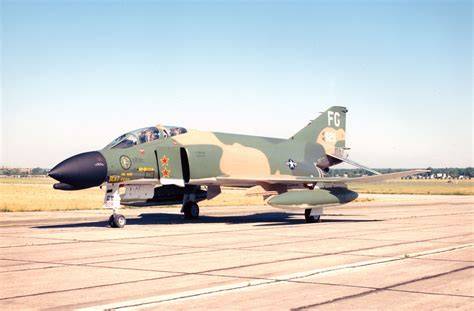
While it was initially intended for the U.S. Navy, the USAF quickly recognized the exceptional qualities of the McDonnell Douglas F-4 Phantom II and added it to its inventory in 1963. The U.S. Marine Corps flew it as well, and it proved an ideal fighter during the Vietnam War, where it saw extensive service. A total of 5,057 Phantom IIs were produced, and the USAF operated 2,874 of them — more than any other service. The USMC and USN collectively accounted for 1,264 airframes, while 919 went to allied nations. The Phantom began operating for the U.S. military in 1961, making it the primary fighter-bomber and interceptor when America’s involvement in Vietnam escalated. Once it took to those unfriendly skies, the F-4 quickly proved itself an excellent fighter. The USAF primarily employed it as an air superiority fighter, but it was equally capable of reconnaissance and ground-attack missions, a versatility that kept it relevant long after newer designs arrived. One detail captures its dominance over Vietnam: all five American aces of the conflict earned their kills while piloting F-4s.
Part of what made the Phantom so deadly was its reliance on air-to-air missiles rather than guns in the fighter role, including the long-serving AIM-9 Sidewinder, which entered the USAF inventory in 1956. That missile-first philosophy came at a cost — early engagements revealed that guns still mattered — but the F-4’s reach and speed more than compensated. The USAF flew the Phantom for decades before retiring the versatile, deadly multirole aircraft in 1997. Some airframes found their way into museums, but most were converted into flying drones for target practice, serving as supersonic targets until 2016.
McDonnell Douglas F-15 Eagle
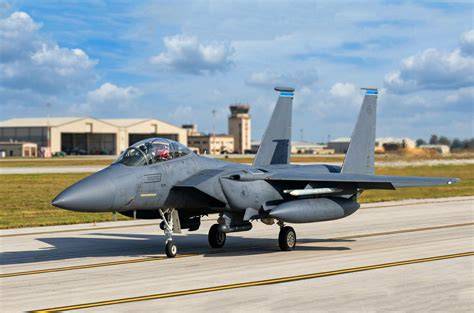
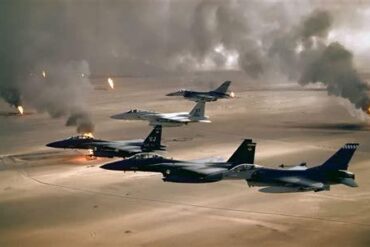
The USAF began flying the McDonnell Douglas F-15 Eagle as its primary air superiority fighter in 1974, and it took little time for the service to appreciate how versatile the aircraft was. The Eagle now holds one of the most impressive records of any frontline fighter jet: it has never been lost to air-to-air combat, while being credited with shooting down 104 enemy aircraft — an unrivaled kill ratio of 104:0. That does not mean no Eagle has ever gone down; several have been lost to ground-based air defenses. Indeed, three F-16s were mistakenly shot down by Kuwait in a friendly-fire incident in 2026, a reminder that the air remains a dangerous place. Yet the fighter’s air-to-air victories still set it apart as something extraordinary. During Operation Desert Storm, USAF F-15s were credited with 34 of the branch’s 37 air-to-air victories, proving the aircraft remained devastatingly relevant nearly two decades after its introduction. The F-15 initially featured two Pratt & Whitney F100-PW-100 turbofan engines, giving it blistering speed — it could reach 1,875 mph — along with a wide variety of ordnance loadouts built around air-to-air missiles.
Over time the F-15 evolved, and its current model, the F-15EX Eagle II, is among the USAF’s best fighter jets. The Eagle II was first revealed in 2021 and has since been involved in numerous combat operations, none of which has cost an airframe to air-to-air combat, ensuring the F-15’s perfect record remains untouched. Manufactured by Boeing, the Eagle II extends the F-15’s service life well into the future as it replaces older Eagles with the newest variant, blending the classic airframe’s raw performance with modern sensors and weapons capacity.
General Dynamics F-16 Fighting Falcon
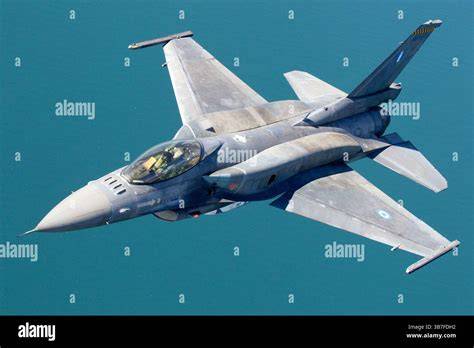
The General Dynamics F-16 Fighting Falcon was also developed in the 1970s, first entering the USAF inventory in 1979. It began life as an air superiority fighter and has operated in that capacity — and many others — for decades. Like the F-15, it remains in operation to this day, though the F-16 flying now is significantly more advanced than the one that arrived in the late ’70s. In 2012, Lockheed Martin delivered the 4,500th F-16, an impressive milestone that underscored just how successful the design had become. While the USAF continues to fly the Falcon, it is also operated by dozens of other nations around the world, including Belgium, Greece, Indonesia, Norway, and many more. Despite being over 40 years old, many F-16s stand ready to fly at a moment’s notice, remaining deadly and versatile. The fighter features an M-61A1 20mm multibarrel cannon and 11 hardpoints capable of carrying a wide assortment of ordnance.
The modern variant is the F-16V Viper, a substantially upgraded version of the original aircraft equipped with everything a contemporary air arm expects: advanced electronic warfare capabilities, modern radar systems, and an updated cockpit. Lockheed touts it as “the most technologically advanced 4th generation fighter in the world,” though with its modern capabilities it is more accurately described as a 4.5th-generation fighter. It has no set retirement date and will likely continue flying until the 2040s, even as the USAF ultimately plans to replace the F-16V with the F-35A Lightning II.
Lockheed Martin F-22 Raptor
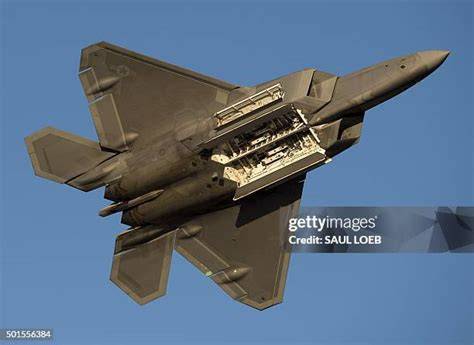
The Lockheed Martin F-22 Raptor is the world’s first 5th-generation fighter jet, and it is exclusive to the USAF. Unlike the F-35 Lightning II, which comes in three variants for the USAF, USN, and USMC, the F-22 remains the sole property of the Air Force, and that is unlikely to change. The program that developed it cost so much money that the original order of 750 aircraft was curtailed to just 187, a decision that capped production far below what many planners wanted. Despite this, the F-22 remains one of the most advanced stealth aircraft in operation, and it is slated to continue flying well into the 2040s thanks to several modernization upgrades. The Raptor entered the USAF inventory in 2005 and has been used in numerous combat operations ever since.
The aircraft boasts an impressive supercruise ability that enables transonic flight beyond Mach 1 without engaging its afterburners, a capability that preserves stealth and fuel alike. With the burners lit, the F-22 can fly at incredible speed, exceeding Mach 2. It is powered by two bespoke Pratt & Whitney F119-PW-100 turbofan engines featuring two-dimensional thrust vectoring, giving the Raptor exceptional maneuverability at angles of attack that would stall lesser fighters. The F-22 can be outfitted with a variety of weapons systems, including air-to-air missiles for a pure air superiority loadout, or two 1,000-pound GBU-32 JDAM bombs alongside two AIM-120 air-to-air missiles for its air-to-ground configuration. Even as it performs both roles brilliantly, the USAF is unlikely to order additional F-22s, capping the entire inventory at roughly 100 operational aircraft as of this writing.
How These Five Fighter Jets Were Chosen
There is no denying that the USAF has flown some of the world’s most impressive fighter jets, and with dozens of excellent candidates, selecting the top five was no easy task. Because calling any plane “the best” is inherently subjective, the selection leaned on overall aircraft usage and quality rather than on any single metric. Some jets earned their place because they are iconic of the branch — certainly true of the F-22, which no other service flies. Others, like the F-15 Eagle, made the cut because of an unmatched combat record: pilots have shot down over 100 enemy aircraft without losing a single Eagle, an unparalleled achievement. The same can be said of the F-16; while it serves numerous air forces worldwide, it is fundamentally an Air Force aircraft that has represented the branch for nearly half its existence.
Conversely, the F-35 Lightning II was left off because it is still relatively new and is flown by the USN, USMC, and numerous allied nations, making it less iconic of the USAF. The F-4 Phantom II, though also operated by other branches and countries, was primarily an Air Force aircraft, and its performance in Vietnam lifted it above the competition. Whatever the criteria, one thing remains clear: these aircraft have been flown by some of the most exceptional men and women ever to wear the uniform, and their legacies continue to shape American air power today.