The Cold War did not merely produce weapons; it produced audacity. In an era when schoolchildren practiced nuclear drills and governments calculated megatonnage like grocery bills, American aerospace engineers explored concepts that felt closer to speculative fiction than military procurement. Among the most astonishing was the Lockheed LC-1201, a proposed flying aircraft carrier so vast, so ambitious, that it blurred the line between strategic deterrent and airborne leviathan.
Unlike Hollywood fantasy, this was no comic-book invention. The LC-1201 emerged in the late 1960s as a serious conceptual study, reportedly supported by NASA schematics and internal aerospace research. It promised not merely mobility, but permanence in the sky. If traditional aircraft carriers projected naval dominance across oceans, this machine would have projected dominance across continents — untethered, relentless, and powered by a nuclear heart.
The idea was simple in theory yet staggering in execution: build an airborne fortress capable of carrying multiple fighter aircraft, operating for weeks without refueling, and striking anywhere on Earth. In practice, it would have been one of the largest flying machines ever conceived.
A Nuclear Titan of the Cold War

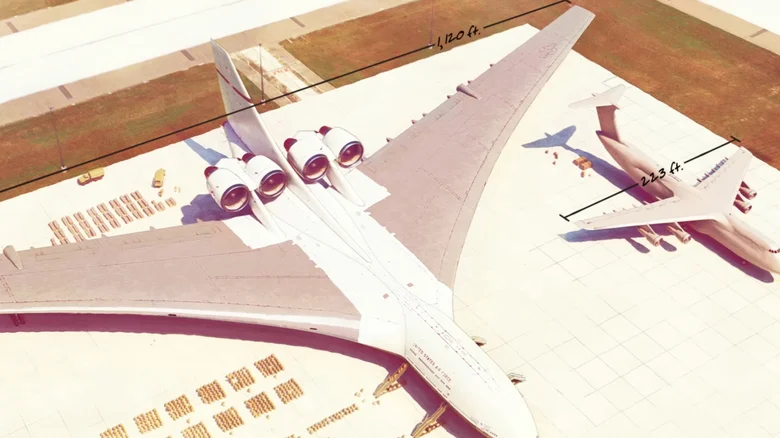
Estimates drawn from leaked or unofficial design studies describe a machine approximately 560 feet long with a wingspan stretching an astonishing 1,120 feet. To grasp that scale, imagine a commercial airliner’s wingspan — and then double it, and then double it again. The reported weight was roughly 5,265 tons, exceeding 11 million pounds. That is not an aircraft; that is airborne infrastructure.
The LC-1201’s most radical feature was its power source. Engineers reportedly envisioned a 1.83 gigawatt nuclear reactor onboard. To contextualize that output, one megawatt can power roughly 200 homes in parts of the United States. Multiply that by 1,830. Theoretically, this airborne carrier’s reactor could energize hundreds of thousands of households — yet instead of lighting suburbs, it would have been tasked with keeping millions of pounds of metal suspended in the atmosphere.
The reactor would have enabled continuous operation for up to 1,000 hours, or more than 41 days. With a reported cruising speed of Mach 0.8, the aircraft could have circled the globe multiple times without refueling. In Cold War logic, endurance equaled deterrence. A platform that never had to land was a platform that could never be easily neutralized.
The Attack Aircraft Carrier Variant
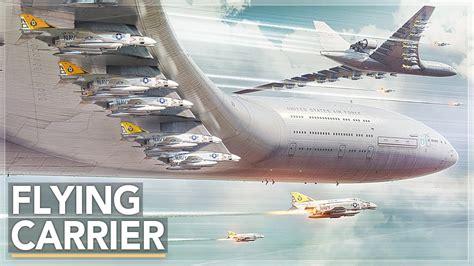
Two versions reportedly progressed through conceptual development, though details of one remain obscure. The more discussed configuration — sometimes referred to as an Attack Aircraft Carrier — would have carried multi-role fighters such as the F-4 Phantom II. These aircraft would dock beneath the massive wings, launching on command and returning mid-air for rearmament and refueling.
This airborne carrier would not simply transport fighters; it would serve as their base of operations. The strategic implications were profound. No reliance on overseas airfields. No vulnerability to naval chokepoints. A floating airbase in the stratosphere, able to position itself wherever geopolitical tension demanded.
Its defensive systems were expected to include layered anti-aircraft weaponry, potentially guided missiles and electronic countermeasures. Yet the irony was inescapable: despite its formidable firepower, the LC-1201 would have been visible on radar from extraordinary distances. Stealth technology was decades away. In the skies of the 1960s, size equaled visibility.
Engineering the Impossible
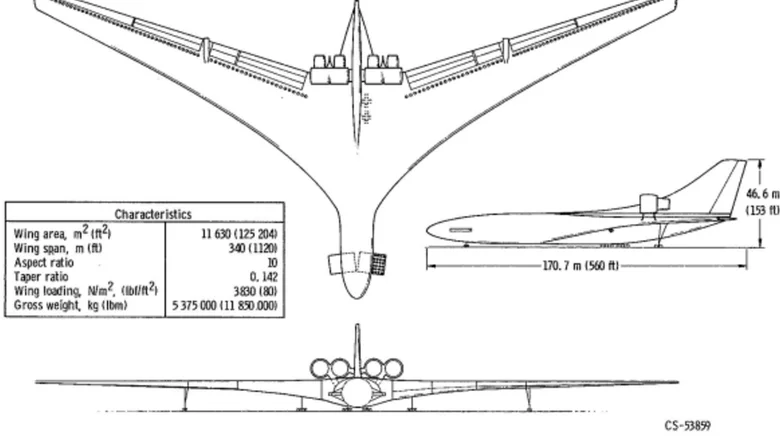
Ambition collided with physics almost immediately. Runway length alone posed an existential problem. No existing airstrip on Earth could accommodate a conventional takeoff for a machine of this magnitude. Lockheed engineers reportedly considered a Vertical/Short Takeoff and Landing (V/STOL) approach, similar in concept to the British Harrier jump jet.
Dozens of turbofan engines would provide vertical lift during takeoff, transitioning to nuclear-powered propulsion once airborne. The mechanical complexity of coordinating such thrust bordered on science fiction. Even today, synchronizing multiple lift engines on a vehicle that size would be a monumental challenge. In the late 1960s, it was effectively insurmountable.
Then there was the reactor itself. Housing a 1.83 gigawatt nuclear powerplant inside an aircraft demanded unprecedented advances in miniaturization, shielding, and heat dissipation. Nuclear reactors are not compact devices. The world’s largest nuclear power facilities occupy vast tracts of land, measured in square kilometers. Shrinking that output into an airborne format required materials science breakthroughs that simply did not exist.
Shielding alone presented a paradox. Protecting crew members from radiation meant adding massive amounts of weight. Reducing weight compromised safety. The LC-1201 sat trapped between aerodynamic necessity and nuclear reality.
A Strategic Giant with Fatal Vulnerabilities
Even if engineers had solved propulsion and reactor constraints, strategic weaknesses remained glaring. A nuclear-powered aircraft of this size would have been an obvious target. Enemy radar systems would detect it from immense distances. Surface-to-air missile systems were advancing rapidly during the Cold War. A successful strike on a nuclear-powered aircraft could have catastrophic environmental consequences.
Crash survivability raised further doubts. Traditional nuclear reactors rely on reinforced containment structures. Designing a pressure vessel that could withstand anti-aircraft fire or an emergency landing scenario — while remaining light enough for flight — bordered on contradiction.
Cost was another silent adversary. For comparison, the Lockheed C-5 Super Galaxy, one of the largest operational military aircraft ever built, measures 247 feet in length and costs well over $150 million per unit. The LC-1201 would have been more than twice as long, dramatically heavier, and infinitely more complex. Estimates suggest a per-unit cost approaching or exceeding $1 billion in 1960s dollars — an astronomical figure in Cold War budgeting.
Congress would not simply have funded an aircraft. It would have funded a flying nuclear city.
Why the LC-1201 Remains a Fascinating “What If”
The LC-1201 ultimately died not in flames, but on drafting tables. Its demise was a consequence of technological limitations, economic realities, and strategic reconsiderations. Intercontinental ballistic missiles and nuclear submarines offered more reliable deterrence with fewer engineering miracles required.
Yet the concept remains captivating because it represents the outer boundary of Cold War imagination. It was an era when engineers genuinely asked: if we can split the atom, why not lift it into the sky?
The Lockheed LC-1201 stands as a reminder that innovation often lives at the edge of impossibility. It demonstrates how military anxiety can accelerate radical creativity — and how physics serves as the final arbiter of ambition.
Had it flown, it would have been terrifying not merely because of its weapons, but because of what it symbolized: a world where permanence in the sky was achievable, where power plants had wings, and where deterrence hovered overhead for weeks at a time.
Instead, it remains one of aviation history’s most audacious unrealized dreams — a nuclear-powered colossus that never left the drawing board, yet continues to loom large in the imagination of engineers, historians, and anyone captivated by the extremes of aerospace ambition.