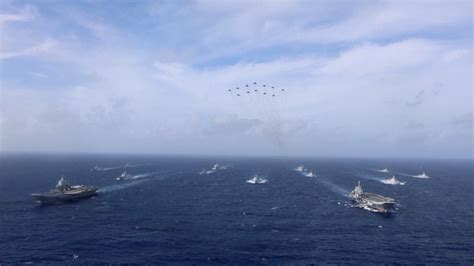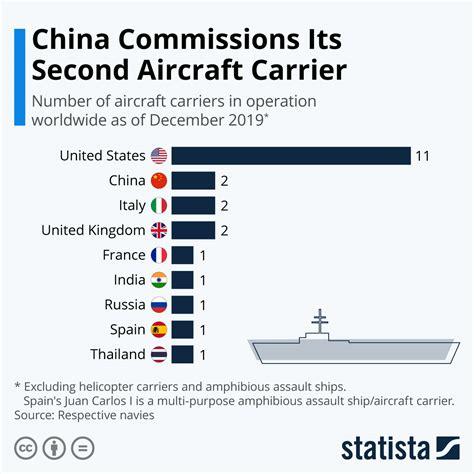
China’s ascent as a major naval power has fundamentally reshaped global maritime dynamics. Once trailing far behind traditional naval giants like the United States, the People’s Liberation Army Navy (PLAN) has, over the past decade, executed a rapid and ambitious aircraft carrier development program. As of mid-2025, China possesses three operational aircraft carriers, with more on the horizon—an effort that signals its long-term intention to project power well beyond the First Island Chain and possibly rival American maritime dominance in Asia.
The leap from having no carriers in 2011 to three active flattops within just over a decade reflects a dramatic shift in China’s military doctrine and shipbuilding capabilities. The PLAN has not only transitioned from dependency on foreign-built hulls but is now venturing into indigenous, advanced designs—mirroring yet modifying Western carrier architecture.
Type 001 Liaoning: The Beginning of a Carrier Era
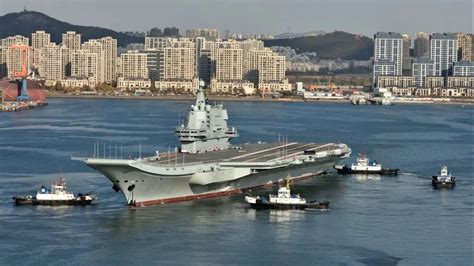
The Type 001 Liaoning, originally the Soviet Kuznetsov-class carrier Varyag, marked China’s inaugural step into carrier operations. Purchased from Ukraine in the late 1990s, the ship was extensively refitted at the Dalian Shipyard and commissioned into service in 2012. Despite being derived from a 1980s Soviet hull, Liaoning is more than a mere training platform; it provides essential blue-water operational experience.
Liaoning features a ski-jump flight deck and a short take-off but arrested recovery (STOBAR) system. Its displacement is estimated at 60,000 tons, much smaller than its American counterparts like the USS Gerald R. Ford, which displaces over 100,000 tons. The ship operates J-15 fighters, which are themselves derivatives of Russian Su-33 airframes, albeit upgraded with Chinese avionics and modifications.
However, Liaoning’s role has shifted more toward pilot training, carrier group formation exercises, and tactical development rather than frontline operations. It serves as the operational testbed for future designs, helping the PLAN develop procedures and protocols for carrier-based power projection.
Type 002 Shandong: China’s First Indigenous Carrier
Commissioned in December 2019, the Type 002 Shandong represents China’s first domestically built aircraft carrier. Although its design heavily draws on the Liaoning, it incorporates numerous upgrades and refinements—most notably improved internal layout for aircraft storage, enhanced radar systems, and better living quarters for crew.
With a similar STOBAR flight system and also displacing around 66,000 tons, Shandong features a larger hangar and a slightly modified ski-jump ramp, allowing for more efficient sortie rates. It also supports a complement of around 36 aircraft, including J-15 fighters, Z-18 helicopters, and AEW (airborne early warning) variants.
Strategically stationed in Sanya, Hainan Island, Shandong gives the PLAN enhanced access to the South China Sea, where China’s maritime claims and artificial island outposts continue to stoke regional tensions. The ship’s presence effectively extends Chinese naval influence deep into contested waters.
Type 003 Fujian: A Technological Leap Forward
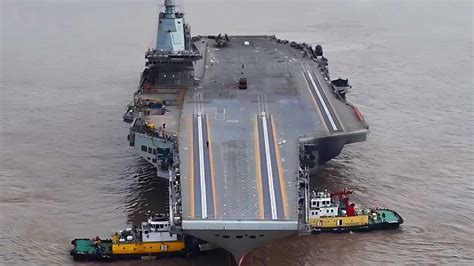
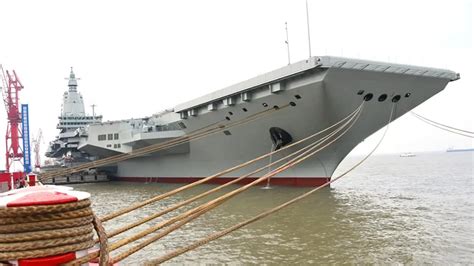
China’s third and most advanced carrier to date, the Type 003 Fujian, signifies a watershed moment in Chinese naval engineering. Launched in June 2022 and undergoing sea trials since 2024, the Fujian departs significantly from the previous STOBAR-configured ships. It employs the CATOBAR (Catapult-Assisted Take-Off But Arrested Recovery) system, making it the first non-U.S. carrier to feature electromagnetic launch systems.
With an estimated displacement of over 80,000 tons, the Fujian bridges the technological gap between China’s older carriers and the Gerald R. Ford-class of the U.S. Navy. Its use of EMALS (Electromagnetic Aircraft Launch System) rather than steam catapults enables faster launch cycles, accommodates heavier aircraft, and reduces stress on airframes.
However, unlike American nuclear-powered carriers, the Fujian is conventionally powered by steam turbines and diesel generators, somewhat limiting its endurance. Still, the ship is expected to become operational by 2026, with multiple air wings and integrated air-defense capabilities, giving the PLAN a formidable blue-water platform.
Aircraft Carrier Capabilities and Limitations
Despite rapid expansion, China’s current aircraft carriers have clear limitations:
- Conventional propulsion restricts their range and operational tempo compared to U.S. nuclear-powered vessels.
- J-15 fighter aircraft, while capable, suffer from high maintenance needs and limited payload due to takeoff method constraints.
- Lack of operational combat experience, particularly in blue-water scenarios involving carrier strike groups, places China behind in carrier doctrine.
Nevertheless, the learning curve is flattening quickly. The integration of advanced radar systems, more capable airframes, and coordinated support vessels signals increasing sophistication.
Looking Ahead: The Type 004 and Beyond
China’s ambition to expand its carrier fleet to six by 2035 is well underway. The next evolution in this trajectory is the Type 004, currently in the design and early prototyping phase. Unlike its predecessors, the Type 004 will feature nuclear propulsion, enabling true global reach and extended deployments without the need for constant refueling.
Development of the Type 004 began in 2024, with a land-based nuclear prototype being tested for feasibility. It is expected that the Type 004 will carry fifth-generation aircraft, possibly including carrier variants of the J-35 stealth fighter, and will incorporate cutting-edge radar and electronic warfare systems.
Once operational, the Type 004 will signal China’s transition from a regional naval power to a global maritime force, capable of sustained presence in the Indian Ocean, Western Pacific, and potentially even Atlantic corridors.
Strategic Implications and Regional Responses
China’s expanding carrier fleet has not gone unnoticed. Regional rivals such as India, Japan, and Australia, along with traditional Western powers like the United States and United Kingdom, have recalibrated their naval postures. The increasing presence of carrier strike groups in the South China Sea and Western Pacific has prompted:
- Expanded freedom of navigation operations (FONOPs) by U.S. and allied navies
- Increased investment in anti-access/area denial (A2/AD) systems among Southeast Asian nations
- Greater emphasis on submarine and unmanned drone capabilities to counteract carrier threats
China’s aircraft carriers also serve political objectives, providing a powerful visual symbol of strength during international missions, joint exercises, and port visits. As a cornerstone of President Xi Jinping’s vision of a world-class military, the PLAN’s carrier program illustrates the regime’s prioritization of long-term strategic projection over near-term tactical parity.
Conclusion: Not Just Numbers, But Capability
As of July 2025, China has three operational aircraft carriers—the Liaoning, Shandong, and Fujian—with the Type 004 under development. While these numbers may seem modest compared to the 11 nuclear-powered carriers of the United States, the rate and trajectory of growth suggest a long-term plan for global maritime influence.
The Chinese aircraft carrier program reflects a deliberate, phased evolution from imported platforms to indigenous engineering, from regional training vessels to technologically advanced strike carriers, and soon, from conventional propulsion to nuclear-powered endurance. The coming decade will likely witness China challenging the status quo not merely with more ships, but with strategically integrated carrier strike capabilities that redefine the balance of power in the Indo-Pacific and beyond.