The McDonnell Douglas MD-11 remains one of the most recognizable commercial aircraft ever produced, largely because of its distinctive three-engine configuration. Among aviation enthusiasts and casual observers alike, one question appears surprisingly often: does the MD-11’s tail engine actually have a fan, or is it simply an intake duct feeding another mechanism?
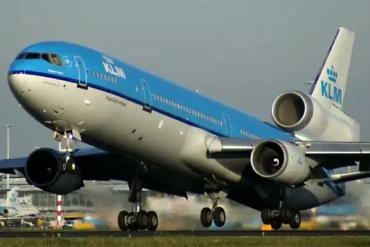
The answer is straightforward. Yes, the MD-11’s tail-mounted center engine absolutely has a fan. Unlike some other trijet designs where the fan sits deep inside the fuselage behind an S-shaped intake duct, the MD-11 places an entire high-bypass turbofan engine in a prominent external housing mounted above the rear fuselage. The fan exists just as it does in the aircraft’s wing-mounted engines, but its installation method is what makes it appear unusual.
Understanding why McDonnell Douglas selected this configuration requires examining the company’s engineering philosophy, its financial realities, and the competitive environment that shaped one of aviation’s final great trijets.
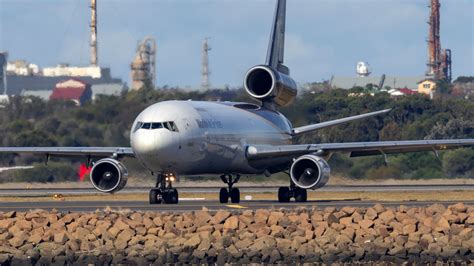
The MD-11’s Tail Engine Uses a Complete High-Bypass Turbofan
At first glance, the center engine seems almost hidden by the aircraft’s vertical stabilizer, leading some observers to assume that air simply flows through a duct into an internal powerplant. That interpretation would be correct for several other trijets, but not for the MD-11.
The aircraft’s number two engine is a complete turbofan installation mounted externally in a long nacelle extending from the upper rear fuselage. At the front of that nacelle sits a large rotating fan, identical in operating principle to the fans installed on the engines hanging beneath the wings.
Whether equipped with the General Electric CF6-80C2 or the Pratt & Whitney PW4460/PW4462 family, the center engine contains all the expected turbofan components: the fan, compressor stages, combustion chamber, turbines, and exhaust system. The visible intake at the front feeds directly into the fan without requiring an elaborate curved air channel.
That design decision became one of the defining visual characteristics separating the MD-11 and its predecessor, the DC-10, from virtually every other major commercial trijet.
Why Many People Think the Tail Engine Has No Fan
The confusion stems from comparisons with aircraft such as the Lockheed L-1011 TriStar or Boeing 727.
Those airplanes place their center engines inside the fuselage itself. Air enters through an opening near the vertical stabilizer and travels along an S-shaped intake duct before reaching the fan. Because the fan sits deeper inside the aircraft, it is difficult or impossible to see from many viewing angles.
The MD-11 instead eliminates the complicated S-duct arrangement. Looking into its intake reveals a conventional turbofan layout because the fan is positioned directly behind the inlet lip.
Consequently, the question is not whether the MD-11 possesses a fan but rather why its fan is installed so differently from most competing aircraft.
The Straight Intake Was a Deliberate Engineering Choice
McDonnell Douglas inherited substantial experience from earlier commercial programs and approached the DC-10 project with cost-conscious engineering priorities. Rather than investing heavily in sophisticated intake geometry, designers selected a simpler configuration that mounted the engine above the fuselage with a straight airflow path.
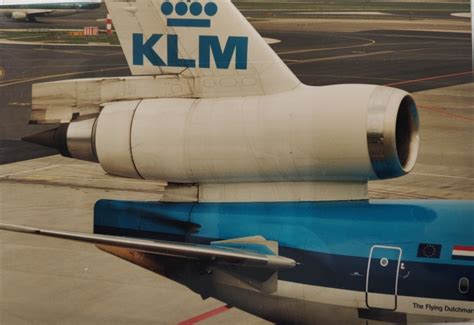
This arrangement offered several practical benefits.
First, straight airflow into the fan reduces aerodynamic distortion entering the compressor stages. Air approaching the engine follows a more direct path instead of negotiating multiple curves, helping preserve airflow quality.
Second, development costs remained significantly lower because engineers avoided designing and validating a highly optimized S-duct capable of maintaining smooth pressure recovery under every flight condition.
Third, accommodating future engine upgrades became easier. A larger nacelle could often be integrated without completely redesigning the internal fuselage structure.
These advantages aligned perfectly with McDonnell Douglas’ objective of controlling development expenses while producing a competitive widebody airliner.
How the Design Differs From the Lockheed L-1011 TriStar
The rivalry between the DC-10 and Lockheed L-1011 TriStar defined much of the early widebody era.
Although both aircraft employed three engines and served similar market segments, their center-engine philosophies diverged dramatically.
Lockheed pursued technological sophistication. The L-1011 integrated its center engine entirely inside the rear fuselage using an elegantly engineered S-duct. The resulting external appearance looked cleaner and potentially generated lower aerodynamic drag.
McDonnell Douglas preferred manufacturing simplicity and cost efficiency. Its engine installation projected above the fuselage, producing the distinctive hump that became instantly recognizable across airports worldwide.
Each solution represented a compromise between aerodynamic refinement, structural complexity, maintenance considerations, and development budgets.
The MD-11 inherited this external installation almost unchanged because redesigning the entire aft fuselage would have demanded enormous financial resources that the company simply did not possess.
Why the DC-10 Legacy Shaped the MD-11
The MD-11 was never conceived as an entirely clean-sheet aircraft.
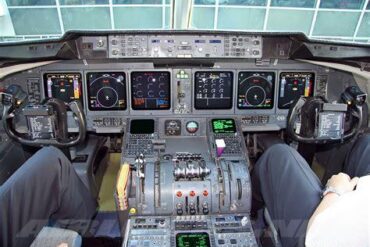
Instead, it evolved directly from the successful McDonnell Douglas DC-10, incorporating improvements while preserving much of the earlier airframe architecture. Engineers stretched the fuselage, redesigned the wings, installed winglets, modernized cockpit systems, and introduced newer engines, but the fundamental trijet layout remained intact.
Because the center engine installation already existed and functioned reliably, retaining it minimized certification risks and reduced engineering costs.
For airlines transitioning from DC-10 fleets, the continuity also simplified maintenance planning and operational familiarity.
The result was an aircraft that looked modernized without abandoning its proven structural foundation.
A Fan Hidden in Plain Sight
Unlike aircraft featuring buried engines, the MD-11’s fan is physically accessible from the front of the intake. Maintenance personnel inspecting the nacelle can observe the large fan blades directly after opening appropriate access areas or viewing through the intake.
This visibility occasionally surprises aviation enthusiasts accustomed to S-duct trijets.
The fan itself performs the same essential function as any modern high-bypass turbofan. It accelerates a massive volume of air, with much of that airflow bypassing the engine core to generate efficient thrust while reducing fuel consumption relative to earlier turbojet concepts.
In operational terms, the center engine behaves just like the two wing engines despite occupying a dramatically different physical location.
The Benefits of Mounting the Engine Above the Fuselage
Positioning the complete turbofan externally created several operational advantages beyond development savings.
Maintenance access could often be simplified because technicians worked on a discrete nacelle rather than removing major fuselage structures to reach internal components.
The straight intake also reduced engineering complications associated with airflow separation inside curved ducts. S-ducts require extensive computational analysis and wind-tunnel validation to prevent uneven pressure distributions reaching the fan.
Additionally, future compatibility with evolving engine families became more manageable because dimensional constraints inside an enclosed fuselage bay were less restrictive.
For a manufacturer facing financial pressure, these practical considerations carried significant weight.
The Aerodynamic Trade-Offs of the MD-11 Tail Engine
Engineering decisions rarely deliver benefits without costs.
Although simpler structurally, the external tail engine installation generated additional aerodynamic drag compared with more integrated fuselage solutions. The nacelle projected into the airflow and interacted with the vertical stabilizer in complex ways.
Furthermore, engine placement influenced aircraft handling characteristics during asymmetric thrust situations. Losing thrust from one engine on a trijet always demands careful control inputs, but the exact aerodynamic consequences depend partly on engine location.
The MD-11’s upper-mounted center engine introduced unique airflow interactions requiring dedicated certification analysis and pilot training.
These compromises remained acceptable during the aircraft’s design era but became less attractive as highly efficient twin-engine airliners matured.
Why the MD-11 Struggled in the Passenger Market
Despite incorporating updated avionics, improved engines, and aerodynamic refinements, the MD-11 entered an aviation landscape changing rapidly.
Extended-range twin-engine operational approvals, commonly known as ETOPS, allowed aircraft like the Boeing 767, later the Boeing 777, and the Airbus A330 to fly routes previously requiring three or four engines.
The economic argument supporting trijets weakened dramatically.
At the same time, the MD-11 failed to consistently achieve some of its ambitious payload and range targets during early service, disappointing several airline customers expecting stronger performance.
Combined with higher fuel consumption relative to advanced twins, these shortcomings limited passenger market success despite the aircraft’s impressive appearance and substantial capabilities.
The Tail Engine Was Not the Aircraft’s Main Problem
It may be tempting to blame the unusual center engine arrangement for the MD-11’s disappointing commercial performance, but doing so oversimplifies history.
The tail engine itself functioned effectively and represented an established concept already proven through years of DC-10 operations.
Instead, broader industry trends worked against the aircraft. Twin-engine reliability improved enormously during the late twentieth century. Engine manufacturers delivered unprecedented durability, regulators expanded ETOPS approvals, and airlines increasingly prioritized fuel efficiency over the redundancy of three engines.
In that environment, even an optimized trijet faced difficult economics.
The MD-11 became a victim less of flawed engineering than of shifting technological priorities across global aviation.
Why Cargo Airlines Continued Flying the MD-11
Ironically, the characteristics limiting passenger appeal created opportunities elsewhere.
Cargo operators evaluate aircraft differently from passenger airlines. Acquisition costs, payload flexibility, fleet availability, and depreciation frequently outweigh absolute fuel efficiency.
As passenger carriers retired MD-11 fleets, freight companies obtained relatively inexpensive airframes capable of carrying significant loads across intercontinental networks.
FedEx and UPS in particular embraced the type extensively, converting many former passenger aircraft into freighters while operating factory-built cargo variants.
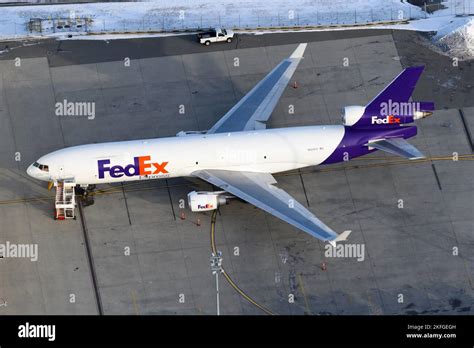
For years, the MD-11 represented one of the most capable dedicated cargo platforms available before newer freighters such as the Boeing 777F entered widespread service.
Modern Engines Changed the Competitive Landscape
The MD-11’s center engine includes a fully functional fan because it uses the same basic turbofan technology driving contemporary commercial aviation.
Yet advances in engine efficiency ultimately reduced the need for three engines altogether.
By producing greater thrust with exceptional reliability, large twin-engine aircraft could safely perform missions once reserved for trijets and quadjets. Airlines benefited from lower maintenance requirements, fewer overhaul events, reduced fuel burn, and simplified operations.
Consequently, manufacturers shifted almost entirely toward twin-engine widebody designs.
The MD-11 became one of the final representatives of an architectural philosophy that had once dominated long-range aviation planning.
The Lasting Legacy of the MD-11’s Unique Tail Engine
The McDonnell Douglas MD-11 occupies a fascinating place in aviation history because it combines proven engineering with transitional technology. Its center engine does not conceal an unconventional propulsion system or omit the defining fan found in modern turbofans. On the contrary, the tail engine houses a complete high-bypass turbofan with a fully integrated fan positioned directly behind the intake, mounted externally rather than buried inside the fuselage.
That choice reflected pragmatic engineering shaped by cost constraints, manufacturing priorities, and continuity with the earlier DC-10. While competitors embraced sophisticated S-duct installations, McDonnell Douglas favored a straightforward solution that simplified development and maintenance, even if aerodynamic perfection remained elusive.
Although the MD-11 ultimately struggled against increasingly capable twin-engine rivals, its distinctive silhouette ensured lasting recognition. Today, whenever one of these trijets climbs into the sky on a cargo mission, the unmistakable tail-mounted nacelle serves as a reminder that aviation innovation often involves balancing elegance, practicality, economics, and timing. And hidden behind that unmistakable intake is exactly what many people wonder about: a genuine turbofan fan spinning at tremendous speed, powering one of the most iconic aircraft ever built.