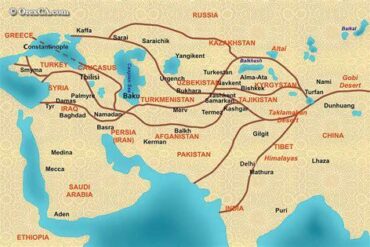
United Airlines is quietly mapping out a route map that stretches into territory no American carrier has ever touched. Chief Executive Scott Kirby has confirmed that Uzbekistan and Kazakhstan are on the carrier’s long-range radar, revealing that Patrick Quayle, United’s Senior Vice President of Global Network Planning and Alliances, traveled to both countries this year to evaluate them as future additions to the network. The disclosure, made on the Cheeky Pint podcast, marks the first time United has publicly attached names to its Central Asian ambitions, and it arrives at a moment when the region’s economic profile is rising even as the geopolitics around it remain forbidding.
Neither Kazakhstan nor Uzbekistan has ever received scheduled passenger service from a US airline, a gap that has persisted through three decades of independence and through the rapid expansion of transatlantic and transpacific flying. Should United ultimately commit, it would become the first American carrier to operate passenger flights to either nation, a distinction with genuine symbolic weight for a region that sits at the crossroads of the old Silk Road and the modern China-Europe trade corridor.
Russian Airspace Closures Keep Tashkent and Almaty Out of Reach
What is holding United back is not a lack of interest but a matter of geography and airspace. US airlines have been barred from Russian skies since March 2022, when Washington prohibited Russian carriers from American airspace in response to the invasion of Ukraine and Moscow retaliated in kind. That closure forces any flight toward Central Asia onto a substantially longer southerly routing, burning additional fuel and crew hours on a mission that already demands exceptional range. Kirby was candid that the obstacle is structural rather than commercial, saying Quayle reported that the pairing “could work down the road” but that United “can’t fly there today because we can’t fly over Russia.”
The detour carries more than cost implications. Operating far from diversion airports across sparsely equipped airspace raises credible questions about emergency planning, ETOPS margins and crew duty limits, making any launch a far more complex undertaking than a simple range calculation suggests.
Newark Emerges as the Likely Gateway for a Historic Pairing
Kirby did not identify which hub United would use, but the distance math points east. A flight from the US East Coast to Central Asia is considerably shorter than a West Coast departure, making Newark Liberty International Airport the natural candidate for any future service to Tashkent International Airport or Almaty Airport. Tashkent and Almaty sit roughly 420 miles apart, a proximity that opens the possibility of a single combined pairing, similar to the way Lufthansa links the Kazakh capital with Almaty on one Frankfurt rotation.
United’s confidence rests on data rather than speculation. Kirby noted that roughly 60 percent of passengers on its flights to Frankfurt and Munich continue onward, and Kazakhstan ranks among those onward itineraries. That connecting flow gives United a ready-made passenger base to build upon, with partner carriers already carrying its customers into the region.
Uzbekistan Airways and Air Astana Set the Competitive Bar
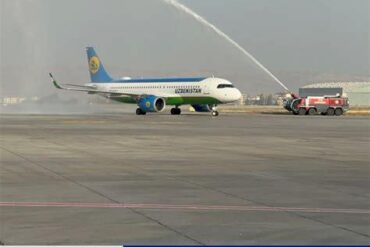
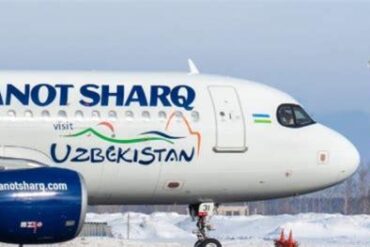
The route already has an incumbent. Uzbekistan Airways operates nonstop Boeing 787 service between Tashkent and New York’s John F. Kennedy International Airport up to five times weekly in summer, proving that demand exists on the American side of the equation. Kazakhstan’s flag carrier Air Astana is pursuing nonstop flights to New York next year, contingent on earning a Category 1 safety rating from the Federal Aviation Administration and on the same Russian airspace obstacle, and has signaled openness to codesharing with a US partner.
Precedent suggests United can move decisively when the numbers line up. In May 2025 the carrier launched seasonal Tokyo Narita to Ulaanbaatar service and became the first American airline to fly to Mongolia, a decision driven by the discovery that about 12 percent of passengers on one of its Tokyo flights were connecting onward to the Mongolian capital. It is a playbook built on spotting quiet connecting flows and converting them into nonstop opportunity, and Central Asia fits that template precisely.