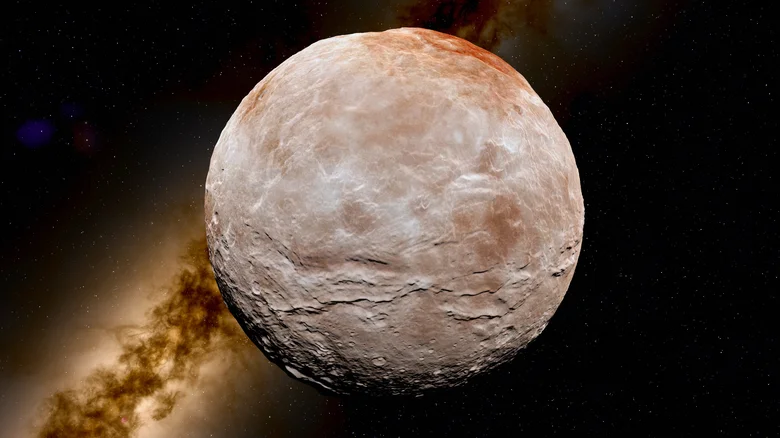
Every so often, the outer reaches of the solar system quietly undermine our confidence. Beyond Neptune lies a realm so vast and underexplored that even a single new discovery can ripple through decades of planetary theory. That is precisely what has happened with a small, dim, icy body informally known as Ammonite—a trans-Neptunian object whose strange orbit may preserve a fossil record of the solar system’s violent youth.
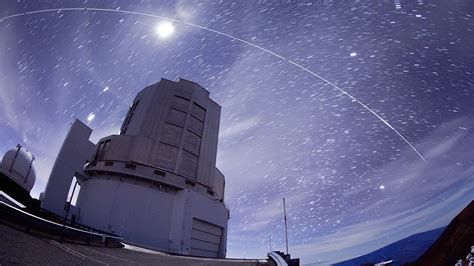
First detected in 2023 by the Subaru Telescope in Hawaii, this object carries the formal designation 2023 KQ14. Its nickname comes from the FOSSIL project—Formation of the Outer Solar System: An Icy Legacy—which aims to uncover remnants from the era when the giant planets were still finding their places. Ammonite is not a planet, nor a dwarf planet. It belongs to an exceptionally rare class called sednoids, bodies so distant and detached that Neptune’s gravity barely touches them.
At its closest approach to the Sun, Ammonite remains about 66 astronomical units away, more than twice Neptune’s distance. On average, it drifts an astonishing 252 AU from our star, placing it over 23 billion miles into interstellar twilight. Based on reflected sunlight, astronomers estimate its diameter at 137 to 236 miles, a modest size that belies its scientific importance. What makes Ammonite remarkable is not how big it is, but how little it has changed since the solar system’s infancy.
An Orbit That Defies Easy Explanation
Ammonite’s orbit is extreme even by outer solar system standards. It takes roughly 4,000 Earth years to complete a single elongated, steeply tilted loop around the Sun. This makes it only the fourth sednoid ever identified, joining Sedna, 2012 VP113, and 541132 Leleākūhonua. Each of these objects follows a path seemingly disconnected from the gravitational influence of known planets.
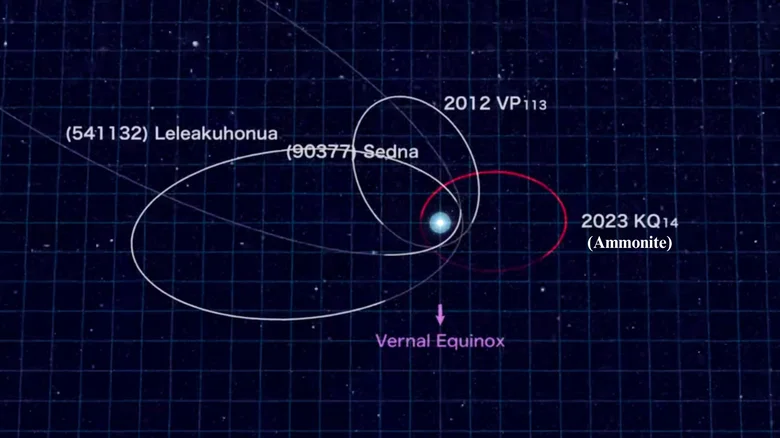
Sednoids are prized by astronomers because their orbits appear frozen in time. They are thought to preserve clues from a chaotic era over four billion years ago, when the Sun still resided in a dense stellar nursery and planetary orbits were anything but stable. Ammonite, however, adds a twist. Unlike its siblings, its orbital orientation points in the opposite direction, disrupting what once looked like a neat pattern.
The Planet Nine Hypothesis Under Pressure
The discovery immediately reignited debate around the controversial Planet Nine hypothesis, which proposes that a massive, unseen planet far beyond Neptune shepherds these icy bodies into aligned orbits. The clustering of sednoids has long been cited as circumstantial evidence for such a planet’s gravitational pull.
Yet Ammonite complicates that narrative. According to orbital simulations led by Yukun Huang, its misaligned path weakens the case for a single, still-present Planet Nine shaping all sednoids today. The data suggest something more subtle—and perhaps more dramatic—occurred.
Huang and colleagues propose that a ninth planet may have existed early on, only to be ejected from the solar system during a gravitational encounter. Alternatively, a passing star could have disturbed the outer regions, scattering small icy bodies into their current detached orbits. Both scenarios fit with models placing sednoids on much closer trajectories 4.2 billion years ago, before being flung outward.
Why This Small World Matters So Much
Ammonite is easy to dismiss as just another distant speck. That would be a mistake. Objects like this are time capsules, preserving gravitational scars from events that shaped the planets we know today. Unlike Earth or Mars, they have not been melted, resurfaced, or reworked by internal heat. Their orbits are the evidence.
Studying this small, icy world offers a rare opportunity to test competing theories about stellar flybys, rogue planets, and the early architecture of our cosmic neighborhood. Ammonite alone does not rewrite solar system history—but it sharpens the questions. In the dark beyond Neptune, the past is still waiting, quietly circling the Sun.