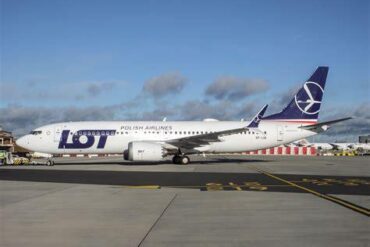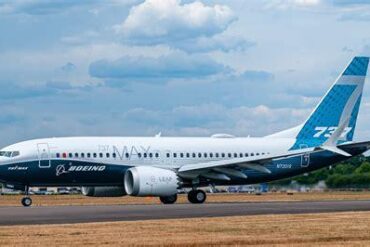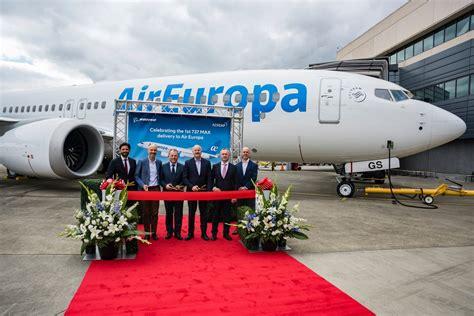
Air Europa has completed one of the most remarkable Boeing 737 MAX 8 delivery flights seen in recent years after a newly delivered aircraft flew nonstop from Seattle to Madrid across the North Atlantic. The journey immediately attracted attention among aviation enthusiasts and industry analysts because the flight pushed the narrowbody jet close to the upper edge of its practical operating capability.
The aircraft involved, registered EC-OSS, departed Boeing Field near Seattle and arrived at Adolfo Suárez Madrid-Barajas Airport after more than ten hours in the air. What made the operation exceptional was not only the distance itself, but the fact that the Boeing 737 MAX 8 is typically associated with medium-haul routes rather than ultra-long transatlantic sectors.
Public flight tracking data showed the aircraft crossing the Atlantic without making the originally expected fuel stop in Glasgow. Instead, favorable weather conditions and optimized delivery-flight planning allowed the aircraft to continue directly to Spain, creating what may be one of the longest nonstop flights ever completed by a standard-configured Boeing 737 MAX 8.
Why The Seattle-To-Madrid Boeing 737 MAX 8 Flight Was So Unusual
The Boeing 737 MAX 8 is officially marketed with a range of approximately 3,550 nautical miles under normal commercial operating conditions. The Seattle-to-Madrid route, however, stretched well beyond that figure. The great-circle distance for the sector reached roughly 3,873 nautical miles, placing the operation into territory rarely attempted by the aircraft during regular airline service.
That gap between published range figures and actual operational performance explains why the flight generated widespread discussion online. Aviation forums and flight-tracking communities quickly began debating whether the Air Europa mission represented the longest nonstop Boeing 737 MAX 8 flight ever recorded.
Under normal airline conditions, a route of this length would be difficult for the aircraft to operate consistently while carrying a full cabin of passengers, checked baggage, cargo, and the required fuel reserves. Delivery flights operate under entirely different circumstances. Manufacturers and airlines can remove most payload limitations because the aircraft typically carries only a small crew, minimal equipment, and no commercial passengers.
Reducing aircraft weight dramatically improves fuel efficiency and extends operational range. Airlines also benefit from highly specialized route planning, altitude optimization, and carefully selected weather windows that allow the aircraft to maximize performance.
Favorable Jet Stream Winds Helped Extend The Aircraft’s Range
One of the most important factors behind the successful nonstop crossing was the North Atlantic jet stream. Eastbound flights from North America to Europe frequently receive substantial tailwinds at cruising altitude, reducing flight time and fuel consumption.
In the case of the Air Europa delivery flight, those winds appear to have been strong enough to eliminate the need for a scheduled stop in Scotland. Instead of landing at Glasgow Airport for refueling, the aircraft continued directly toward Madrid, saving both time and operational complexity.
The flight lasted just over ten hours, a figure that highlights how efficiently modern narrowbody aircraft can perform under optimized conditions. Although the Boeing 737 MAX 8 was never designed primarily as a long-haul transatlantic aircraft, the combination of lighter payloads, advanced fuel planning, and favorable atmospheric conditions allowed the jet to complete a mission that would normally fall outside its commercial profile.
Boeing 737 MAX Aircraft Are Expanding Into Longer Routes
The Air Europa delivery flight reflects a much broader shift taking place across the airline industry. Over the past decade, modern narrowbody aircraft have steadily expanded into routes once dominated entirely by larger widebody jets.
Advances in engine efficiency, aerodynamics, and operational economics have transformed aircraft like the Boeing 737 MAX and Airbus A320neo family into capable long-range performers. Airlines increasingly prefer smaller aircraft on thinner long-haul routes because they lower financial risk while maintaining direct connectivity between cities.
Instead of relying exclusively on large twin-aisle aircraft that require high passenger demand, airlines can now profitably operate long-distance services with fewer seats and lower fuel burn. This strategy has opened dozens of transatlantic city pairs that previously could not sustain traditional widebody operations.
United Airlines recently announced plans to use the Boeing 737 MAX 8 on routes between Newark and Glasgow, further demonstrating how airlines are testing the outer boundaries of narrowbody capabilities. However, even these scheduled services remain shorter than the Seattle-to-Madrid delivery sector completed by Air Europa.
The economics behind these operations are increasingly attractive. Modern narrowbody jets consume substantially less fuel than older aircraft while requiring smaller crews and lower maintenance costs. For airlines facing volatile fuel prices and fluctuating passenger demand, the flexibility offered by aircraft like the 737 MAX has become strategically important.
Air Europa’s Fleet Modernization Strategy
For Air Europa, the arrival of additional Boeing 737 MAX 8 aircraft forms part of a larger modernization effort aimed at improving efficiency across its European and regional operations.
The Spanish airline has spent recent years updating both its short-haul and long-haul fleets. Alongside the introduction of Boeing 787 Dreamliners for intercontinental routes, the carrier has also focused on replacing older Boeing 737 variants with newer MAX aircraft.
These newer jets offer significant reductions in fuel consumption compared to previous-generation narrowbody aircraft. Lower fuel burn not only reduces operating costs but also helps airlines improve environmental performance at a time when sustainability pressures continue increasing throughout the aviation industry.
Air Europa operates from its primary hub in Madrid-Barajas Airport, where it connects European traffic with destinations across Latin America, North America, and the Caribbean. The airline remains one of Spain’s largest privately owned carriers and competes directly with Iberia on several major international markets.
Could This Be The Longest Boeing 737 MAX 8 Flight Ever?
While aviation databases have not officially confirmed the Seattle-to-Madrid sector as the single longest Boeing 737 MAX 8 flight in history, it almost certainly ranks among the most ambitious nonstop operations ever completed by the type.
Several ferry and delivery flights conducted by airlines or leasing companies may have covered comparable distances under similarly optimized conditions. However, flights exceeding 3,800 nautical miles remain exceptionally rare for the standard Boeing 737 MAX 8 configuration.
The operation also demonstrates the substantial performance margins available in modern commercial aircraft when payload restrictions are minimized. Although passengers should not expect airlines to launch regular Seattle-to-Madrid 737 MAX services anytime soon, the flight serves as a powerful example of how far narrowbody aircraft technology has evolved.
For Boeing, the flight offers another reminder of the versatility that airlines continue seeking from modern single-aisle aircraft. Despite years of regulatory scrutiny and delivery delays surrounding the 737 MAX program, airlines worldwide continue integrating the aircraft into fleets because of its fuel efficiency and operational flexibility.
The Air Europa transatlantic delivery flight may not redefine commercial aviation overnight, but it highlights a growing reality within the industry: modern narrowbody jets are increasingly capable of missions that once seemed impossible for single-aisle aircraft.