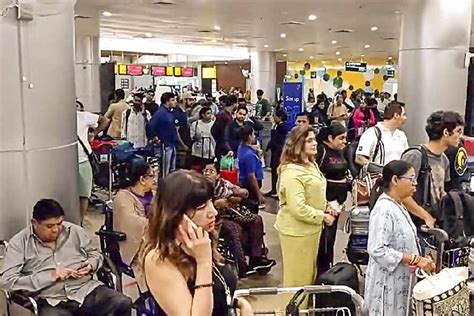
At Dabolim International Airport in Goa, a routine Air India flight to Dubai unraveled into a chaotic and deeply frustrating ordeal for international passengers, revealing glaring deficiencies in crisis handling, communication protocols, and airport infrastructure. The cancellation of the Dubai-bound flight in the early hours of Sunday, June 15, 2025, due to an unexpected technical fault on the incoming aircraft, left dozens stranded without timely updates or adequate support. The incident has not only stirred outrage among affected travelers but has also reignited broader conversations around India’s readiness to manage international flight disruptions.
A Delayed Departure Turns into a Canceled Flight
The Air India flight, originally scheduled for Saturday night, was first delayed and rescheduled to depart at 2:55 am Sunday morning. This change, while inconvenient, kept hopes alive among passengers, many of whom were on tight international itineraries. However, the mood shifted dramatically when, by 1:05 am, the airline announced a full cancellation. The culprit: a critical mechanical issue with the inbound aircraft from Dubai, which had failed to arrive in Goa as scheduled.
What followed was confusion and anger. Passengers were left with little information, no immediate alternatives, and a mounting sense of helplessness as the night progressed. Airport lounges and terminals became scenes of distress, especially for elderly travelers, families with young children, and those with pressing onward travel obligations.
Technical Glitch Reveals Deeper Operational Weaknesses
While mechanical issues are not uncommon in aviation, the unfolding of this particular scenario illuminated the broader systemic weaknesses of operating international routes from tier-2 airports like Goa. The technical snag, though reportedly serious, might have been more tolerable had it been accompanied by a swift, transparent, and efficient response plan.
Instead, passengers described an alarming lack of organization and accountability. Multilingual support was virtually nonexistent. Staff on the ground appeared overwhelmed and often uninformed. Language barriers only compounded the confusion for non-Indian travelers, many of whom found themselves unable to receive real-time information or alternative travel options.
Ground Response Under Fire: A Breakdown in Communication
The spotlight quickly turned to Goa’s Dabolim Airport, where passengers said airport officials and airline staff failed to provide basic crisis management. There were no dedicated assistance counters, no clear instructions, and no contingency frameworks in place.
One traveler, a Dubai-based business consultant who requested anonymity, expressed dismay: “There was no one taking charge. We had to keep asking different staff for information, only to get conflicting answers or none at all.”
Some passengers were eventually rebooked: about 35 individuals boarded a replacement flight on Sunday. Others were offered seats on a flight the following day. Those unwilling to wait were issued full refunds. But by that time, the damage had already been done—missed connections, visa complications, and immense financial losses plagued many travelers.
The Ripple Effects: Travel, Business, and Trust
This disruption extended well beyond the confines of Dabolim Airport. Passengers who had connecting flights from Dubai missed them. Those on tight schedules for visa deadlines, work commitments, or pre-paid accommodation arrangements were hit hard. The incident triggered a cascade of issues:
- Missed international connections, forcing rebookings and long layovers
- Cancelled hotel bookings, often non-refundable due to short notice
- Lost business opportunities, particularly for time-sensitive meetings
- Additional financial burden, including last-minute hotel stays and re-routing
For many, the experience shattered trust in the reliability of flying from or through mid-sized airports like Goa, which have seen increasing international traffic in recent years but may not yet be equipped with matching infrastructural sophistication.
A Wake-Up Call for India’s Aviation Sector
Experts in the travel and aviation sectors have highlighted this event as symptomatic of a broader challenge: India’s expanding international travel hubs are outpacing their operational maturity. Airports like Goa’s are increasingly important links in the global aviation chain. Yet they remain vulnerable due to limited redundancy in aircraft support, over-reliance on single airframes for routes, and outdated crisis playbooks.
The Air India incident underscores the urgent need for:
- Standardized disruption response protocols
- Dedicated multilingual crisis teams at all international terminals
- Automated passenger communication tools for real-time alerts
- Investments in backup aircraft and maintenance flexibility
Calls for Passenger-Centric Reform
The travelers affected by the Goa–Dubai disruption have been vocal in their criticism, but also in their expectations. Many have urged Air India and airport authorities to prioritize transparency, assistance, and reliability. Several have taken to social media platforms to demand:
- Instant notification systems via app or SMS
- Clear rebooking options with minimal wait time
- Multilingual hotlines and on-ground interpreters
- Passenger compensation for delays and missed connections
These are no longer ‘value-adds’ in modern air travel—they are necessities in an era where every disruption can instantly become a viral public relations disaster.
International Perception and Reputational Risk
As India continues to promote itself as a global travel and business destination, incidents like these could deter both leisure tourists and business travelers. The optics of chaotic terminals, silent staff, and passengers sleeping on airport benches are powerful deterrents for international flyers accustomed to structured, responsive airline ecosystems.
Industry insiders suggest that unless Indian airports adopt global best practices for crisis management and invest in real-time coordination technologies, recurring disruptions will damage the nation’s standing in the competitive aviation market.
Infrastructure vs. Experience: Bridging the Gap
Goa’s rise as a strategic international gateway is undeniable. Tourism is booming, business connectivity is expanding, and airlines are adding new routes. But all this growth is being built on aging foundations. Dabolim Airport, in particular, has long faced criticism over limited terminal space, bottlenecks in ground handling, and delayed upgrades.
Without parallel improvements in passenger handling, support systems, and technological adaptability, these infrastructures risk becoming liabilities rather than assets. The Goa–Dubai flight fiasco is a stark illustration of what happens when volume grows but systems stagnate.
A Broader Industry Reckoning
Globally, airlines are now re-evaluating their service commitments post-COVID. While many have doubled down on digital upgrades and flexible booking models, others have yet to address the Achilles heel of passenger support during crises. Air India, despite a renewed strategic vision under Tata Group’s stewardship, faces ongoing challenges in modernizing its operations.
For India’s aviation industry, this isn’t just about one flight. It’s a litmus test for how well-equipped the system is to respond to inevitable operational hiccups without compromising traveler dignity or safety. Delays and technical issues may be inevitable—but poor crisis response is not.
Conclusion: Toward a More Reliable Travel Future
The Air India flight disruption on the Goa–Dubai route has emerged as a defining case study of the consequences of underpreparedness in modern aviation. It reveals how quickly a single aircraft fault can metastasize into a wide-ranging public relations, operational, and passenger trust crisis.
To prevent future occurrences, both airlines and airports must embrace a passenger-first philosophy, integrating technical resilience with human-centered service. This includes creating infrastructure that scales with demand, ensuring staff are trained for multilingual crisis support, and investing in digital tools that keep passengers informed and empowered.
The road ahead is clear: global connectivity demands global standards. And for Goa—and India’s rapidly evolving aviation ecosystem—this is the moment to rise to that standard, before growth outpaces capability once again.