Dubai International Airport, one of the world’s busiest aviation hubs, descended into sudden disruption after a drone strike ignited a fuel tank, forcing authorities to halt operations and restrict access to foreign airlines. The incident, tied to escalating regional tensions, exposed the fragility of global air travel networks when critical infrastructure is hit with precision.
In the early hours before dawn, operations at DXB were proceeding as usual—long-haul arrivals descending through the desert haze, departures lining up for takeoff. Then, at approximately 04:30 AM local time, a Shahed-type drone breached air defenses and struck a fuel storage facility near the airport. The resulting explosion sent a towering plume of smoke into the sky, followed by an intense fire that burned for hours despite rapid emergency response.
Authorities moved swiftly, suspending all airport activity and temporarily closing UAE airspace. While no casualties were reported, the operational shockwave rippled far beyond Dubai’s borders, affecting dozens of flights already airborne.
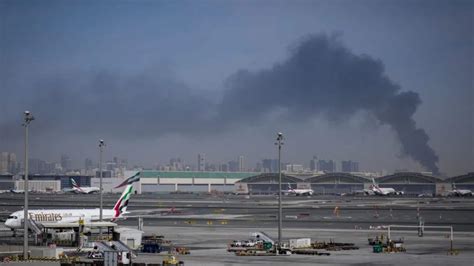
Drone Strike on DXB Fuel Infrastructure Sparks Immediate Shutdown
The targeted fuel tank sits within a critical logistical zone that supports continuous aircraft refueling at DXB. When it was hit, the risk of cascading explosions and fuel shortages became an immediate concern. Civil Defense teams contained the blaze, but cooling operations continued long after flames were extinguished, underscoring the volatility of aviation fuel storage under attack conditions.
Officials confirmed that airport operations would resume only in a limited capacity, prioritizing safety and infrastructure integrity checks. Foreign carriers were barred from landing, a move that effectively reduced traffic and allowed authorities to regain control over scheduling and ground operations.
This was not an isolated event. It marked the fourth drone or missile-related incident affecting DXB since regional hostilities intensified, signaling a troubling pattern of repeated targeting.
Over 60 Flights Diverted as Airspace Chaos Unfolds
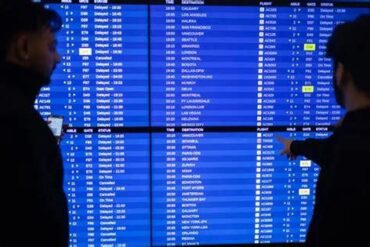
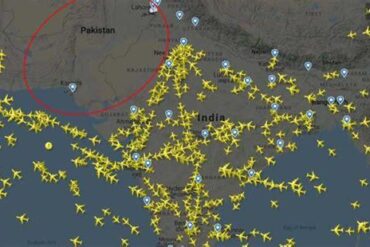
As the situation escalated, aircraft already en route to Dubai found themselves in a rapidly changing airspace environment. Flight tracking data revealed that 65 flights were diverted across 34 different airports, spanning continents.
Many aircraft were rerouted to nearby alternatives such as Al Maktoum International Airport (DWC), Abu Dhabi (AUH), Muscat (MCT), and Jeddah (JED). Others were forced into a more frustrating outcome—turning back entirely.
The phenomenon known in aviation as a “flight to nowhere” became a harsh reality for thousands of passengers. Some flights remained airborne for over ten hours before returning to their origin. One notable example involved an Emirates Airbus A380 departing Paris, which reversed course mid-flight over Saudi Arabia. Another service from Edinburgh turned back while crossing Egyptian airspace.
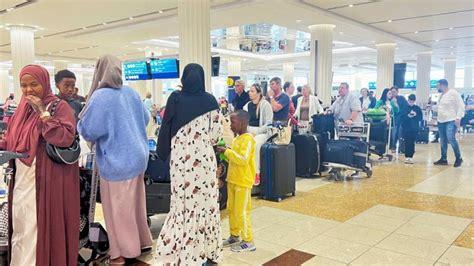
Inside those aircraft, passengers experienced a peculiar limbo—neither arriving nor progressing, but suspended in a logistical paradox created by geopolitics and fuel constraints.
Emirates and Hub Operations Face Severe Strain
Dubai’s aviation ecosystem revolves around Emirates, whose hub-and-spoke model depends on tightly synchronized arrivals and departures. When DXB halted operations, that synchronization unraveled almost instantly.
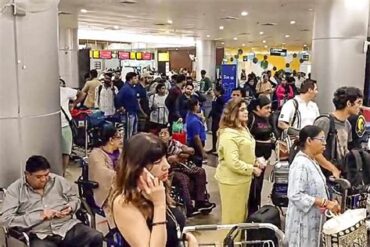
Aircraft were stranded out of position, crews exceeded duty limits, and connecting passengers missed onward flights in cascading fashion. The airline faced what can only be described as a network-wide scheduling shock, with recovery likely to take days rather than hours.
The temporary exclusion of foreign carriers added another layer of complexity. While it reduced congestion, it also disrupted international connectivity, isolating Dubai from parts of its global route network.
Jet Fuel Prices Surge Amid Escalating Conflict
Beyond the immediate operational chaos lies a slower-burning consequence: rising fuel costs. The broader regional conflict has already driven jet fuel prices sharply upward, with the Argus US Jet Fuel Index climbing from $2.50 to $3.99 per gallon in a short span.

Fuel is typically the second-largest expense for airlines, accounting for up to 35% of operating costs. When prices spike, airlines have limited options: absorb the hit and erode margins, or pass costs onto passengers through higher fares.
This incident compounds that pressure. Damage to fuel infrastructure at a major hub introduces uncertainty into supply chains, which markets tend to punish with higher prices. The result is a feedback loop where geopolitical instability directly inflates the cost of global mobility.
Aviation’s Fragility in an عصر of Asymmetric Threats
What makes this event particularly unsettling is not just the disruption itself, but the method. A relatively low-cost drone managed to impact a critical node in global aviation infrastructure, demonstrating how asymmetric tools can produce outsized effects.
Airports are designed with redundancy, but they are not invulnerable. Fuel farms, runways, and control systems are inherently exposed, and defending them against small, fast-moving aerial threats remains a complex challenge.
This incident serves as a case study in modern vulnerability: a single strike triggering global flight diversions, economic ripple effects, and operational paralysis within minutes.
The sky, often romanticized as a realm of freedom and connection, turns out to be tightly coupled to fragile systems on the ground. When those systems falter—even briefly—the illusion of seamless travel dissolves, revealing the intricate, precarious machinery that keeps the world moving.