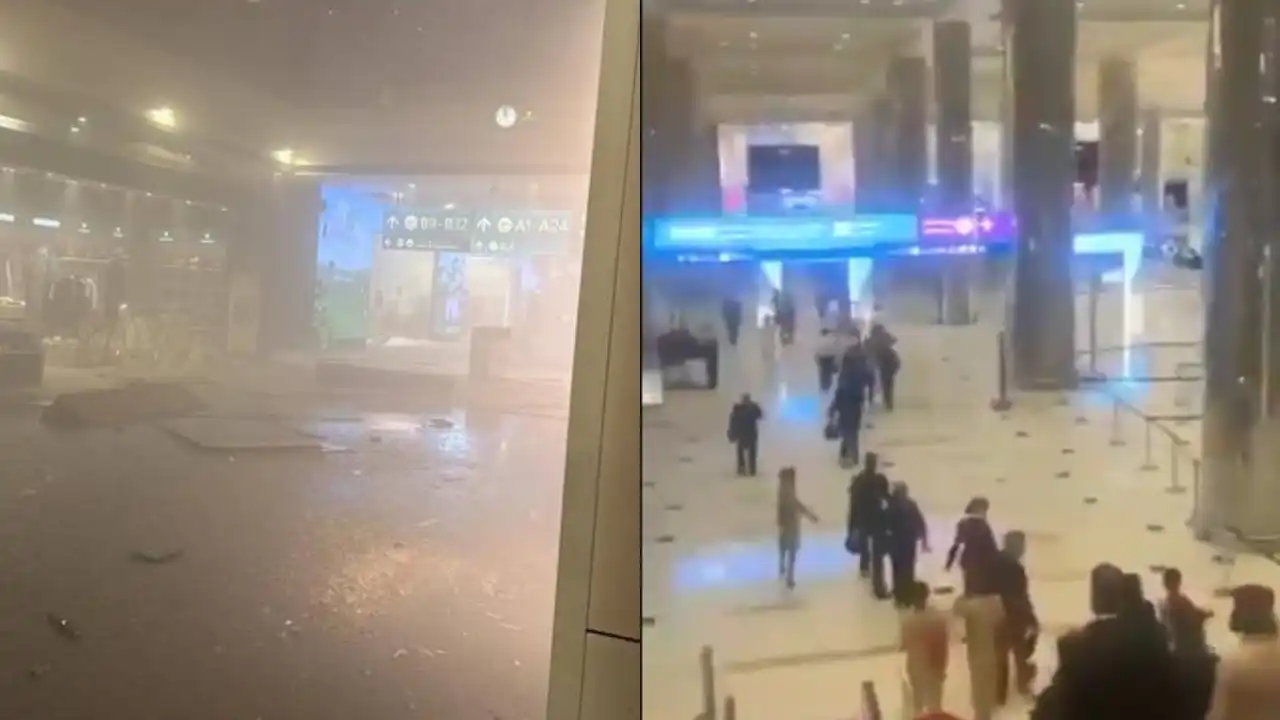
Dubai International Airport, the beating heart of global aviation in the Gulf, was struck by an Iranian drone amid a sweeping wave of retaliatory attacks that rippled across the Middle East. The impact triggered an emergency evacuation at the world’s busiest international hub, sending thousands of passengers rushing through smoke-filled concourses as alarms echoed across Terminal 3. The strike unfolded against the backdrop of a joint United States and Israeli military operation targeting Iran earlier in the day, marking a dramatic escalation with immediate civilian consequences.
The drone impact forced Dubai Airports to activate full emergency protocols. Fire crews from Dubai Civil Defence converged on the scene to contain localized fires sparked by the explosion. Authorities later confirmed four injuries, with emergency medical teams providing urgent care. The normally seamless choreography of arrivals and departures at Dubai International—often referred to simply as DXB—gave way to confusion and rapidly evolving security measures.
Dubai International Airport Evacuation and Immediate Aftermath
In the hours before the strike, reports surfaced of explosions elsewhere in Dubai, including damage near The Fairmont hotel on The Palm. The widening perimeter of incidents signaled a coordinated regional offensive. Inside Terminal 3, one of the airport’s primary long-haul gateways, dense smoke prompted a swift evacuation order. Witness footage showed travelers abandoning baggage carts and streaming toward exits under the guidance of airport security personnel.
🚨#BREAKING: At this time a Iranian drone has struck Dubai International Airport with Evacuations are underway at the airport. pic.twitter.com/Hocct1xJHi
— R A W S A L E R T S (@rawsalerts) February 28, 2026
Dubai International Airport handles more than 90 million passengers annually, serving as the primary base for Emirates and a strategic transfer point linking Europe, Asia, Africa, and the Americas. Its immense capacity magnified the disruption. By late afternoon Eastern Standard Time, over 1,800 flights across the Middle East had been canceled, with approximately 340 of those linked to airports in the United Arab Emirates. Nearly one-third of the nation’s scheduled flights were grounded.
Emirates alone saw 177 of its 269 scheduled services through March 3 scrapped, representing roughly 65 percent of planned operations. Etihad Airways, based in neighboring Abu Dhabi, confirmed that half of its 200 scheduled flights were canceled. The shockwaves extended far beyond the UAE as Qatar, Kuwait, Jordan, Bahrain, Iraq, and Israel closed their airspace entirely, while the UAE implemented partial restrictions.
Regional Airspace Chaos and Strategic Reverberations
The strike on Dubai International Airport did not occur in isolation. Explosions were reported in Jordan and Kuwait, while Qatar’s Ministry of Defence announced that its forces intercepted approximately 44 missiles and eight drones aimed at its territory. The region’s air traffic control networks were forced into rapid rerouting, creating congestion in alternative corridors and prompting long-haul diversions stretching into Europe and South Asia.
The UAE occupies a pivotal geographic and geopolitical position. As a strategic partner of the United States and host to key military installations, it sits at a crossroads of commerce and security flashpoints. The targeting of civilian infrastructure—particularly a globally connected aviation hub—signals a deliberate attempt to impose economic and symbolic pressure.
Footage later emerged showing flames at the iconic Burj Al Arab, further underscoring the scale of the confrontation. While official assessments of damage to landmarks remain ongoing, the psychological impact was immediate. Dubai’s global brand, built on stability and connectivity, suddenly faced images of fire and air-raid sirens broadcast worldwide.
Casualty Report and Drone Debris in Abu Dhabi
The crisis deepened in Abu Dhabi, where a separate drone incident resulted in one fatality. Security forces reportedly intercepted an incoming Iranian drone near Abu Dhabi International Airport, yet falling debris struck the ground, killing one man and injuring seven others. Authorities confirmed the casualty but withheld further identifying details. Approximately 70 departures from Abu Dhabi were canceled, representing around 30 percent of its scheduled operations.
Flight tracking data revealed that Dubai International had already scrapped nearly 500 departures—close to 80 percent of its daily schedule—by Sunday evening. Airlines including Emirates, Etihad, flydubai, and Qatar Airways were compelled to suspend hundreds of services, stranding passengers across continents. For transit travelers mid-journey, the cascading cancellations produced a chain reaction of missed connections and extended layovers.
A Global Aviation Powerhouse Under Strain
Dubai’s airport is not merely a transport facility; it is a linchpin of international mobility. Approximately 20 million passengers originate or terminate their journeys in the UAE each year, while tens of millions more pass through in transit. Disruptions at this scale ripple through global supply chains, tourism flows, and corporate travel networks.
Airport authorities stated that emergency response teams remain fully deployed and are coordinating with national security agencies. Updated operational guidance is being issued as conditions evolve. Yet the broader implications are unmistakable: a direct strike on Dubai International Airport marks one of the most consequential escalations in recent Middle Eastern tensions affecting civilian aviation infrastructure.
As diplomatic channels strain and airspace closures persist, airlines and passengers alike face an uncertain horizon. The incident underscores the vulnerability of even the most advanced transport hubs to geopolitical conflict—and the profound global consequences when the arteries of international travel are abruptly severed.