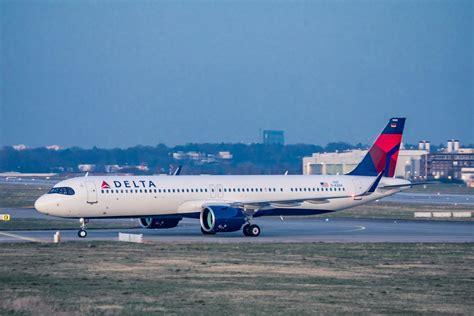
Delta Air Lines is making a decisive statement about its future, and that statement has two engines, sharklets on its wingtips, and a cabin tuned for the modern premium traveler. With the decision to exercise options for 34 additional Airbus A321neo aircraft, Delta has locked in a total of 189 of the type. That number does more than fill an order book. It reshapes the airline’s identity. The A321neo is on track to become the largest fleet type in Delta’s modern history, surpassing even the storied Boeing 727-200 era.
This is not incremental growth. It is strategic concentration. The Atlanta-based carrier took delivery of its first A321neo in 2022 and already operates 92. With 97 more on order and the latest deliveries expected from 2029 onward, Delta is methodically constructing a narrowbody backbone built around efficiency, flexibility, and premium yield. The A321neo is not just replacing older jets; it is redefining how Delta competes across domestic and short-haul international markets.
A321neo Efficiency: The Economics Behind Delta’s Commitment
The heart of Delta’s expansion lies in performance metrics that directly shape profitability. The Airbus A321neo delivers fuel burn improvements of roughly 20–30% compared to previous-generation narrowbodies. In a business where fuel remains one of the largest cost variables, that margin is transformational. Over hundreds of aircraft flying multiple sectors daily, the savings compound into structural advantage.
Lower fuel burn is only part of the story. The A321neo offers the lowest operating cost of any narrowbody in Delta’s fleet, a distinction that strengthens the airline’s cost discipline while preserving network flexibility. It can operate dense domestic trunk routes, premium transcontinental services, and short-haul international missions with equal confidence. This adaptability reduces the need for fragmented fleet subtypes and simplifies planning, crew allocation, and maintenance logistics.
Delta’s long-standing partnership with Pratt & Whitney, now spanning 90 years, continues through the selection of PW GTF engines for the A321neo fleet. These geared turbofan engines reduce fuel consumption and deliver a noticeably quieter acoustic footprint. That matters not only for community noise compliance but for the onboard passenger experience. Quieter cabins subtly elevate perceived comfort, a detail frequent travelers quickly recognize.
Premium Strategy in the Narrowbody Segment
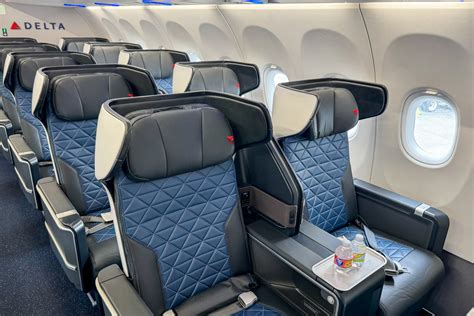
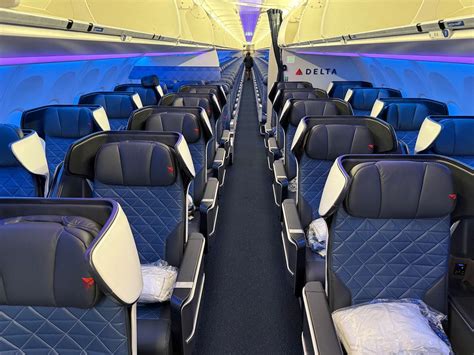
The A321neo is central to Delta’s premium ambitions. The aircraft features more Delta First and Delta Comfort seats than any other Delta narrowbody, reinforcing the airline’s focus on higher-yield passengers. Domestic premium travel has evolved; business flyers and affluent leisure travelers expect seatback entertainment, power at every seat, reliable connectivity, and refined cabin finishes even on two- or three-hour flights.
Delta’s configuration leans into that expectation. Larger overhead bins ease boarding friction. Seatback screens maintain brand differentiation in an era where some competitors have removed them. Upgraded seating materials and cabin design choices create a cohesive, modern aesthetic. Passenger satisfaction metrics reflect the payoff: the A321neo consistently earns the highest onboard satisfaction scores among Delta’s narrowbody fleet.
The aircraft’s capacity sweet spot enhances this strategy. With a higher “gauge” than smaller narrowbodies, the A321neo allows Delta to deploy more premium inventory on routes with strong demand. On competitive transcontinental corridors and high-frequency business markets, that matters. Revenue per departure rises without a proportional increase in operating cost.
From Boeing 727-200 to A321neo: A Historic Fleet Shift
Delta has seen dominant fleet types before. Between 1972 and 2003, the airline operated 183 Boeing 727-200 aircraft, which once defined its narrowbody presence. That fleet symbolized a different era of aviation, when trijets ruled medium-haul routes and fuel efficiency was measured by different standards.
The A321neo surpasses that legacy in scale and technological sophistication. Unlike the 727-200, which gradually gave way to Boeing 737-800s and 757-200s, the A321neo is designed to anchor Delta’s network deep into the next decade. It represents not a transitional fleet but a structural pivot.
This pivot aligns with Delta’s broader fleet modernization plan. Alongside the A321neo, the carrier has more than 60 Airbus A220-300s on order, plus additional A330-900s, A350-900s, and forthcoming A350-1000s. Over 100 Boeing 737 MAX 10 aircraft remain on order, with deliveries expected to begin next year. Yet within this diverse lineup, the A321neo stands out as the core narrowbody platform.
Network Flexibility and Deployment Strategy
The A321neo’s range and payload capabilities enable Delta to deploy it across a broad mission set. It is equally suited to high-frequency domestic routes linking hubs such as Atlanta, New York, and Los Angeles as it is to short-haul international services into the Caribbean, Mexico, and parts of Central America.
By standardizing on a high-capacity, fuel-efficient narrowbody, Delta gains operational elasticity. Aircraft can be shifted between markets with minimal compromise. Seasonal adjustments become smoother. Maintenance planning becomes more predictable. Crew training and certification pipelines streamline around a dominant type.
The result is not merely cost efficiency but resilience. Airlines operate in a volatile environment shaped by fuel price fluctuations, economic cycles, and shifting travel patterns. A large, modern fleet of versatile aircraft acts as a shock absorber. The A321neo provides that stabilizing influence.
Sustainability and Long-Term Positioning
Sustainability commitments are increasingly intertwined with airline strategy. The A321neo’s improved fuel efficiency directly reduces carbon emissions per seat. When multiplied across nearly 200 aircraft operating thousands of annual flights, the environmental impact reduction becomes substantial.
Delta’s investment signals confidence that the A321neo will remain relevant even as aviation moves toward sustainable aviation fuel expansion and next-generation propulsion research. A more efficient baseline aircraft enhances the benefits of any future fuel innovations layered on top.
Importantly, this modernization also reshapes Delta’s cost structure over time. Older aircraft typically carry higher maintenance burdens and fuel penalties. Replacing them with new-generation models reduces variability and supports margin stability. Investors, analysts, and network planners all track that shift closely.
Why the A321neo Becomes Delta’s Definitive Workhorse
The word “workhorse” is often overused in aviation, yet it fits here. A workhorse is reliable, adaptable, and relentlessly productive. The Delta A321neo fleet, approaching 189 aircraft, embodies that definition. It combines premium cabin strength, operating efficiency, environmental improvement, and deployment versatility in a single platform.
By 2029 and beyond, as additional deliveries join the fleet, the A321neo will not simply be another aircraft type on Delta’s roster. It will be the backbone of the airline’s domestic and short-haul international operations. It will carry business travelers between financial centers, vacationers to beach destinations, and families across the country with equal competence.
This transformation is less about numbers and more about architecture. Delta is building a future in which one aircraft type becomes the strategic anchor for growth, profitability, and customer experience. In that architecture, the Airbus A321neo is not a supporting actor. It is the structural beam running through the center of the airline’s next chapter.