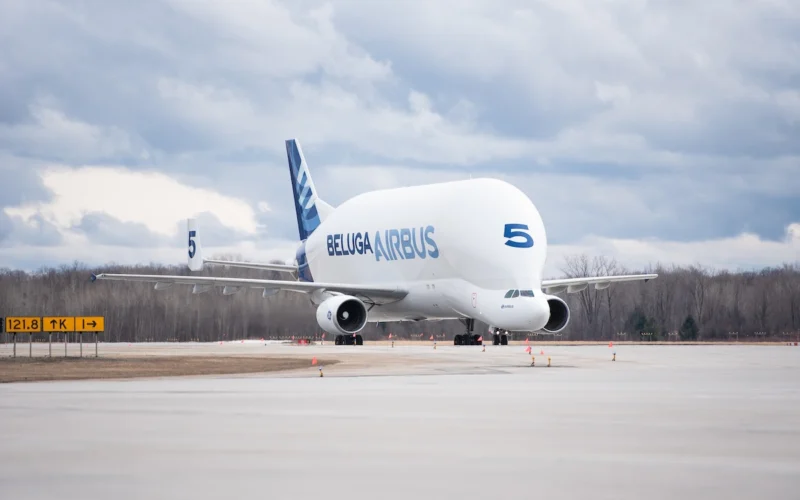
The final flight of the Airbus BelugaST marks the quiet closing of one of European aviation’s most recognizable industrial chapters. On January 29, 2026, the bulbous, white freighter will perform a farewell flypast over Northern Wales before descending toward Broughton Airfield, ending its operational life where so many Airbus wings once began their journey. For engineers, spotters, and production planners alike, this moment represents the end of a machine that was never glamorous by design, yet became iconic through relentless utility.
Derived from the A300-600 airframe, the A300-600ST entered service in 1996 as Airbus’s solution to a uniquely European problem: how to move enormous aircraft sections quickly between factories scattered across national borders. Its outsized fuselage, swing-open nose, and cavernous cargo bay allowed entire wings, fuselage barrels, and tail sections to fly rather than crawl across roads or seas, compressing production timelines in ways that quietly reshaped modern aircraft manufacturing.
End of an Era for the Airbus BelugaST
Over nearly three decades, the BelugaST became a constant presence in European skies, its distinctive silhouette instantly identifiable even to casual observers. As Airbus production rates climbed and programs like the A350 demanded larger, heavier components, the aircraft evolved from a clever workaround into a mission-critical artery. Reliability, not speed or range, defined its value, and the fleet delivered tens of thousands of flawless internal cargo flights.
The final operational chapter unfolded quietly. The last revenue-supporting BelugaST mission took place on September 17, 2025, after Airbus concluded that its newer BelugaXL fleet could fully absorb internal transport demands. Through late 2025, the older aircraft were parked, systems powered down, and schedules erased, leaving only a carefully choreographed farewell flight to provide closure for a fleet that rarely sought attention.
Thursday’s flypast and landing at Broughton Airfield around 11:00 local time is more than ceremonial theater. Broughton is a symbolic endpoint, deeply linked to Airbus wing production, and the arrival underscores how tightly the BelugaST was woven into daily manufacturing rhythms. For many workers on the ground, this will be the last time a familiar shape drifts overhead, punctuating shifts and seasons as it did for decades.
Engineering a Flying Production Line
From a strategic perspective, the retirement is driven by arithmetic rather than sentiment. The A330-based BelugaXL offers roughly 30% greater payload capacity, allowing Airbus to move larger assemblies in fewer flights while reducing maintenance complexity.
The transition also closes the brief experiment known as Airbus Beluga Transport, an attempt to commercialize spare capacity on the aging fleet. Range limitations, weight constraints, and specialized loading infrastructure proved difficult to monetize in a competitive outsized cargo market. Ending the program allows Airbus to refocus entirely on the invisible but essential task of keeping assembly lines synchronized across Europe.
While the BelugaST steps aside, its successor is firmly entrenched. Airbus Transport International now operates six BelugaXL aircraft purpose-built for internal logistics, supported by dedicated ground facilities and rapid turnaround procedures. Airbus has even retained tooling to build additional examples if future production rates demand it, signaling long-term confidence in the concept.
Preservation now becomes the next challenge. Airbus intends to place at least one BelugaST on static display, but the aircraft’s sheer dimensions severely limit suitable locations. Museums, educational centers, and aerospace campuses are under consideration, each requiring extensive logistical planning simply to position the aircraft, let alone maintain it as a public exhibit.
What Comes After the BelugaST
The emotional resonance of the farewell should not be underestimated. The BelugaST embodied a distinctly European engineering philosophy: pragmatic, cooperative, and unapologetically specialized. It was never meant to impress passengers or break records, yet it earned affection precisely because it did one job extremely well, day after day, without spectacle.
Looking ahead, the Beluga name remains very much alive. The BelugaXL fleet is expected to remain in service for decades, quietly underpinning Airbus’s global competitiveness. What remains uncertain is whether Airbus will ever again attempt to sell outsized cargo capacity externally, having learned how unforgiving that niche can be.
In that sense, the final BelugaST flight is not an ending but a handover. One generation of specialized aircraft yields to another, refined by experience and scaled for modern demand. As the white fuselage disappears from regular flight schedules, its legacy endures in every wing and fuselage section that arrives exactly where it needs to be, exactly on time.
For Northern Wales, January’s flypast will be brief, but its significance will linger. Few aircraft have been so visually unconventional yet so functionally indispensable. The BelugaST’s retirement reminds the industry that progress often looks strange at first, and that the most important machines are sometimes the ones passengers never see, faithfully carrying the burden of innovation behind the scenes.
When the aircraft finally settles onto the runway at Broughton, the moment will close a logistical chapter that reshaped how airplanes are built in Europe. The skies will look ordinary again, but Airbus’s production system will continue to move with the quiet efficiency the BelugaST helped perfect. Its absence will be felt after the noise fades, quietly and respectfully today.