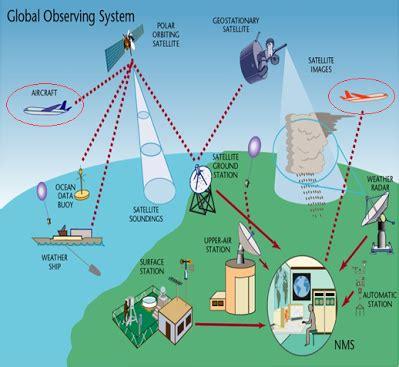
The World Meteorological Organization (WMO), in collaboration with over 40 airlines worldwide, has launched the Aircraft Meteorological Data Relay (AMDAR) program. This program is a crucial aircraft-based meteorological observation system. It uses data collected and transmitted by aircraft during flight to enhance the information gathered by traditional meteorological instruments. This helps improve the accuracy of weather forecasts.
AMDAR collects and shares a variety of meteorological data, including high-resolution vertical profiles of air temperature, wind speed, and direction at airports. It also provides regular updates on meteorological variables from airplanes flying at cruise altitude. Additionally, it records precise measurements of coordinates, such as time, latitude, longitude, and pressure altitude, along with turbulence data. Some equipped aircraft can also collect water vapor or humidity data.
So, how does AMDAR work? The system utilizes a specially designed avionics software package to record meteorological data from the aircraft’s existing sensors. This data is automatically sent to ground stations via VHF (very high frequency) or satellite links through the aircraft’s communication systems (ACARS). Once received by the airline, the data is forwarded to National Meteorological Services for further processing, quality control, and distribution via the WMO Global Telecommunications System (GTS). The collected data supports various meteorological applications, including public weather forecasting, climate monitoring, early warning systems for weather hazards, and essential weather insights for the aviation industry.
Data acquisition occurs from the moment an aircraft takes off until it lands. The AMDAR software allows for customizable observation frequencies. Typical observation profiles include:
-
Takeoff: For 90 seconds after the “OFF” time, observations are taken every 6 seconds.
-
Climb/Descent: In the lower troposphere, observations are made at 10 hPa intervals or at intervals ranging from 6 to 60 seconds. In the upper troposphere, the rate is generally at 50 hPa intervals or every 20 to 60 seconds.
-
Cruise: During cruise, observations are recorded at intervals of approximately 3 to 7 minutes.
The benefits of the AMDAR program are significant. Weather is a leading cause of air traffic delays globally, and many of these delays could be mitigated with better weather information. The data obtained through AMDAR enhances forecasting skills and boosts the accuracy of Numerical Weather Prediction (computer-based) systems. Users of this improved data can enjoy various advantages, such as:
-
Selecting optimal flight altitudes to improve efficiency in severe weather conditions.
-
Planning routes that minimize unplanned flight deviations.
-
Avoiding severe turbulence and adverse weather.
-
Reducing their carbon footprint through more efficient climb and descent profiles.