Alaska Airlines is reshaping its network once again, canceling seven routes while bringing back a popular intra-California connection between San Jose and Los Angeles. The changes highlight the carrier’s evolving strategy as it balances demand, aircraft availability, and its growing focus on Hawaii.
As the fifth-largest US airline by flights, Alaska now represents roughly 6% of US scheduled services, a footprint that has expanded significantly following its acquisition of Hawaiian Airlines. That larger network gives the carrier more opportunities to grow, but it also means Alaska must continually adjust routes that fail to generate sufficient demand or fit its broader strategy.
The latest changes, reported by Ishrion Aviation and reflected in scheduled data, affect markets in Mexico, California, and the wider US network. Several seasonal routes will not return in 2027, while Alaska is simultaneously restoring a California route that disappeared earlier this year.
Alaska Airlines Will Drop Three Puerto Vallarta Routes in 2027
The largest concentration of cuts involves Puerto Vallarta International Airport (PVR) in Mexico. Alaska Airlines will not resume its seasonal services from Puerto Vallarta to Sacramento, St. Louis, or New York-JFK in 2027.
All three routes were relatively recent additions to Alaska’s network and generally operated during the peak winter travel season, typically from January through April. The Puerto Vallarta–JFK and Puerto Vallarta–Sacramento services last operated in April, while the St. Louis route ended in March.
Their disappearance reflects a broader shift in Alaska’s Mexico strategy. The airline has already removed its Puerto Vallarta–Las Vegas service, alongside other seasonal routes from Los Angeles and Las Vegas. At the same time, Alaska has increasingly emphasized Hawaii as it integrates its expanded network following the Hawaiian Airlines acquisition.
The changes also demonstrate how aircraft and airport resources can be redirected toward stronger markets. The JFK slot previously associated with Puerto Vallarta is reportedly being used for a fifth daily Alaska Airlines flight between Seattle and New York-JFK, strengthening the carrier’s core transcontinental network rather than maintaining a seasonal international operation.
Two Santa Rosa Routes Are Also Being Removed
Two additional cancellations affect Charles M. Schulz–Sonoma County Airport (STS) in Santa Rosa, California. Alaska Airlines has been deeply established at the airport for nearly two decades and was the first carrier to restore commercial service there. It remains the airport’s largest airline.
Despite that strong presence, Alaska is ending its Santa Rosa–Ontario and Santa Rosa–Salt Lake City services. The Santa Rosa–Ontario route is particularly notable because Alaska only launched it in March 2026.
The service was introduced after Avelo Airlines abandoned the market. Avelo had previously connected Sonoma County with Ontario but canceled the route in April 2025 before eventually leaving Santa Rosa altogether. Alaska and airport officials had positioned the replacement service as an important nonstop link between Sonoma County and California’s Inland Empire.
Alaska currently operates Santa Rosa–Ontario daily with an Embraer E175, but the scheduled final flight is October 31. The Santa Rosa–Salt Lake City route will also disappear before entering regular operation. Alaska had planned to fly the latter route up to daily from November 1 through April 21, 2027, but it has now been removed from the schedule.
Other Alaska Airlines Routes Already Ending
The seven-route reduction extends beyond Puerto Vallarta and Santa Rosa. Alaska is also ending service between San Luis Obispo and Las Vegas and between Sacramento and Los Cabos.
Both routes have already seen their final scheduled operations, with San Luis Obispo–Las Vegas ending on April 20 and Sacramento–Los Cabos ending on April 18. Combined with the three Puerto Vallarta routes and two Santa Rosa routes, these decisions bring the total number of affected markets to seven.
| Route | Status |
|---|---|
| Santa Rosa–Salt Lake City | Removed before planned November launch |
| Santa Rosa–Ontario | Ends October 31 |
| San Luis Obispo–Las Vegas | Ended April 20 |
| Sacramento–Los Cabos | Ended April 18 |
| Puerto Vallarta–Sacramento | Seasonal service will not return |
| Puerto Vallarta–St. Louis | Seasonal service will not return |
| Puerto Vallarta–New York-JFK | Seasonal service will not return |
The pattern is important. Alaska is not simply shrinking across the board. Instead, it is moving capacity away from selected thinner markets while strengthening routes that better support its larger network strategy.
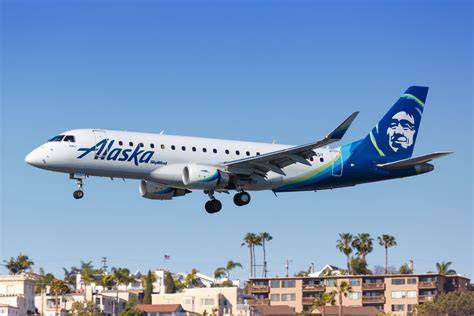
San Jose–Los Angeles Returns With Four Daily Flights
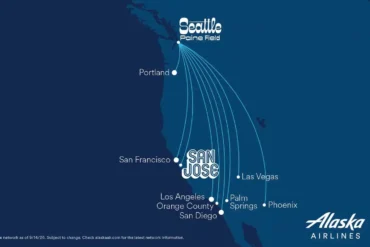
Against the backdrop of these cancellations, Alaska Airlines is making a strikingly different move in California by restoring its San Jose–Los Angeles route.
The carrier originally launched the service in 2017 but discontinued it in January 2026. Alaska had cut the route amid several reductions involving San Jose, Los Angeles, and San Francisco, citing slower-than-expected new aircraft deliveries during 2026.
Now, the route is scheduled to return on November 1 with four daily flights, providing considerably more capacity than the previous operation.
The biggest difference is the aircraft. Before its cancellation, Alaska operated San Jose–Los Angeles using a 76-seat Embraer E175. Upon its return, the airline plans to use a 173-seat Boeing 737-900ER, configured with 157 economy seats and 16 business-class seats.
That represents a substantial increase in available capacity and suggests Alaska sees enough demand to justify a much larger aircraft on the short California sector.
What the Changes Mean for Alaska’s Network
Taken together, the cancellations and reinstatement reveal a carrier trying to make its expanded network more efficient. Alaska has more opportunities following the Hawaiian Airlines acquisition, but a larger fleet and route map also require careful decisions about where aircraft should be deployed.
The airline is simultaneously preparing for future international growth, including planned seasonal Seattle–Athens and Seattle–Paris services in 2027, while reinforcing major hub markets. The fifth daily Seattle–JFK flight is another example of capacity being concentrated where Alaska can potentially achieve stronger year-round utilization.
The return of San Jose–Los Angeles is equally significant because it shows that route cuts are not necessarily permanent. As aircraft availability improves and demand patterns change, Alaska can bring back markets that previously appeared unsuitable.
For travelers, the result is a mixed picture. Some communities will lose nonstop options, particularly in Santa Rosa and smaller seasonal international markets. Yet passengers traveling between San Jose and Los Angeles will regain a convenient nonstop connection, this time with substantially more seats available on every flight.
Alaska Airlines’ latest network adjustment therefore looks less like a simple contraction and more like a strategic redistribution of capacity. The carrier is trimming weaker or seasonal markets while putting larger aircraft and additional frequencies into routes it believes can perform better.