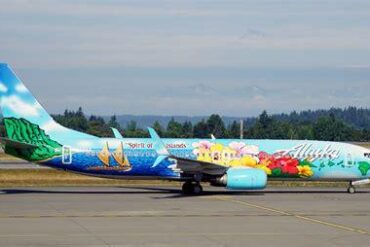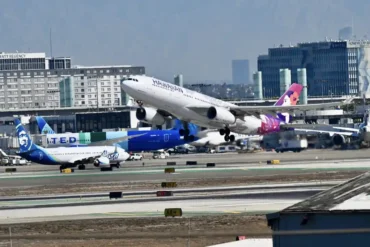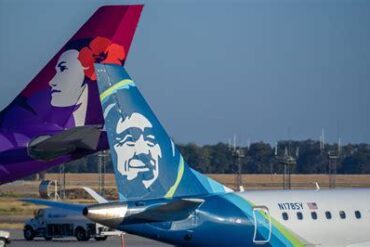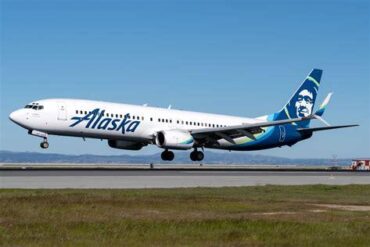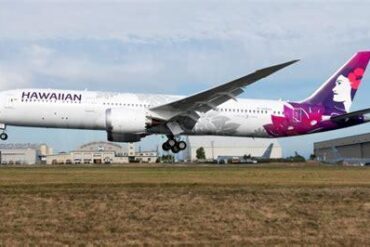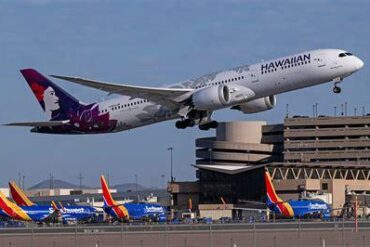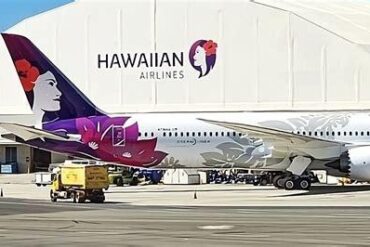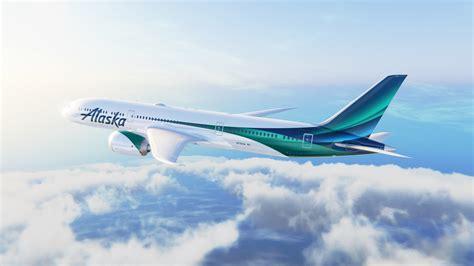
The visual identity of Hawaiian Airlines’ Boeing 787-9 Dreamliners has disappeared almost as quickly as it arrived. Less than two years after entering service with the carrier’s iconic purple-and-orange “Pualani” livery, the aircraft have now been completely repainted under Alaska Airlines’ new Global brand, marking another visible step in the integration of the two airlines following their 2024 merger.
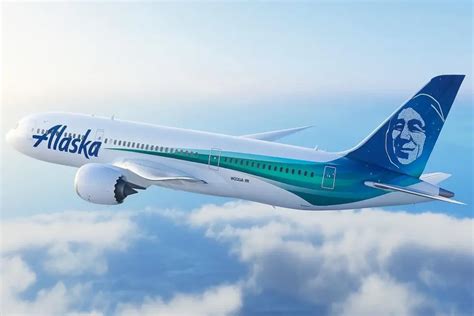
The repainting effort moved swiftly. Over the course of several months, all four original Hawaiian 787-9 aircraft were ferried to Fort Worth Meacham International Airport (FTW), where technicians removed the tropical-themed paint scheme that once symbolized Hawaiian’s long-haul ambitions. In its place now sits a striking new design inspired by the Aurora Borealis, featuring deep blues and emerald greens that signal Alaska Airlines’ push into global markets.
While the transformation may appear cosmetic on the surface, the disappearance of Hawaiian’s signature branding from its newest widebody aircraft represents a deeper strategic shift. The Dreamliner fleet was originally meant to usher Hawaiian Airlines into a new era of international growth. Instead, the aircraft have become the foundation for Alaska Airlines’ emerging long-haul network from Seattle.
The End of Hawaiian’s Dreamliner Livery Era
Hawaiian Airlines introduced the Boeing 787-9 Dreamliner into its fleet in 2024, positioning the aircraft as the centerpiece of a modernized long-haul strategy. The jets carried the beloved Pualani tail design, often called the “Flower of the Sky,” a symbol deeply tied to the airline’s heritage and identity across the Pacific.
That era proved unexpectedly short.
The four aircraft—N780HA, N781HA, N782HA, and N783HA—have all now undergone full repainting into Alaska Airlines’ Global livery. Aviation tracking data shows the final aircraft, N783HA, returning to Seattle-Tacoma International Airport (SEA) on March 11 before reentering service just two days later on a flight to Honolulu (HNL).
The repainting process itself was far from trivial. Alaska Airlines reported that each aircraft required close to 1,000 hours of labor over roughly two weeks. Layers of paint were carefully stripped away before the new multi-tone finish—designed to mimic the glow of northern lights—was applied across the Dreamliner’s composite fuselage.
The result is a dramatic visual departure from Alaska’s traditional look. Most notably, the airline removed its longtime “Chester” Eskimo face tail emblem from these aircraft, replacing it with an abstract northern-lights motif intended to symbolize the carrier’s global ambitions.
A Fifth Dreamliner Joins the Fleet Already in Alaska Colors
The repainting story extends beyond the four original Hawaiian jets. A fifth Boeing 787-9, registered N784HA, joined the fleet in a somewhat unusual state.
Instead of arriving in Hawaiian Airlines colors, the aircraft was delivered in a neutral all-white scheme, reflecting the uncertainty surrounding branding during the early stages of the Alaska-Hawaiian integration. The aircraft entered the paint shop in December 2025, receiving the Aurora-inspired livery before officially debuting in Seattle in early January.
The aircraft’s unveiling drew significant attention from aviation enthusiasts. Unlike many airline liveries that rely on simple stripes or tail graphics, Alaska’s Global design spreads across the fuselage in flowing color gradients meant to replicate the shifting movement of the aurora in the night sky.
According to the airline, the visual concept aims to reflect both Alaska’s northern geography and its expanding international reach.
Inside the Cabin: Hawaiian’s Interior Still Survives
Despite the dramatic exterior transformation, stepping onboard these Dreamliners still feels unmistakably Hawaiian—for now.
Alaska Airlines has chosen to retain the original Hawaiian Airlines cabin interiors, postponing a full redesign until a future retrofit program. That decision means passengers are still experiencing the same layout and seat products that debuted when Hawaiian launched the Dreamliner type.
Each aircraft accommodates approximately 300 passengers across two classes:
- 34 business class seats
- 266 economy class seats
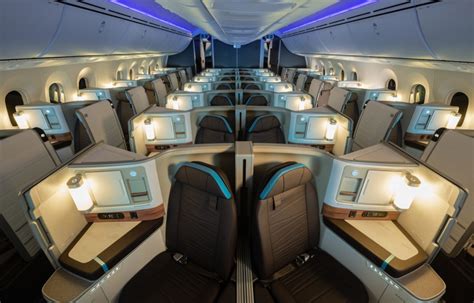
The highlight of the cabin remains Hawaiian’s Leihōkū Suites, a modern business-class product introduced alongside the Dreamliner. These suites feature fully lie-flat seats with privacy doors, arranged in a 1-2-1 configuration that provides every passenger with direct aisle access.
Passengers also benefit from 18-inch in-flight entertainment screens, generous personal storage, and design elements inspired by Hawaiian culture.
Economy class is equally notable. The cabin features Collins Aerospace Aspire seats, lightweight units designed to maximize passenger comfort while reducing aircraft weight. Each seat includes a 12-inch seatback entertainment display, a relatively large screen for economy travel.
For travelers seeking additional comfort, the aircraft also offer 79 Extra Comfort seats, which provide additional legroom and priority boarding benefits.
Alaska Airlines has confirmed that a full interior overhaul will eventually take place, though the company has not yet revealed when that retrofit will begin.
Dreamliners Power Alaska’s Global Strategy
The newly repainted Dreamliners are already playing a central role in Alaska Airlines’ international expansion strategy. Historically focused on North American routes and West Coast connections, the airline is now building a long-haul network centered around Seattle.
At present, the aircraft operate on two major Asian routes:
- Seattle – Tokyo Narita (NRT)
- Seattle – Seoul Incheon (ICN)
These routes mark a significant evolution for Alaska Airlines, which previously relied heavily on partnerships rather than operating its own widebody international flights.
The network is about to grow further. Alaska plans to launch new Dreamliner services from Seattle to London Heathrow (LHR) and Rome Fiumicino (FCO) during the upcoming spring season, marking the airline’s first direct flights to Europe using its own aircraft.
The airline’s ambitions stretch well beyond these initial routes. Executives have indicated that Seattle could host as many as 12 long-haul international destinations by 2030, supported by a steadily expanding Dreamliner fleet.
Earlier this year Alaska placed an order for five additional Boeing 787 aircraft, bringing its total commitment to 17 Dreamliners. Interestingly, most of those future deliveries will be the larger Boeing 787-10 variant, which typically offers around 40 more seats than the 787-9.
The trade-off is range. The 787-10 cannot fly quite as far as the 787-9, but for many transatlantic and transpacific routes from Seattle, the additional capacity makes the aircraft economically attractive.
For aviation observers, the rapid disappearance of Hawaiian’s Dreamliner branding highlights just how quickly airline identities can evolve after a merger. Aircraft that once symbolized Hawaiian Airlines’ independent global ambitions are now flying under a different banner, helping build Alaska Airlines’ next chapter as an international carrier.