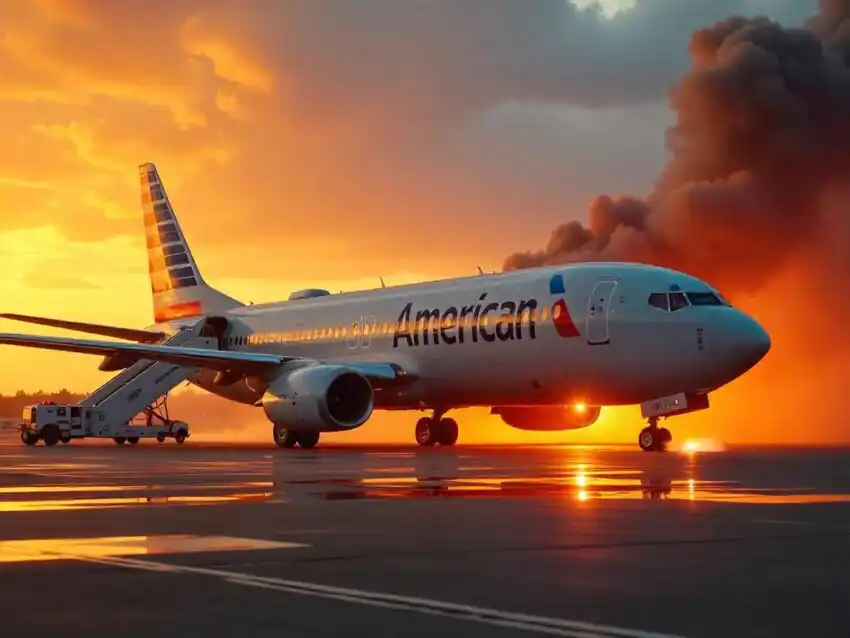
A quiet Wednesday morning on March 13, 2025, quickly descended into a scene of chaos and fear when American Airlines Flight AA1006, a Boeing 737-800, was forced into an emergency landing at Denver International Airport. What began as an engine vibration soon escalated into a fireball scare that rocked the aviation world. Now, as the NTSB releases its preliminary findings, a narrative of neglect, rushed maintenance, and procedural breakdowns is emerging — one that threatens to shake public trust in one of the nation’s largest carriers.
The Fireball That Shattered Routine
Flight AA1006, scheduled to travel from Colorado Springs to Dallas/Fort Worth, encountered engine trouble shortly after takeoff. At an altitude of 16,000 feet, vibrations from the right engine prompted pilots to divert the aircraft. That swift decision likely saved lives. However, the worst was yet to come.
As the plane touched down safely in Denver and taxied toward the gate, a visible fluid leak streamed from the affected engine. Smoke followed. Then, flames. What was initially managed as a precaution became a full-blown emergency.
Passenger Panic and Evacuation Breakdown
Inside the cabin, panic spread rapidly. With thick smoke seeping in and no immediate communication from the flight deck, flight attendants took control, initiating an emergency evacuation. The scenario spiraled.
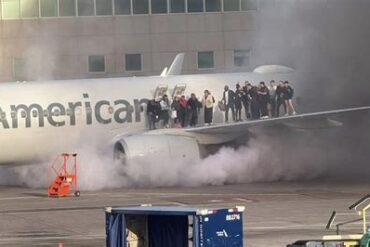
Passengers exited via multiple routes—some through the jet bridge, others down the inflatable rear slide, while several escaped through the overwing exits. But one critical slide failed to deploy, and worse, the aircraft’s flaps had not been extended, leaving overwing evacuees exposed and unsupported.
On the wing, a number of passengers became stranded, clinging to the surface as flames crackled beneath. Ground crew and emergency responders worked urgently to extinguish the fire and retrieve the evacuees. Yet the chaotic breakdown in coordination and equipment painted a harrowing picture of unpreparedness.
NTSB Investigation: A Damning Set of Failures
In the weeks following the incident, the National Transportation Safety Board (NTSB) launched a thorough investigation. Their findings are stark. The fire was entirely preventable.
Key maintenance oversights were identified:
- A loose safety wire that failed to properly secure a fuel connection
- An improperly installed Variable Stator Vane (VSV) actuator, a component vital to regulating internal airflow
- A blocked drainage pipe coated with an adhesive substance, which caused pressure buildup
Together, these errors created a perfect storm—fuel leakage, uncontained pressure, and flammable materials interacting inside an engine already showing signs of distress. The implication is clear: basic maintenance protocols were either ignored or rushed.
The Age Factor: 13-Year-Old Jet Under Scrutiny
The aircraft involved—a Boeing 737-800 delivered in 2012—is not considered old by commercial aviation standards. But its age does underscore the need for rigorous, timely maintenance. Despite the damage sustained and the psychological toll on passengers and crew, the aircraft was returned to service on June 1, 2025.
This decision has been met with criticism. Industry watchdogs, safety analysts, and airline unions question whether the reintroduction was premature, especially considering the unresolved questions surrounding American’s internal maintenance operations.
Trust and Transparency at a Tipping Point
American Airlines, once a bastion of aviation prestige, now faces a storm of skepticism. In the age of real-time social media and heightened consumer awareness, safety incidents aren’t forgotten—they’re replayed, analyzed, and scrutinized.
Every misstep—like the failure of a single evacuation slide or the lack of cockpit-cabin communication—adds to the erosion of trust. For flyers already uneasy due to labor strikes, flight delays, and economic turbulence, this fireball scare raises existential concerns.
Passengers are no longer reassured by the mere absence of crashes. They demand transparency, rigor, and proactive safety culture. In this climate, maintenance isn’t just technical—it’s reputational.
Industry-Wide Implications: A System Under Pressure
The ramifications of the Flight AA1006 incident extend far beyond one airline. As the FAA increases oversight, other carriers are also under the microscope. Budget constraints, technician shortages, and overburdened schedules are common across U.S. aviation.
American Airlines’ blunder has become a cautionary tale—a warning that the margin for error is vanishingly thin. Industry experts predict that federal regulators may now push for:
- More frequent audits of airline maintenance records
- Mandatory dual-verification of critical engine component installations
- Stricter emergency evacuation protocol reviews across carriers
The Human Toll: A Cabin Full of Fear
Passengers aboard Flight AA1006 have spoken of the terror that gripped the cabin as smoke poured in. Screams echoed, many feared the worst. For some, this will be the last time they fly. For others, the trauma will linger for years.
Flight attendants, though praised for their swift action, were forced into split-second decisions in a communication vacuum. Without updates from the flight deck, they took initiative to preserve lives—a commendable but avoidable scenario.
This emotional and procedural fallout underscores the stakes of maintenance errors. They don’t just damage hardware—they damage people.
American Airlines’ Response: Silence or Strategy?
To date, American Airlines has offered no comprehensive statement addressing the specific failures identified by the NTSB. Instead, the company has maintained a standard line emphasizing cooperation with investigators and commitment to safety.
But aviation insiders suggest the lack of a direct, accountable response may signal internal uncertainty—or worse, legal positioning. Transparency, long championed as an industry virtue, is now under threat from corporate damage control.
Passenger Safety Must Be Non-Negotiable
The Flight AA1006 disaster is a line in the sand. For an industry defined by precision and control, the presence of human negligence in core engine systems should be unthinkable.
Moving forward, airline leadership must reaffirm one principle: safety is not scalable. It cannot be compromised for schedules, stock prices, or superficial on-time performance.
Every flight is a promise. And that promise is broken the moment preventable failure threatens human life.
Conclusion: The Cost of Complacency
As the NTSB continues its investigation, one reality has already crystallized: this fire didn’t have to happen. The failures weren’t flukes—they were systemic, layered, and known hazards that went unchecked.
For American Airlines, the path forward will demand reckoning, not rhetoric. For the industry, this moment must galvanize reform. And for passengers, the expectation remains simple but absolute: safety, always.
Lives depend on it.