Arajet, the fast-rising Dominican ultra-low-cost carrier (ULCC), is charting an aggressive path toward becoming a major player in North American air travel. With roots as a charter airline under the name Dominican Wings, the company’s 2022 rebranding as Arajet marked a strategic shift. Backed by investment giants Bain Capital and Griffin Global Asset Management, Arajet has transformed itself into a streamlined low-cost operator with a focus on point-to-point international routes, particularly between Latin America and North America.
By the end of this year, Arajet expects to serve 30 destinations in 18 countries, reflecting an expansion trajectory that few carriers in the region can match. Most notably, the airline is zeroing in on new US routes that will solidify its position as a transcontinental link for leisure and diaspora markets.
Arajet’s breakthrough in the United States was made possible by the Open Skies agreement signed between the Dominican Republic and the United States in December 2023. This regulatory milestone has enabled a flurry of new services to be launched, including the airline’s inaugural US flight to Miami International Airport in April 2024.
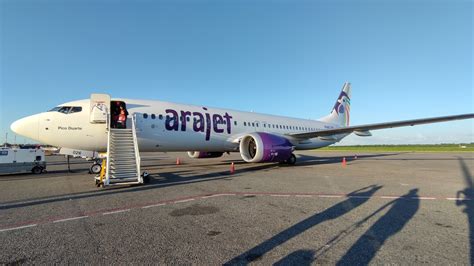
Bold Vision: The ‘Hub of the Americas’ Strategy
Central to Arajet’s blueprint is its dual-hub strategy, anchored in Santo Domingo and Punta Cana. The capital city’s Las Américas International Airport (SDQ) is intended to become a connecting hub for flights across the Americas, while Punta Cana—long a Caribbean tourist magnet—caters to high-volume leisure travel.
Arajet’s CEO, Víctor Pacheco, has made no secret of the airline’s aspirations. In an interview with Aviacionline, he underscored the strategic importance of building a reliable bridge to North America:
“We are on a mission to create the ‘Hub of the Americas’ in Santo Domingo, taking advantage of our geographic position. But our operations at our Punta Cana hub have also grown because of the tourism demand. For both of these parts of the business model, our connections to the United States are crucial.”
The goal is clear: by 2028, 50% of Arajet’s revenue is projected to come from North American routes—a bold target that underlines just how vital the US market is for the airline’s long-term viability.
Expanding Presence: Arajet’s Active and Upcoming US Routes
Arajet’s initial wave of US expansion has been swift. Following its Miami debut, the airline added Newark Liberty International Airport and San Juan, Puerto Rico, to its roster. Flights now operate from both Santo Domingo and Punta Cana to these destinations. Additional services will roll out in Fall 2025, including routes to Boston, Chicago, and Orlando.
Interestingly, Arajet’s Orlando flights will land at Orlando Sanford International Airport (SFB), a secondary facility not typically served by legacy carriers. Instead, it’s the stronghold of Allegiant Air, a fellow ULCC. This decision reflects Arajet’s strategy of avoiding high-cost primary airports and seeking underserved markets with cost efficiencies.

Arajet’s Active and Scheduled US Routes:
- Santo Domingo – Miami (Daily, Active)
- Santo Domingo – Newark (Daily, Active)
- Santo Domingo – San Juan (4x weekly, Active)
- Santo Domingo – Boston (4x weekly, Starts November)
- Punta Cana – Miami (6x weekly, Active)
- Punta Cana – San Juan (4x weekly, Active)
- Punta Cana – Chicago (3x weekly, Starts November)
- Punta Cana – Orlando Sanford (3x weekly, Starts October)
Arajet’s ability to scale from zero to eight US routes within 12 months is not just a demonstration of operational agility—it’s a strategic declaration. Yet, the airline isn’t stopping there.
11 New Route Applications: An Ambitious Move Toward National Connectivity
Arajet has officially submitted a request to the Junta de Aviación Civil (JAC), the Dominican Republic’s Civil Aviation Board, for permission to launch 11 additional US routes. These include several new cities that Arajet has never served before, spread across the continental United States.
These applications aim to connect three different Dominican airports—Santo Domingo (SDQ), Punta Cana (PUJ), and Santiago de los Caballeros (STI)—to key American cities, including:
- Atlanta (ATL)
- Denver (DEN)
- Houston (IAH)
- Los Angeles (LAX)
- Philadelphia (PHL)
- Providence (PVD)
- San Francisco (SFO)
These cities represent strategic additions to Arajet’s network, with most either being underserved by direct connections to the Caribbean or dominated by legacy players. In addition, flights from Santiago de los Caballeros—the Dominican Republic’s second-largest city—are likely aimed at tapping into the Dominican diaspora communities in cities like Newark and Miami.
Competitive Pressure and Market Landscape
With these new routes, Arajet is entering markets dominated by low-cost competitors like Spirit Airlines and Frontier, and legacy giants such as American, United, and Delta. The Dominican Republic has always been a highly trafficked leisure destination, but Arajet’s bid to compete on volume and price marks a shift toward affordable regional mobility.
What sets Arajet apart is not just price, but network design and scalability. Most competing carriers treat the Dominican Republic as a point-to-point vacation destination. Arajet, on the other hand, wants to make Santo Domingo a connecting hub, funneling traffic from Central and South America to the US through its geographic midpoint strategy.
This model mimics the success of airlines like Panama’s Copa Airlines, which uses Tocumen International Airport as a strategic hub for the Americas. But Arajet intends to do it with a low-cost structure, a far more aggressive bet.
The Backbone of Growth: Arajet’s Expanding 737 MAX Fleet
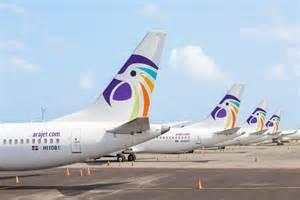
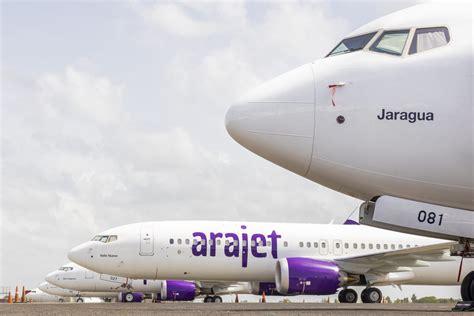
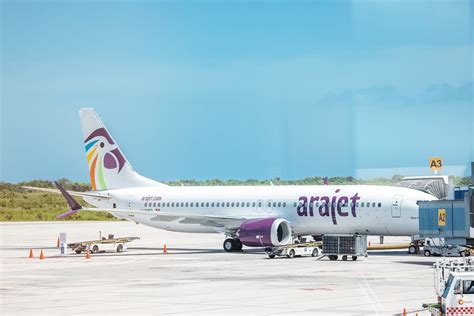
To support its booming route network, Arajet is reinforcing its fleet with next-generation aircraft. The airline currently operates ten Boeing 737 MAX 8s, each averaging just 4.5 years in age. The MAX 8 is renowned for its fuel efficiency, range, and seating capacity, making it an ideal choice for trans-Caribbean and North American routes.
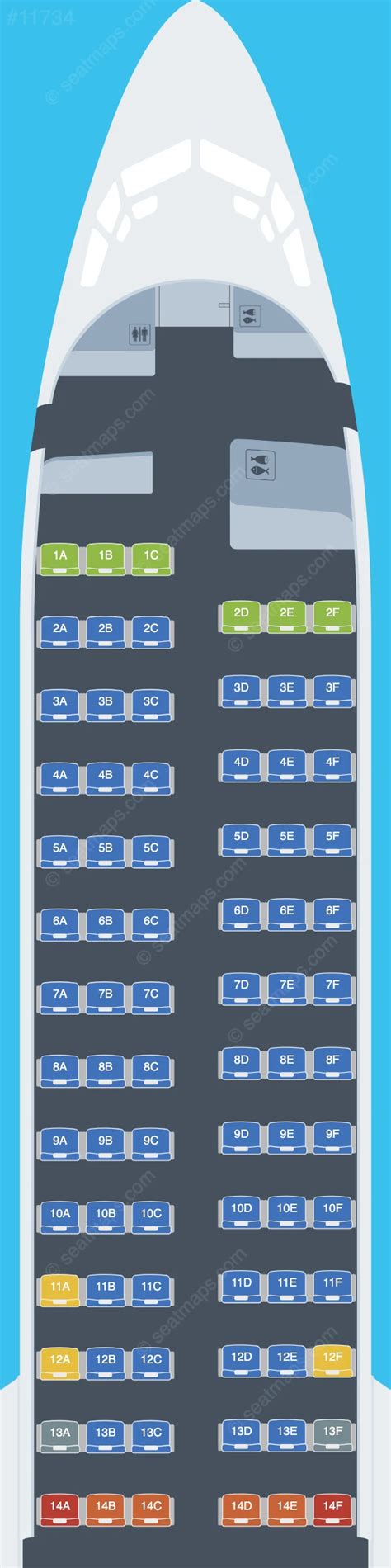
In June, Arajet signed a new lease agreement with BOC Aviation for five additional 737 MAX 8 aircraft. Three are scheduled to be delivered this year, with the remaining two arriving in 2026. On top of this, Arajet holds a firm order for 20 more MAX 8s directly from Boeing, with options for 15 further units.
It is anticipated that several of the upcoming aircraft will be of the 737-8-200 variant—a high-capacity configuration that seats up to 200 passengers in a single-class layout. This model has been adopted by Ryanair, VietJet, and Allegiant, and is optimized for low-cost, high-density markets.
This investment in hardware signals Arajet’s long-term commitment to becoming a dominant ULCC not only in the Caribbean but throughout the Americas.
Strategic Implications: A New Powerhouse in Regional Aviation
Arajet’s strategic moves are not occurring in a vacuum. The airline is capitalizing on growing demand for low-cost international travel, increasing diaspora traffic, and favorable regulatory changes. Its focus on building a low-cost, high-frequency hub-and-spoke system from the Caribbean is a unique proposition in the regional market.
If successful in securing all 11 proposed US routes and integrating them efficiently, Arajet could become the first Caribbean-based ULCC to operate a comprehensive North American network. This would not only benefit travelers with lower fares and new options but also inject competitive pressure on incumbents, pushing down prices industry-wide.
For now, much depends on regulatory approval, fleet delivery timelines, and market response. But if the current pace continues, Arajet may soon move from being a startup with potential to a central fixture in the Americas’ aviation ecosystem.
Conclusion: Eyes on the Skies, Feet on the Runway
Arajet is redefining what it means to be a Caribbean airline in the 21st century. By blending low-cost discipline, modern fleet choices, and a clear vision for continental connectivity, it is uniquely positioned to capture a growing share of both leisure and VFR (Visiting Friends and Relatives) traffic across the Americas.
With the US expansion gaining momentum, new fleet deliveries on the horizon, and an innovative dual-hub model in full swing, Arajet’s ambitions may soon translate into a new regional aviation powerhouse—one that connects the North and South through the heart of the Caribbean.