When we evaluate military compensation, raw base pay is only the opening chapter of a more complex financial story. The commonly cited figures labeled “Avg. Yearly Pay w/ Benefits” for enlisted ranks translate military income into a civilian-equivalent lens by assigning dollar values to allowances, healthcare, housing, retirement accrual, and other institutional benefits. This article explains what those converted numbers mean for enlisted sailors from E-1 through E-7, documents how the calculation is usually constructed, and provides pragmatic context so readers can make decisions that reflect both financial value and lived experience.
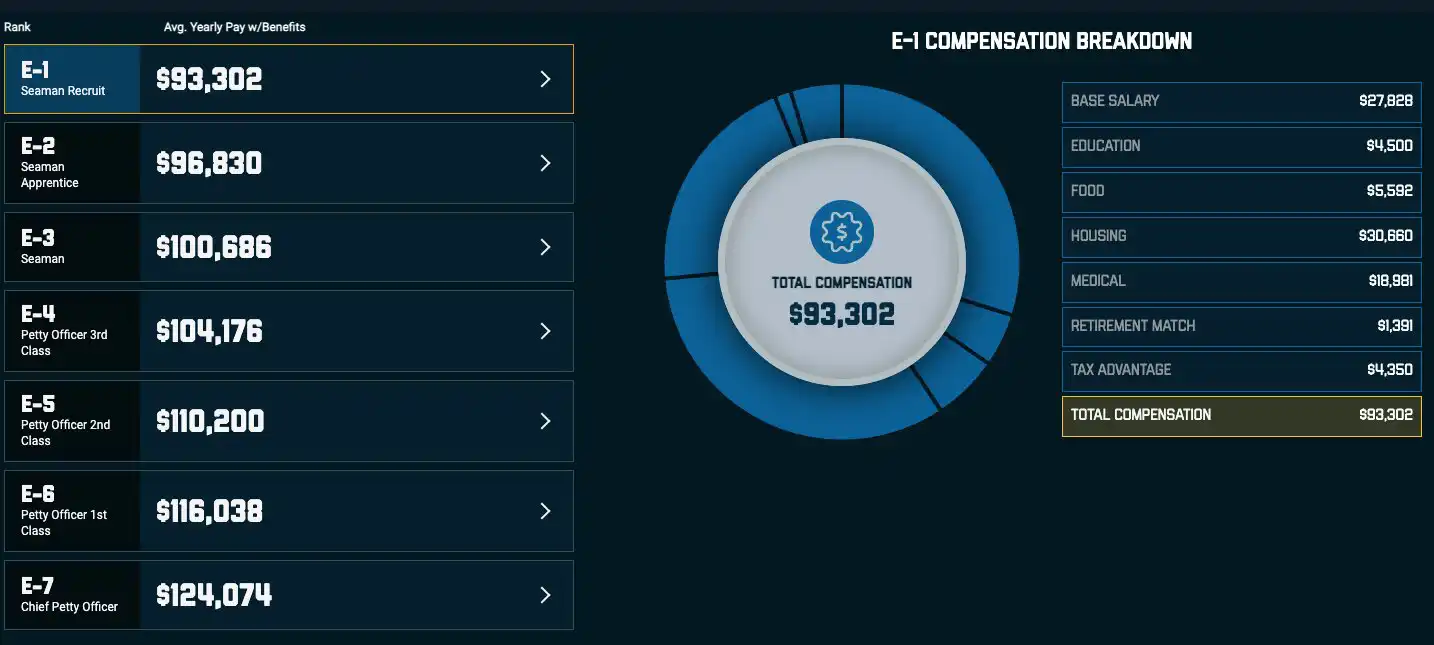
At the heart of the conversion is a simple idea: some forms of military compensation are nontaxable or provided in-kind, and those elements reduce living costs in ways a civilian salary must cover out of pocket. The figures commonly circulated — for example, an E-1 shown as approximately $93,302 annual civilian-equivalent, or an E-6 shown around $116,038 — bundle together base pay, Basic Allowance for Housing (BAH), Basic Allowance for Subsistence (BAS), employer-paid health care value, retirement accrual estimates, education assistance, and other benefits. These numbers are intended to show an economist’s view of how much it would cost a civilian employer to replicate the total package the sailor receives.
How the conversion from military pay to “with benefits” is typically constructed
We begin by distinguishing two classes of compensation: cash pay (taxable base pay and certain special pays) and non-cash / tax-advantaged value (untaxed allowances, health care, education, and retirement benefits). Analysts add the market-equivalent value of the non-cash items to cash pay to create a civilian-equivalent annual figure. For instance, BAH is often treated as an addition to gross income because a civilian would need to earn extra money to pay rent and utilities; TRICARE (military health care) is valued by estimating the employer’s premium for comparable private coverage; BAS is valued as free or subsidized meals; tuition assistance and GI Bill benefits are converted into a present-dollar education subsidy; and pension accrual is often estimated as an employer contribution. The resulting aggregate is presented as the “Avg. Yearly Pay w/ Benefits.”
What the published E-rank figures tell us — and what they don’t
The headline numbers are useful because they correct a frequent misunderstanding: a sailor who sees a modest figure on their LES (Leave and Earnings Statement) may nonetheless be receiving a much larger total compensation once benefits are monetized. For example, an E-3 listed near $100,686 in civilian-equivalent reflects not only base pay but also housing support and the value of medical care, which can be a large hidden subsidy. However, those numbers do not equate to take-home cash, and they are not equal to a guaranteed disposable-income stream a sailor can freely spend. These estimates rarely reflect the variability of individual circumstances — single versus married status, number of dependents, geographic location (BAH differs dramatically by duty station), or utilization of benefits (education assistance is only valuable if used). They also do not deduct the intangible costs of deployments, separation from family, and the irregular work schedules that make true work-hour equivalency difficult to calculate.
Tax treatment and why a Navy dollar often goes further
A salient feature behind inflated civilian-equivalent numbers is tax advantage. Untaxed allowances such as BAH and BAS reduce a sailor’s taxable income relative to identical cash wages paid to a civilian employee. That means a sailor keeping $37,000 in untaxed housing allowance has a higher net standard of living than a civilian with the same gross paycheck taxed at federal and possibly state rates. Furthermore, TRICARE and military dental/vision substantially lower out-of-pocket healthcare expenses. When analysts convert a sailor’s package into a civilian-equivalent salary, they often add the market cost of private insurance and after-tax housing costs, producing a figure that feels large compared to base pay. Yet that conversion assumes full utilization of those benefits; for an unmarried sailor living in barracks or on ship, some of that supposed “value” is not directly received as spendable income.
Promotion, longevity, and the compound effect on compensation
One of the long-term financial strengths of military service is structural predictability. Promotion timelines and periodic pay raises create a stair-step income path: a junior sailor can reasonably forecast raises, increases in BAH with family changes, and pension accrual should they complete a career. That predictability is the bedrock of the pension calculation that makes a 20-year career financially attractive; employer-like contributions to retirement and access to the Thrift Savings Plan (TSP) accelerate retirement readiness compared to many civilian jobs without defined-benefit components. The civilian-equivalent figures for higher enlisted ranks (for instance, E-7 shown as $124,074) reflect both higher base pay and larger associated benefits accrued over time. Still, this compound effect depends on retention: the first few years show steep relative gains as pay charts and allowances scale with rank and years of service.
Operational tempo, hours worked, and the hidden cost of compensation
Numbers are one side of the ledger; time and risk are the other. Many sailors report duty cycles and extended workweeks that far exceed standard civilian schedules. The time-cost, separation from family, and mental-health toll of repeated deployments or austere working conditions are real and can reduce the utility of higher nominal compensation. When an analyst divides the civilian-equivalent pay by total hours on duty (including watches, drills, and often unpaid standby time), the effective hourly rate for some sailors plummets. Conversely, sailors who are stationed ashore, qualify for locality or special pays, or are married and claim BAH can achieve a much stronger economic position. The takeaway is that compensation must be considered alongside workload and life quality; money alone does not buy well-being if the job exacts continuous personal sacrifice.
Caveats and common misinterpretations to avoid in recruitment and personal planning
We consistently see two distortions: first, recruiters sometimes present the civilian-equivalent number as a guaranteed take-home wage, which it is not. Second, critics compare base pay to civilian salaries without accounting for allowances and health coverage, which understates military value. Responsible planning requires distinguishing between net spendable pay and total compensation value. For example, juniors living in barracks may not benefit from BAH, and single sailors who do not plan to use tuition assistance or move to expensive duty stations will have materially different outcomes than the average. Additionally, geographic nuances matter: BAH in San Diego or Hawaii may be several times a rural duty station; thus, two sailors at the same rank and paygrade can have drastically different cost-of-living and net-savings outcomes.
Practical examples across E-1 to E-7 (how to read the numbers)
If we take the publicized civilian-equivalent values at face value, an E-1 monetized at roughly $93k is reflecting a package that imputes housing and healthcare; an E-4 at about $104k shows the cumulative effect of early-rank pay increases and allowances; an E-6 near $116k and an E-7 around $124k reveal both paygrade increases and the growing market-equivalent valuation of benefits and pension accrual. For financial planning, it is better to convert these estimates back into two practical numbers: (1) expected annual net spendable income after taxes and mandatory deductions, and (2) annual benefit value that reduces personal expenses (healthcare premiums, housing, meals). Together they form a realistic picture for comparisons against civilian job offers.
Decision framework: when the Navy’s compensation makes sense and when it may not
We advise approaching the decision to join or stay with a three-part framework: finances, career trajectory, and personal alignment. Financially, if a candidate values low out-of-pocket healthcare, predictable housing assistance, tuition aid, and a strong retirement system, the Navy package — when properly accounted — can beat many early-career civilian paths. From a career perspective, technical training, credentialing programs, and guaranteed promotion lanes for certain rates add long-term human capital value beyond immediate pay. On alignment, if the candidate prioritizes family stability, predictable hours, or the freedom to relocate at will, the service lifestyle may conflict with those goals. No salary figure, however flattering, should obscure the lived tradeoffs of military life.
Conclusion: use the numbers, but mind the context
The “Avg. Yearly Pay w/ Benefits” figures are powerful tools when interpreted correctly: they reveal the market-equivalent cost of a sailor’s total compensation and help translate military packages into civilian comparisons. Yet they are not a substitute for a personalized budget, nor do they capture the subjective costs of service. We recommend anyone evaluating enlistment or reenlistment compute both their likely net spendable income and the monetized benefit value based on their projected duty station, family status, and intended benefit usage. That two-pronged approach will show whether the Navy’s offer is a short-term stepping stone or the foundation of a long-term, secure financial life.
For planners and families, the most useful action is a simple one: model your personal scenario. Replace national averages with your expected BAH, family size, and projected use of education benefits. That transforms a headline number into a realistic forecast — and gives you the clearest answer to the question every recruit and career sailor ultimately asks: how much will military service improve, or complicate, my life?