Understanding Baulked Landings
A baulked landing, often called a rejected landing, is a go-around maneuver initiated from a very low altitude, sometimes even after the aircraft has touched down. Typically, this maneuver occurs when the aircraft is in a low-energy state, making it a high-risk action that demands careful handling. While there isn’t a universally accepted definition for baulked and rejected landings, various National Aviation Authorities (NAA) have their own guidelines for training and procedures related to these situations.
Definitions
According to Transport Canada, a rejected landing is defined as a discontinuation of the landing attempt, usually occurring at low altitude before touchdown. This maneuver can happen in both visual meteorological conditions (VMC) and instrument meteorological conditions (IMC). A rejected landing often leads to a missed approach. Conversely, a baulked landing also refers to a discontinued landing attempt but emphasizes the need to consider the aircraft’s configuration and performance. Although the definitions are similar, this article will focus on the climb performance aspect of a baulked landing.
Criteria for Baulked Landings
During the certification of any aircraft, its performance is evaluated under various weights, configurations, and flight profiles. The Aircraft Flight Manual (AFM) outlines the safe operational limits for the aircraft. Contrary to popular belief, aircraft are not certified to perform a go-around from any point during the landing phase. Specifically, once an aircraft enters the low-energy landing regime—defined by factors such as flap and landing gear configuration, descent thrust being idle, decreasing airspeed, and being 50 feet or lower above the runway—a successful go-around cannot be guaranteed.
Decision-Making in Baulked Landings
A baulked landing is essentially a last-minute decision to go around. This decision can arise from various factors, including:
-
Loss of visual references due to fog or snow
-
Long landings after excessive floating or tailwind operations
-
Bounced landings or strong crosswinds
-
Runway incursions by other aircraft or vehicles
-
Any situation where a safe landing seems unattainable
Risks Involved
There are two main risks associated with baulked landings: the aircraft’s initial performance and climb capability, and obstacle clearance, particularly in IMC conditions. Touching down after initiating a baulked landing further elevates these risks, especially if the pilot decides to abandon the go-around and attempt to complete the landing.
Obstacle Clearance
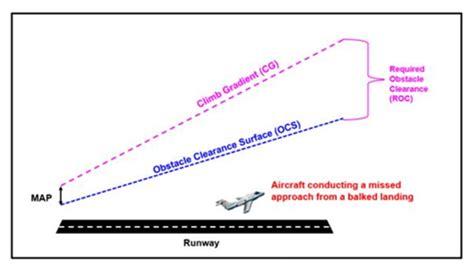
A baulked landing typically starts well below the Missed Approach Point (MAP), which can complicate obstacle clearance. This poses a significant risk of controlled flight into terrain (CFIT), especially at night or in IMC.
Aircraft Performance During Baulked Landings
For most aircraft, standard go-around procedures involve selecting maximum thrust, adjusting pitch attitude, and retracting flaps. However, during a baulked landing, engines are idling, and airspeed may drop below the reference speed (V ref). It’s crucial to recognize that the engines require time to spool up, which can delay thrust generation and increase the risk of tail strikes or aerodynamic stalls if standard go-around actions are followed without caution.
Mitigation Strategies
To reduce risks during a baulked landing, flight crews must focus on both aircraft handling and ensuring obstacle clearance. Here are some recommended actions:
-
Apply maximum thrust and increase pitch to halt or slow descent without attempting to climb or retract flaps until engines are spooled up and airspeed is increasing.
-
If the aircraft touches down, maintain the attitude and thrust until reaching V ref before adjusting for climb.
-
Avoid reversing the go-around decision, as this could lead to a runway excursion.
Summary
Baulked landings are infrequent but carry high risks. Modified go-around procedures are essential to prevent loss of control. Additionally, obstacle clearance strategies should be implemented to minimize CFIT risks.
Real-World Incidents
Numerous incidents highlight the dangers of baulked landings:
-
A320, Hamburg, Germany (2008): An A320 experienced a bounced landing and successfully executed a rejected landing after a strong crosswind.
-
B773, Dubai, UAE (2016): A Boeing 777-300 attempted a go-around but lost control due to a failure to respond to thrust commands.
-
A306, East Midlands, UK (2011): An Airbus A300-600 made a bounced touchdown and attempted a go-around with inadequate thrust management.
-
B77L, Copenhagen, Denmark (2011): A Boeing 777F bounced multiple times during landing, ultimately leading to damage from tail strikes.
-
A320, Varadero, Cuba (2010): An A320 landed on a flooded runway, drifting off but returning safely without injuries.
By understanding these principles and learning from past incidents, flight crews can better prepare for the complexities of baulked landings.