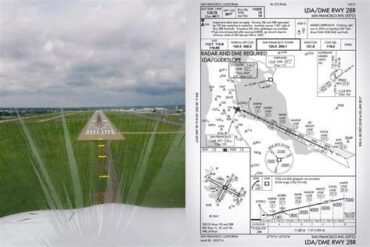
Localiser Performance with Vertical Guidance (LPV) refers to a type of instrument approach that provides vertical guidance without needing to meet the strict precision standards set by ICAO Annex 10. It gives pilots essential information about both course and glidepath deviations, helping them land safely.
LPV is part of Area Navigation (RNAV) Approach minima, available in various locations worldwide. These approaches share many features with Instrument Landing System (ILS) approaches. The key difference lies in the source of guidance signals. ILS relies on ground-based transmitters and antennas for each runway, while LPV uses Global Navigation Satellite System (GNSS) signals from space. This allows multiple aircraft to receive guidance simultaneously at different locations.
To execute an LPV approach, aircraft follow a coded Final Approach Segment (FAS) defined by specific points. The FAS includes the Flight Path Alignment Point (FPAP) and the Landing Threshold Point (LTP), which accurately define the runway’s threshold and centerline. The approach is also guided vertically by the Threshold Crossing Height (TCH) and Glide Path Angle (GPA). Approaches can be initiated through various transitions, including Precision-Area Navigation (P-RNAV) or radar vectoring.
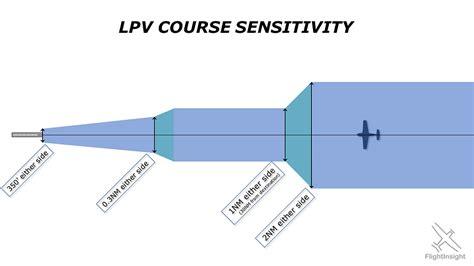
To ensure accuracy, the GNSS signal is enhanced by a Satellite Based Augmentation System (SBAS), like WAAS or EGNOS. These systems improve the guidance’s precision, allowing approaches down to a decision altitude (DA) while accommodating a slight “duck under” if a Go Around is necessary. As the aircraft nears the runway, the angular guidance becomes narrower and more sensitive, similar to ILS. For LPV minima usage, the aircraft must have an LPV-capable Flight Management System (FMS) and a compatible SBAS receiver.
LPV minima benefit from the enhanced guidance and integrity provided by SBAS, allowing for approach design criteria similar to ILS. They can feature a decision altitude as low as 200 feet above the touchdown zone elevation, with visibility minimums reaching 1/2 mile, depending on terrain and airport infrastructure.
Numerous airports in Europe, the U.S., and Canada have designed and certified RNAV approaches, including those with LPV minima. These new approaches often provide Category I ILS capabilities at sites where traditional ILS installations were not feasible. As of June 2019, nearly 4000 RNAV approaches with LPV minima existed in the United States, over 1100 of which served airports without prior ILS capability.
The lateral guidance from LPV is comparable to a localizer, but its protected area is much smaller than that of current LNAV or LNAV/VNAV approaches. An aircraft’s authorization to fly to LPV minima depends on a statement in its Aircraft Flight Manual (AFM) confirming that the equipment supports LPV approaches. Approval and training requirements vary by National Aviation Authority (NAA).