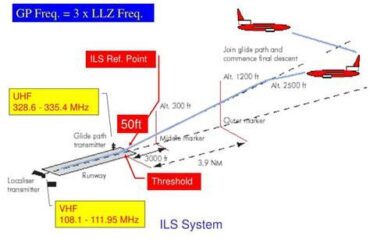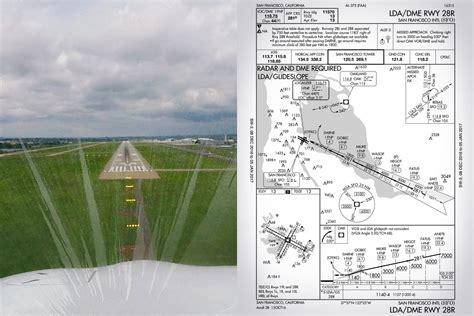
Localiser (LOC) and Localiser Type Directional Aid (LDA) approaches are essential tools for pilots, providing non-precision runway guidance through a single ground-based radio beam. These systems offer horizontal assistance during landing but generally do not include vertical guidance. The localiser gives azimuth guidance, while additional aids like non-directional beacons, marker beacons, and high-intensity runway lights may also assist pilots in positioning themselves for the approach. Recently, many beacons have been replaced by Distance Measuring Equipment (DME), which can be paired with the localiser antenna or located elsewhere, such as with a VOR.
Typically, LOC antennas are found at the runway’s end. However, if obstacles or noise-sensitive areas interfere, they may be placed differently. These antennas emit two narrow beams that slightly offset from the intended course centerline. Where these beams intersect defines the “on LOC” indication, displayed on the aircraft’s instruments. This setup helps pilots see how far off course they might be.
A localiser approach can be a stand-alone option or a fallback for an Instrument Landing System (ILS) if the glide slope is out of service. The International Civil Aviation Organisation (ICAO) specifies that localiser offsets cannot exceed 5° from the extended runway centerline. Meanwhile, the Federal Aviation Administration (FAA) has set a stricter limit of 3°. If the offset exceeds these limits, the approach becomes a Localiser Type Directional (LDA) approach.
LDA approaches feature greater runway centerline offsets. They are designed to allow for maneuvering during the visual segment from the localiser to the runway. The approach ensures that the localiser track intersects the runway centerline at a distance that depends on the offset angle. A larger offset means a further interception point from the runway threshold. If the offset angle exceeds 30°, the procedure is classified as a circling approach, particularly for C and D category aircraft, which have even lower thresholds. Occasionally, LDA approaches may include vertical guidance through a glide slope and can be termed Instrument Guidance System (IGS) approaches.
Most LOC and LDA approaches do not provide vertical guidance. Transitioning to the intermediate approach segment can occur through radar vectors, Standard Arrival Routing (STAR), published transitions, or procedure turns. Once cleared for the approach, pilots must follow the vertical profile shown on the approach chart. This profile often includes “step down” fixes, each with a designated crossing altitude to ensure safe terrain clearance. Pilots need to respect these altitudes and plan to be level at the published final approach fix (FAF) crossing altitude, configured for landing, before reaching the FAF.
The final approach segment’s vertical profile is defined by the FAF crossing altitude and the appropriate minimum descent altitude (MDA) for the aircraft category. There may also be additional step down fixes after the FAF to maintain obstacle clearance. Traditionally, non-precision approaches were flown using a “dive and drive” method, where pilots descend to each designated fix altitude before leveling off. This technique can complicate achieving a stabilized approach and has contributed to Controlled Flight Into Terrain (CFIT) accidents. However, Continuous Descent Final Approach (CDFA) procedures have been introduced to mitigate these risks. In CDFA, equipped aircraft can descend at a specified angle from a defined point and initiate a missed approach based on altitude rather than position, significantly enhancing safety.