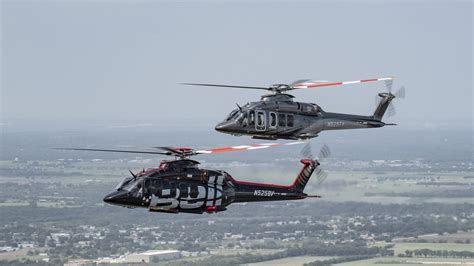
The Bell 525 Relentless stands as a groundbreaking project in rotorcraft engineering—an aircraft designed to bridge a critical gap between performance, safety, and operational versatility in the super-medium helicopter segment. Engineered by Bell Textron, a legacy manufacturer in the aerospace industry, the Bell 525 is the first commercial helicopter in history to feature fly-by-wire controls, setting a new standard for modern rotorcraft systems. Despite a turbulent developmental history, the aircraft is now approaching certification with promising applications in offshore operations, executive transport, and potentially military utility.
A Bold Vision: Origins and Purpose of the Bell 525
The inception of the Bell 525 Relentless dates back to 2012, when Bell publicly introduced the project at the Heli-Expo in Dallas, Texas. Internally known as Project X and later Magellan, the Bell 525 was conceived to serve the niche between medium-lift and heavy-lift helicopters—a segment often underserved in both range and payload.
This super-medium helicopter was designed to complete missions ranging between 50 to 500 nautical miles, a common operational profile in offshore oil and gas logistics, VIP airlift, and even paramilitary applications. By balancing long-range performance, ample passenger capacity, and cutting-edge avionics, the 525 aimed to outclass existing competitors like the AgustaWestland AW189, Sikorsky S-92, and Airbus H175.
Flight-by-Wire Revolution: The First of Its Kind
Perhaps the most distinguishing feature of the Bell 525 is its fly-by-wire flight control system—a technology borrowed from high-performance jets but never before applied in a civilian helicopter. This system replaces traditional mechanical linkages with electronic controls that allow for:
- Precise, computer-assisted handling.
- Tactile cueing and automated stabilization.
- Enhanced safety during adverse weather and engine-out scenarios.
- The potential for single-pilot operations in the future.
Developed with triple redundancy and tested in parallel simulators, this system offers unprecedented responsiveness and situational awareness, particularly when paired with the Garmin G5000H touchscreen avionics suite.
Tragedy and Setback: The 2016 Crash
The path to certification, however, was marred by a tragic incident on July 6, 2016, when the Bell 525 prototype (N525TA) broke up in mid-air during a high-speed test flight near Italy, Texas. The aircraft was flying at approximately 229 mph at 2,000 feet AGL when a 6 Hz vibration in the rotor system triggered a catastrophic biomechanical feedback loop, overwhelming the pilot and control systems.
The accident, which claimed the lives of both test crew members, stemmed from a simulated one-engine-out scenario involving special software that reduced power output from both turbines. The crash delayed FAA certification significantly, pushing Bell’s original 2017 projection into the late 2020s.

Rebound and Recovery: Engineering Revisions and Testing Milestones
Post-crash, Bell collaborated closely with the FAA and NTSB, incorporating engineering changes and procedural safeguards into the 525’s design. These included:
- Updated rotor harmonics analysis and rotor dampening techniques.
- Pilot feedback isolation mechanisms.
- Advanced vibration monitoring software.
By December 2018, the fleet had accumulated over 900 flight hours and 1,300 hours of run time. In early 2019, cold-weather performance trials began in Yellowknife, Canada, validating the helicopter’s capabilities under arctic operational conditions. Bell also performed extensive icing simulations to meet all-weather mission requirements.
Design and Configuration: Super-Medium Done Right
The Bell 525’s airframe is a modern mix of composite and metal, optimized for strength and weight efficiency. Its five-blade composite main rotor, combined with two GE CT7-2F1 turboshaft engines, delivers up to 3,600 shaft horsepower and propels the aircraft to a maximum speed of 190 mph (165 knots).
Key Performance Metrics
- Maximum Takeoff Weight: 20,500 lbs (9,300 kg)
- Passenger Capacity: 16 standard / 20 high-density
- Range: 644 miles (560 nautical miles)
- Fuel Capacity: 650 U.S. gallons
- Service Ceiling: 20,000 feet
- Cruise Speed: 155 knots
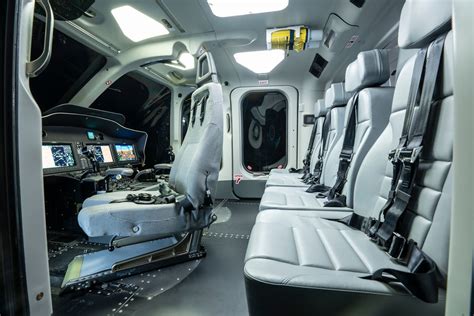
Internally, the aircraft is configured for dual-pilot operations with a spacious cabin that can be adapted for VIP, offshore utility, SAR, or military missions. Category A takeoff and landing certification ensures operational reliability even during engine-out scenarios at max gross weight.
Offshore Market Positioning: Targeting Oil & Gas and VIP Transport
From its inception, the Bell 525 has been squarely aimed at the offshore oil and gas industry, a sector requiring high-reliability, long-range helicopters that can fly in challenging maritime environments. Bell reports that over 50% of expected customers will come from this sector alone.
In 2024, the helicopter secured its first major customer, with Norwegian energy company Equinor ordering ten units for deployment in the North Sea. Deliveries are scheduled for the late 2020s, marking a significant commercial milestone. Equinor’s selection of the Bell 525 was influenced by its three-decade relationship with Bell and the aircraft’s advanced safety architecture, including fly-by-wire and superior performance over long overwater segments.

Military and Government Use: The Missed UK Opportunity
Although primarily civilian in focus, Bell has also promoted the 525 as a multi-role military utility helicopter, capable of troop transport, medical evacuation, and search and rescue. Its ability to carry up to 20 personnel makes it attractive for rapid deployment and logistics missions.
In 2021, Bell pitched the 525 for the UK Ministry of Defence’s New Medium Helicopter (NMH) program, designed to replace aging SA330 Puma helicopters. However, Bell’s offering failed to pass the pre-qualification questionnaire stage, with British defense planners favoring platforms already certified and in production.
Despite this setback, the 525 remains a contender for future government procurement projects, especially in countries prioritizing modern avionics and reduced pilot workload.

Fly-by-Wire vs Traditional Controls: A Transformational Leap
The use of fly-by-wire in helicopters is a watershed moment for rotorcraft engineering. Traditional helicopters rely heavily on manual cyclic and collective inputs, which introduce pilot fatigue and susceptibility to human error during prolonged missions or emergency procedures.
In contrast, fly-by-wire systems in the Bell 525 enable:
- Active stabilization that compensates for environmental disturbances.
- Simplified control logic, making pilot training easier and operations safer.
- Data-driven maintenance alerts to preempt system failures.
This approach mirrors trends in fixed-wing aviation, where digital control systems have long been the norm in commercial airliners like the Airbus A320 and Boeing 787.

Outlook and Future Readiness
As of mid-2024, Bell has completed the majority of certification flight tests, and is actively working with the FAA to finalize Type Certification for commercial deliveries. While a price point for the 525 has not been officially disclosed, Bell has suggested it will be cost-competitive with legacy aircraft such as the AW139 and Sikorsky S-92 across missions between 50–400 nautical miles.
Once certified, the Bell 525 is expected to gain significant market traction in:
- Offshore logistics and crew changeovers
- Executive transport and VIP charter
- Air ambulance and search and rescue
- Government and border patrol operations
Conclusion: A Relentless Path Toward Rotorcraft Evolution
The Bell 525 Relentless represents a decade-long journey of innovation, adversity, and resilience. By introducing advanced technologies such as fly-by-wire flight controls, composite rotor systems, and modular mission capabilities, the Bell 525 is poised to redefine operational standards in the super-medium helicopter category.
While delays and setbacks have tested Bell’s resolve, the upcoming certification marks a pivotal moment not only for the aircraft but also for the future of vertical flight. In an industry where reliability, efficiency, and safety are paramount, the Bell 525 Relentless may soon take its place as one of the most sophisticated civilian helicopters ever built.