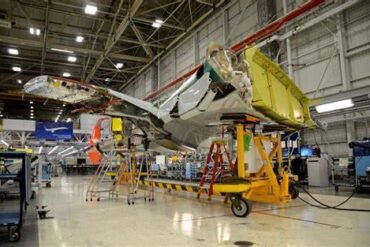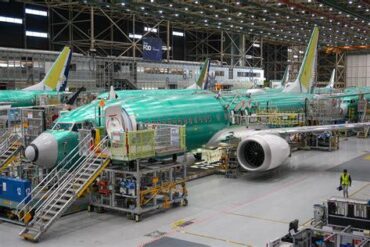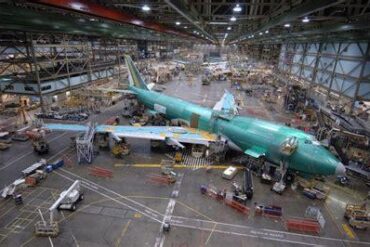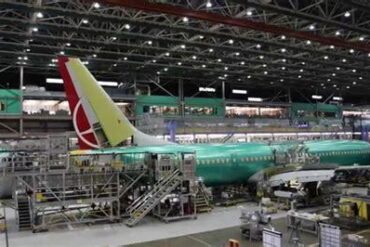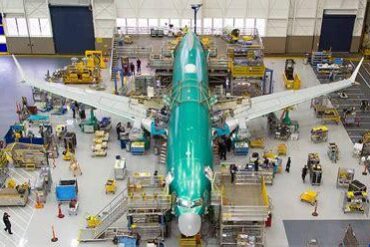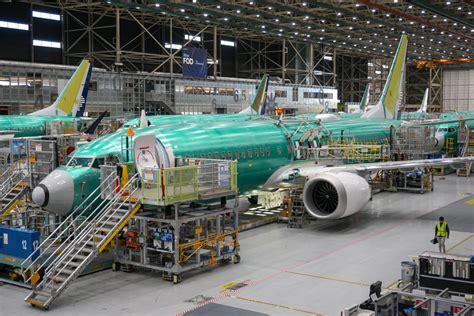
Boeing is preparing a structural shift in its narrowbody manufacturing strategy by bringing a fourth 737 MAX final assembly line to Everett, Washington. Known internally as the North Line, the facility will mark the first time the 737 has been assembled outside Renton, the program’s historic home. While the expansion signals confidence in long-term demand, production targets remain constrained by regulatory oversight and the practical realities of stabilizing output.
For decades, Renton has been synonymous with the 737. Now, Boeing is leveraging available widebody space in Everett to build resilience into its most important commercial program. The North Line is scheduled to come online in mid-summer 2026, but it will not immediately accelerate aircraft deliveries. The company must first staff, train, and stabilize the operation under heightened scrutiny from the Federal Aviation Administration (FAA).
This move is less about speed and more about durability. Boeing’s leadership has framed the Everett expansion as a capacity and resilience measure rather than a rapid growth lever. In the current environment, production increases are directly linked to demonstrable quality improvements, not ambition.
Everett’s North Line: A Strategic Shift Beyond Renton
The Everett facility offers Boeing something Renton cannot: additional physical headroom and workforce flexibility. By utilizing freed-up widebody production space, Boeing reduces single-site risk while expanding its labor pipeline. Everett’s experienced workforce, long associated with the 747, 767, 777, and 787 programs, provides a deep reservoir of manufacturing expertise.
Yet the North Line’s activation does not automatically translate into higher monthly output. Before Boeing can seek approval for rate increases, it must demonstrate repeatable quality at the FAA-approved production ceiling of 42 aircraft per month in Renton. Only after proving sustained performance at that level can the company pursue approval to rise to 47 jets per month, a milestone now expected in 2027 rather than sooner.
The FAA’s post-2024 oversight framework effectively places quality metrics ahead of production ambition. Rate increases are conditional, not automatic. Supplier readiness, inspection compliance, and production consistency all serve as gating mechanisms. Everett’s role, therefore, is to support a longer-term pathway toward Boeing’s stated ambition of 63 737 MAX aircraft per month, not to accelerate near-term output.
Production Delays Reshape The 737 MAX Ramp
The revised production timeline carries financial consequences. The 737 MAX program remains Boeing’s primary cash engine. Slower rate ramps translate into slower delivery growth, limiting how quickly the company can reduce its substantial order backlog.
In practical terms, the North Line will begin as a stabilizing force rather than a volume driver. Early production will likely focus on workforce training and process validation. This staged activation reduces the risk of rework and quality escapes while forcing suppliers to scale in coordination with Boeing’s internal teams.
The delay also underscores a broader shift in tone within Boeing’s commercial strategy. Where aggressive ramp-ups once defined narrowbody expansion, the current environment prioritizes regulatory alignment. Airlines awaiting deliveries are being signaled that additional capacity is coming, but only according to the regulator’s timeline.
Financial And Operational Stakes For 2026
Boeing has outlined 2026 as a pivotal year. The company aims to stabilize 737 production at 42 per month, complete key certification programs, and return to positive free cash flow. The Everett North Line fits directly into this strategy by providing long-term scalability while reinforcing short-term operational discipline.
Beyond the 737, Boeing is targeting stabilization of the 787 Dreamliner at eight aircraft per month. Enhanced 787 variants are expected to begin delivery in the first half of the year, supporting higher-yield long-haul routes for airline customers. At the same time, certification campaigns for the 737 MAX 7 and 737 MAX 10 remain central objectives for 2026, with progress on the 777X continuing through flight testing using production-standard aircraft.
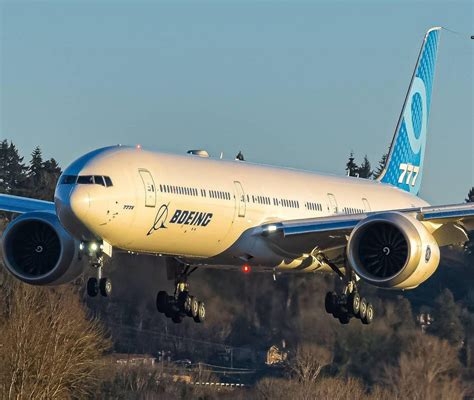
Each of these milestones intersects with regulatory review. Certification approvals, production rate increases, and quality audits now operate in tighter alignment than in previous cycles. The integration of Spirit AeroSystems, a major fuselage supplier, adds another layer of complexity as Boeing works to streamline manufacturing oversight and internalize quality controls.
A Capacity Play With Long-Term Implications
The decision to expand 737 production into Everett is a structural hedge against future bottlenecks. Concentrating all narrowbody assembly in Renton created single-site exposure. By diversifying production geography within Washington state, Boeing reduces operational vulnerability and strengthens workforce continuity.
Over the long term, Everett could serve as a critical lever for reaching the 63-per-month ambition. However, that outcome depends less on physical factory capacity and more on sustained quality performance, regulatory confidence, and synchronized supplier output.
In the near term, expectations remain tempered. The 47-per-month milestone appears more likely in 2027, pushing meaningful delivery acceleration further into the future. For airlines, this reinforces a steady but measured ramp rather than a sudden surge in available aircraft.
Boeing’s North Line represents confidence in the enduring demand for the 737 MAX, but it also reflects a recalibrated philosophy. Growth is now paced by stability. Expansion is gated by proof. And production targets, once framed by ambition, are increasingly defined by compliance and resilience.