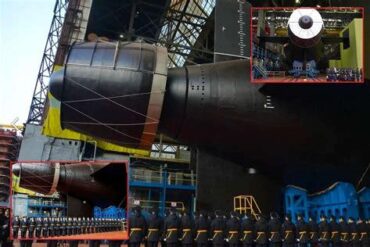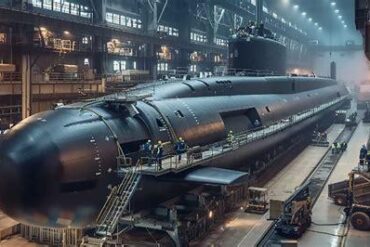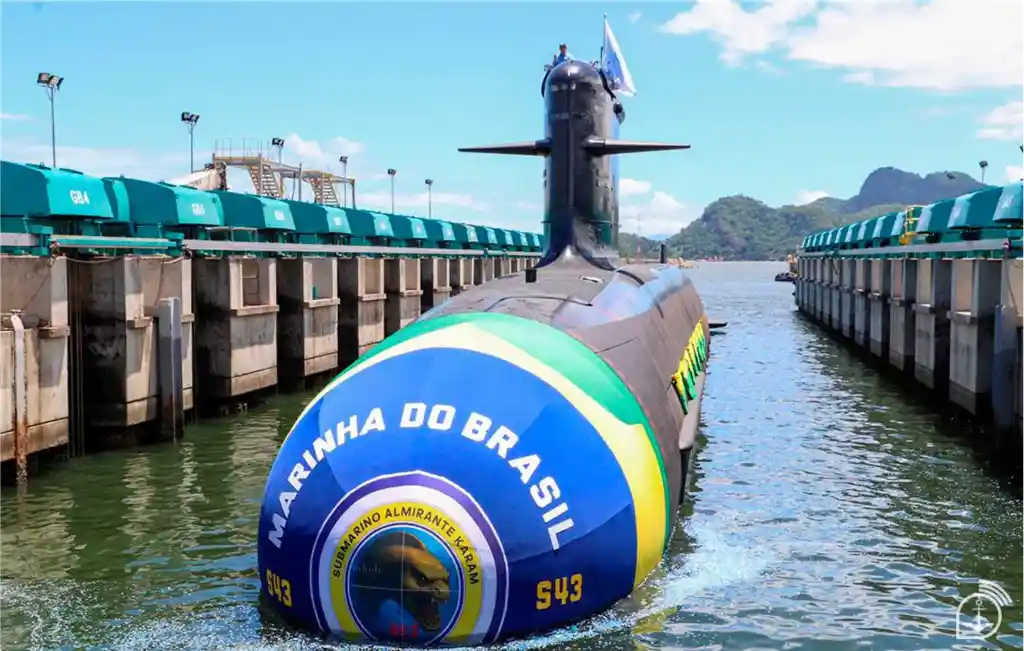
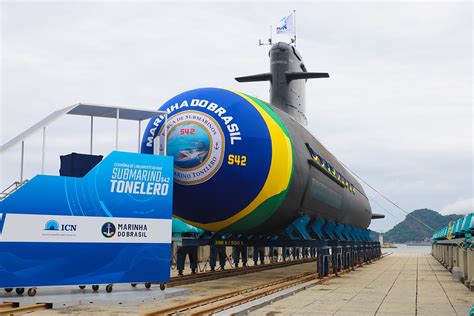
Brazil’s submarine modernization effort reached a decisive turning point with the launch of the Almirante Karam S43, the final conventional unit of the PROSUB program, during a high-profile ceremony at the Itaguaí Naval Complex. The event, held on November 26, 2025, also showcased the Tonelero S42 entering its armament phase, symbolizing the completion of Brazil’s diesel-electric construction cycle and the beginning of full-scale focus on its first nuclear-powered attack submarine, the Álvaro Alberto.
The launch of Almirante Karam serves as the capstone to a multiyear industrial transformation that began in 2008, when Brazil partnered with France’s Naval Group to create PROSUB—an initiative designed not only to build submarines but also to ignite sovereign technological capability. The Itaguaí Naval Complex and its associated shipbuilder, ICN, emerged from this partnership, enabling Brazil to shift from reliance on foreign acquisition to independent submarine construction. This industrial leap paved the way for a new generation of locally assembled vessels and a rising domestic defense ecosystem.
The official unveiling of S43 also affirmed Brazil’s sustained investment in its maritime deterrence strategy. As the vessel slipped into the waters of Itaguaí, naval officials highlighted the symbolic and operational importance of completing the conventional S-BR fleet, a necessary milestone before fully committing the country’s engineering, nuclear, and defense resources to the far more complex Álvaro Alberto.
S-BR Class Submarines: Backbone of Brazil’s Modern Undersea Fleet
The S-BR class—comprising Riachuelo (S40), Humaitá (S41), Tonelero (S42), and Almirante Karam (S43)—is derived from the French Scorpène platform, but the Brazilian variations incorporate extensive local adaptations. Each S-BR submarine stretches 71.6 meters in length and displaces roughly 1,870 tons submerged. They are optimized for stealthy operations across Brazil’s massive Exclusive Economic Zone, an area rich in oil assets, shipping lanes, and strategic chokepoints.
The class features six 533 mm tubes supporting both F21 heavyweight torpedoes and SM39 Exocet anti-ship missiles, offering flexible lethality against surface and subsurface threats. A Brazilian-tailored combat management system enhances sensor fusion and situational awareness, integrating advanced sonar arrays and electronic warfare components suited to South Atlantic conditions. The result is a modern, quiet, and agile vessel capable of extended underwater endurance within the limits of diesel-electric propulsion.
Transition to Nuclear Power: The Álvaro Alberto Era
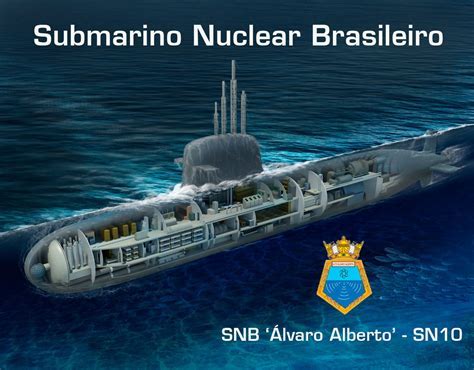
With S43 now afloat, PROSUB turns entirely to its most ambitious undertaking: the construction of the Álvaro Alberto, Brazil’s first nuclear-powered attack submarine (SNCA). Designed to exceed 100 meters in length and displace over 6,000 tons submerged, this platform represents a qualitative leap in regional naval capabilities.
The Álvaro Alberto project relies on an indigenously developed nuclear propulsion system under the direction of the Navy’s Technological Center in São Paulo and the National Nuclear Energy Commission. Nuclear propulsion will provide unmatched submerged endurance and global-range patrol capability—an attribute no other nation in the Southern Hemisphere has ever achieved independently.
Fleet Structure and Strategic Impact
By late 2025, the Brazilian Navy operates four diesel-electric submarines, including two active S-BR units (Riachuelo and Humaitá) and two older German-origin Type 209 boats, Tupi and Tikuna. Once Tonelero and Almirante Karam complete trials, Brazil will field four fully operational S-BR platforms. The eventual commissioning of the Álvaro Alberto will raise the force to six advanced submarines, blending conventional stealth with nuclear endurance.
This emerging structure positions Brazil as the strongest undersea power in Latin America and one of the most capable in the Southern Hemisphere. From the Submarine Base Admiral Castro e Silva in Rio de Janeiro, Força de Submarinos (ForSub) will direct long-range patrols, protect offshore energy infrastructure, secure undersea cables, and participate in multinational exercises.
Industrial and Technological Transformation Under PROSUB
Beyond military capability, PROSUB has reshaped Brazil’s industrial landscape. More than 40 companies contribute to submarine components and systems, supporting thousands of skilled jobs and advancing expertise in metallurgy, systems integration, nuclear propulsion, and underwater warfare technologies. The nuclear program has also stimulated research in reactor miniaturization, naval-grade fuel cycles, and acoustic signature reduction.
The initiation of the SNCA makes Brazil the first country in the Southern Hemisphere to pursue and build a domestically designed nuclear-powered attack submarine. This places the nation among an elite group of naval powers with both the technical and industrial base required for sustained nuclear naval operations.
South Atlantic Strategy and the Path Ahead
Brazil’s decision to expand its submarine force reflects a broader maritime strategy acknowledging the rising geopolitical importance of the South Atlantic. As global competition over strategic resources increases, and as oceanic trade routes face new pressures, Brazil aims to leverage a modern undersea fleet capable of long-duration operations and covert deterrence.
The launch of the Almirante Karam S43 and the advancement of the Álvaro Alberto anchor this strategy, signaling Brazil’s determination to secure maritime autonomy and reinforce its standing among major naval powers. PROSUB now enters its defining phase, one that will ultimately reshape Brazil’s role in regional security and global maritime affairs.