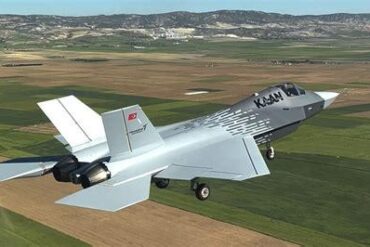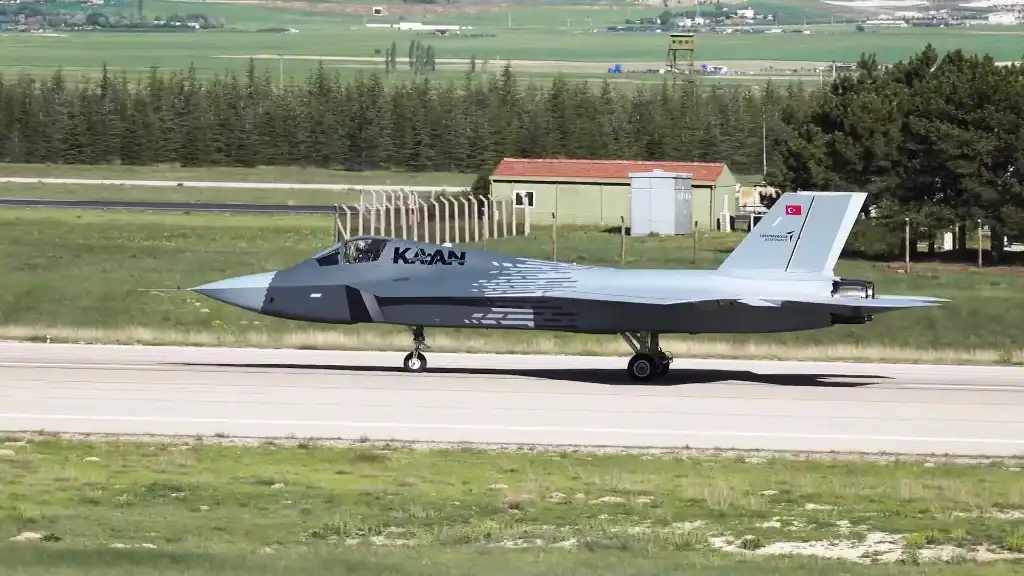
Türkiye’s ambition to field a fully indigenous fifth-generation combat aircraft reached a decisive milestone as Turkish Aerospace Industries confirmed that the first true flight prototype of the KAAN fighter jet is scheduled to take to the skies by May or June 2026. The announcement signals a transition from symbolic proof-of-concept flights to a demanding, multi-airframe test campaign designed to validate systems, performance, and production readiness at scale. For Ankara, this moment represents more than another test flight; it marks the point where the KAAN begins its transformation from a national engineering statement into an operational weapon system.
The confirmation came directly from Turkish Aerospace Industries Chief Executive Officer Mehmet Demiroğlu during a January 2026 interview, where he emphasized that the revised timeline reflects caution rather than difficulty. Extensive ground testing, system verification, and incremental clearance processes have been prioritized to ensure the aircraft enters flight trials with mature subsystems and predictable behavior. In advanced combat aircraft development, these months of preparation often determine whether later stages proceed smoothly or unravel under pressure.
At the center of this approach is a clear structural shift within the program. The KAAN effort now separates early experimental assets from dedicated flight-test aircraft, allowing each airframe to serve a precise purpose. This evolution mirrors the practices of established fifth-generation fighter programs and underlines Türkiye’s intent to manage risk through redundancy rather than speed alone.
A Program Moving Beyond Symbolic Flight Milestones
Earlier in the program, the KAAN relied on an engineering prototype that successfully demonstrated basic flight capability in 2024. That aircraft completed two short but critical sorties, confirming aerodynamic stability, control logic, and baseline systems integration. With those objectives achieved, the airframe has now been reassigned exclusively to ground and system-level testing, where it continues to support software validation, subsystem stress trials, and integration checks without the constraints of flight scheduling.
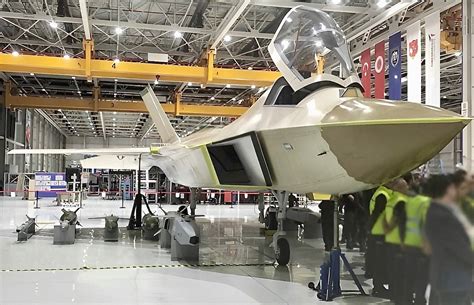
This decision has freed three newly built flight prototypes to shoulder the main airborne test workload. Each of these aircraft is designed from the outset for repeated sorties, instrumentation-heavy operations, and incremental envelope expansion. According to Turkish Aerospace Industries, every prototype undergoes two to three months of intensive ground testing before receiving flight clearance. These tests include resonance analysis to prevent structural harmonics, fuel system validation across multiple flow regimes, and comprehensive electrical and avionics checks intended to uncover faults before they manifest in the air.
Three Dedicated Prototypes Define the Flight Test Strategy
The first of the three dedicated flight prototypes is now the closest to flight readiness and is expected to inaugurate the true test campaign in mid-2026. Initial plans had targeted late April, but final adjustments pushed the window slightly, a shift described by program officials as routine rather than corrective. The second prototype is scheduled to follow by the end of 2026, while the third is expected to join flight testing in late 2026 or early 2027.
This staggered introduction allows test points to be distributed across multiple aircraft, enabling parallel evaluation of aerodynamics, avionics, mission systems, and flight control software. Instead of grounding the entire program when one airframe enters maintenance or modification, engineers can continue gathering data from the remaining prototypes. This approach reduces bottlenecks and accelerates overall learning, even when individual milestones move by weeks or months.
Serial Production Timeline Adjusted to Match Maturity Goals
As flight testing expands, the KAAN’s serial production schedule has been recalibrated to reflect realistic integration and validation timelines. Deliveries are now targeted for 2029, a one-year adjustment from earlier projections. Turkish Aerospace Industries has framed this shift as an alignment exercise, synchronizing flight-test outcomes with industrial readiness rather than compressing development at the risk of later rework.
An initial production order of 20 aircraft is expected to anchor the manufacturing phase and provide the Turkish Air Force with its first operational KAAN units. These early jets are intended to support a gradual transition away from aging F-16 fighters, which are slated to begin retirement in the 2030s. By the time serial production stabilizes, the KAAN is expected to move beyond introductory batches and into sustained delivery.
Interim Propulsion Choices Balance Capability and Risk
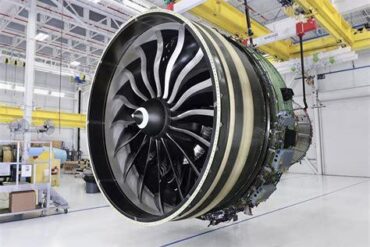
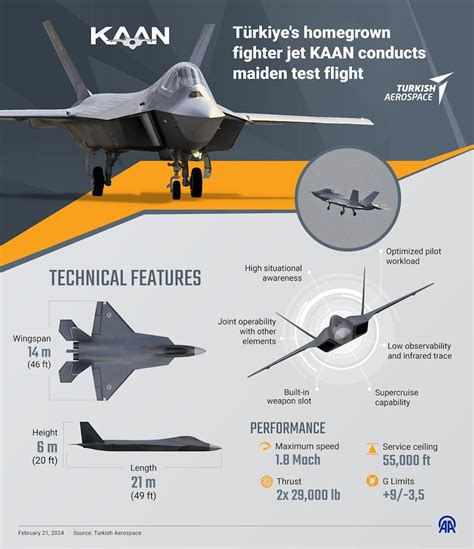
One of the most closely watched elements of the KAAN program is its propulsion strategy. Early production aircraft in the Block 10 and Block 20 configurations will rely on the General Electric F110 engine, an interim solution chosen for its proven performance and existing support infrastructure within Türkiye. The F110, already used by Turkish F-16s, delivers between 29,000 and 30,000 pounds of thrust, sufficient for early operational capability while minimizing integration risk.
Between 20 and 40 KAAN aircraft are expected to be produced with this engine, providing the air force with deployable fighters while indigenous propulsion development continues. Although the F110 does not meet the program’s long-term thrust target, it enables early operational service without waiting for a domestic engine to mature.
TF35000 Engine Development Anchors Long-Term Autonomy
Parallel to interim production, Türkiye is advancing the TF35000 indigenous turbofan engine, developed jointly by TRMotor and TUSAS Engine Industries. Designed to deliver approximately 35,000 pounds of thrust, the TF35000 is central to the KAAN’s long-term performance envelope and strategic autonomy. Full integration of the engine with the airframe is targeted for 2032, aligning with later production blocks and expanded capability growth.
The indigenous engine is expected to unlock improved supercruise performance, payload flexibility, and growth potential for future upgrades. More importantly, it reduces reliance on foreign suppliers, insulating the program from export controls and geopolitical constraints that have historically affected advanced aircraft sales.
Export Strategy Tied to Indigenous Configuration
Export considerations are already influencing KAAN’s technical roadmap. A $15 billion framework agreement with Indonesia positions Jakarta as the expected first international customer. Indonesian officials have indicated a preference for an ITAR-free configuration, meaning they are willing to wait for KAAN variants powered by the indigenous TF35000 engine rather than accepting early aircraft equipped with American propulsion.
The agreement is structured in phases, with initial terms established and further details expected to be finalized during 2026. This phased approach aligns export delivery with the maturation of domestic propulsion, potentially opening additional markets seeking advanced fighters without restrictive licensing conditions.
From Test Flights to Operational Reality
The KAAN’s earlier flights in 2024 remain a critical foundation for the program’s current phase. The maiden sortie on February 21 lasted 13 minutes and reached 8,000 feet at 230 knots, followed by a second flight on May 6 that climbed to 10,000 feet. Subsequent prototypes incorporate design refinements, including reshaped air intakes and structural enhancements, reflecting lessons learned from early data.
By late 2025, the second prototype had entered system integration, and Turkish defense firm Aselsan unveiled a complete, domestically produced weapons package tailored for the aircraft. Together, these developments illustrate a program steadily converting ambition into hardware, methodically and with intent. The coming 2026 flight window will not simply test an aircraft; it will test Türkiye’s ability to sustain a fifth-generation fighter program from prototype to production on its own terms.