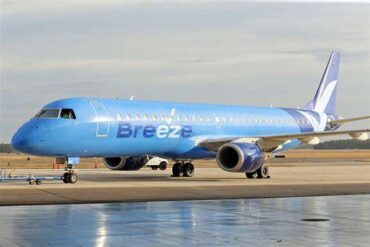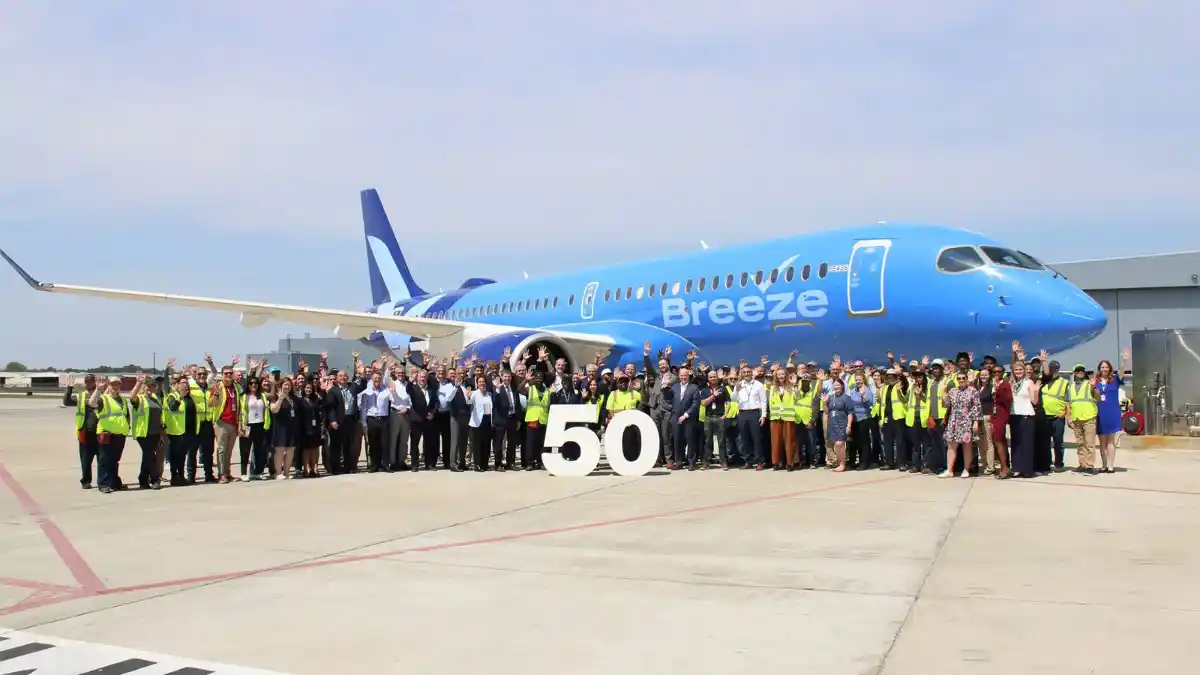
Breeze Airways has reached a defining milestone in its short but remarkably aggressive expansion story with the delivery of its 50th Airbus A220-300. For founder David Neeleman, the achievement represents more than fleet growth. It is another chapter in a career that has already reshaped commercial aviation across multiple countries through airlines including JetBlue, Azul, WestJet, and Morris Air.
The newest aircraft joined the fleet this week at Airbus’ US manufacturing facility in Mobile, Alabama, where Breeze marked the occasion alongside Airbus executives and airline staff. The delivery is part of a broader order for 90 A220 aircraft, positioning Breeze among the largest operators of the type in North America and reinforcing its long-term strategy of connecting underserved city pairs with nonstop service.
Unlike legacy carriers focused on fortress hubs and sprawling international alliances, Breeze has built its business around simplicity and overlooked demand. The arrival of the 50th A220 underscores how rapidly that formula has gained traction since the airline launched operations in 2021.
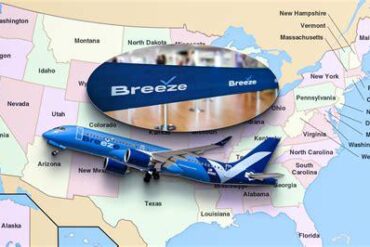
The carrier now serves roughly 76 destinations across the United States and continues to expand from secondary airports that historically lacked nonstop connectivity. That network strategy has allowed Breeze to avoid direct competition on many routes while attracting travelers tired of lengthy hub connections and rising fares.
The Airbus A220 Became the Centerpiece of Breeze Airways’ Strategy
Breeze’s relationship with the A220 dates back to 2018, when the airline — then known as Moxy Airways — signed a memorandum of understanding for 60 Bombardier CS300 aircraft. Shortly afterward, Airbus acquired a controlling interest in the CSeries program and rebranded the aircraft family as the Airbus A220.
At the time, many industry observers viewed the order as ambitious for a startup airline. Today, the decision looks increasingly strategic.
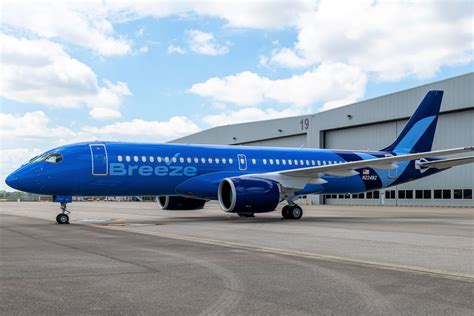
The A220-300 occupies a unique position in the market. It combines the economics of a regional aircraft with the range and cabin comfort expected from larger narrowbody jets. For Breeze, that flexibility is essential. The aircraft allows the airline to profitably operate thinner long-haul routes between smaller metropolitan areas that larger airlines often ignore.
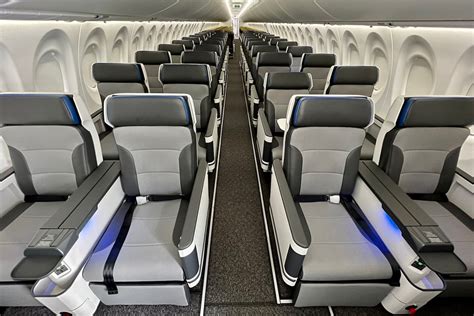
Passengers have also responded positively to the aircraft itself. The A220 cabin is widely regarded as one of the most comfortable in the narrowbody market, featuring larger windows, wider seats, higher ceilings, and improved fuel efficiency compared with older-generation jets.
For Breeze, the economics matter just as much as passenger comfort. Lower fuel burn and reduced operating costs help the airline maintain competitive fares while expanding into routes that would otherwise struggle to support mainline aircraft service.
From Embraer Leasing to an All-A220 Future
Breeze Airways did not begin operations with the A220 immediately. Aircraft delivery schedules forced the airline to adopt a temporary mixed-fleet strategy during its launch phase.
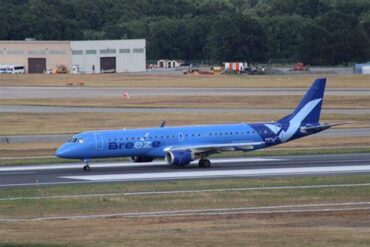
Before its first Airbus delivery, Breeze subleased Embraer 195 aircraft from Azul, another airline founded by Neeleman. Additional Embraer E190s were later sourced through Nordic Aviation Capital, enabling Breeze to launch domestic operations quickly and establish an early route network.
The first A220-300 arrived in October 2021 and entered passenger service in May 2022. Since then, deliveries have accelerated steadily.
The airline has already retired its E195 fleet and plans to shift remaining E190 aircraft into charter-focused operations, signaling a clear transition toward an all-A220 mainline fleet. That move simplifies pilot training, maintenance, scheduling, and operational efficiency — a critical advantage for a fast-growing airline.
Today, Breeze maintains operating bases in cities including Charleston, Fort Myers, Hartford, New Orleans, Norfolk, Orlando, Providence, Raleigh/Durham, Tampa, and Provo. Many of these locations historically lacked extensive nonstop options before Breeze entered the market.
David Neeleman’s Fifth Airline Venture Continues to Defy Expectations
Few airline entrepreneurs possess a résumé comparable to David Neeleman’s. Breeze represents his fifth major airline venture, and once again, he has targeted gaps in the market that larger competitors overlooked.
Neeleman first gained recognition through Morris Air, a low-cost carrier eventually acquired by Southwest Airlines in the 1990s. He later co-founded WestJet in Canada before launching JetBlue Airways in the United States, where he helped redefine low-cost travel with live television, leather seats, and enhanced passenger service.
His influence expanded further with Azul Linhas Aéreas in Brazil, which became the country’s largest airline by destinations served.
Breeze now follows the same underlying philosophy visible throughout Neeleman’s career: low fares paired with operational efficiency and customer-friendly service.
That formula appears particularly effective in today’s US market, where many mid-sized cities have experienced reduced connectivity following years of airline consolidation. Breeze has stepped directly into that gap by offering nonstop flights between secondary airports that traditionally required connections through major hubs.
The strategy also gives the airline a powerful competitive advantage. Breeze executives have previously indicated that roughly 90% of the airline’s routes face no direct competition.
Breeze Airways Positions Itself for Long-Term Expansion
Reaching 50 Airbus A220s is not simply a symbolic milestone. It signals that Breeze has entered a new phase of maturity after several years spent proving its business model.
The airline’s growth trajectory suggests additional expansion is likely across underserved domestic markets, particularly as more A220 deliveries arrive. Breeze has also expressed interest in the larger Airbus A220-500 variant should Airbus eventually launch the stretched aircraft.
With one of the youngest fleets in the United States and a network built around untapped demand, Breeze Airways is increasingly becoming one of the most closely watched success stories in modern American aviation.
For David Neeleman, the 50th A220 delivery is another reminder that his unconventional approach to airline building continues to work — even in one of the world’s most competitive aviation markets.