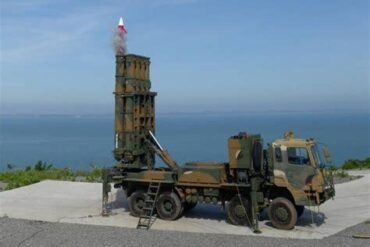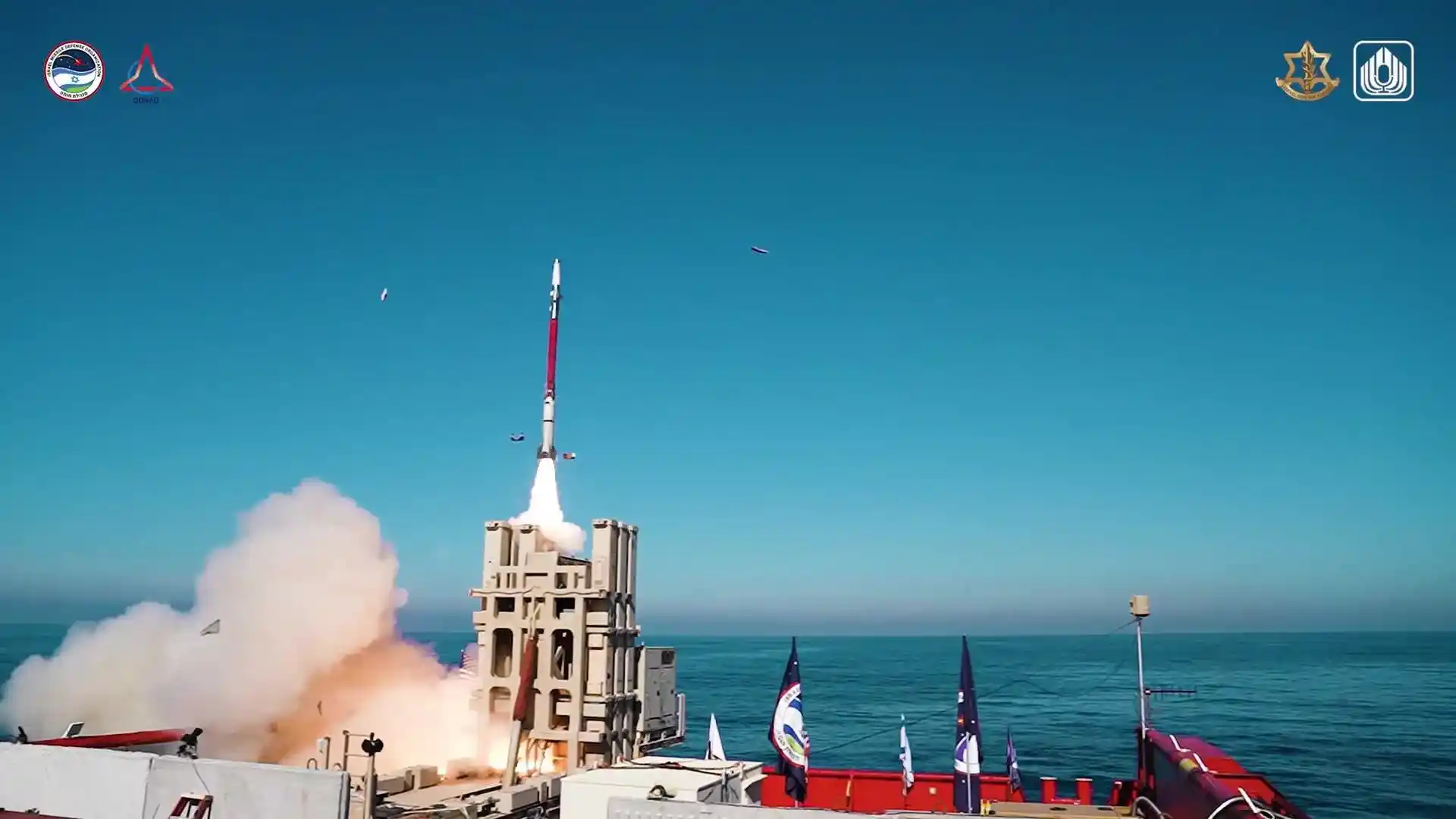
Israel has successfully tested an upgraded version of its David’s Sling air and missile defense system aboard a naval vessel for the first time, marking a significant expansion of the country’s layered defensive architecture from land into the maritime domain. The February 11, 2026 announcement by the Israeli Ministry of Defense confirms that the system—previously deployed exclusively in ground-based batteries since becoming operational in 2017—has now demonstrated shipboard interception capability as part of a broader readiness enhancement program.
The trial was conducted under the leadership of the Israeli Missile Defense Organization (IMDO), in cooperation with the U.S. Missile Defense Agency and prime contractor Rafael Advanced Defense Systems. According to official statements, the exercise formed part of an evolving threat-readiness upgrade cycle shaped by operational lessons learned during the October 7 war and subsequent conflicts, including Operation Rising Lion. The naval deployment represents not merely a technical milestone, but a doctrinal shift toward more flexible, distributed missile defense coverage across air, land, and sea.
The February 2026 trials evaluated the system’s performance against a broad spectrum of threats, including rockets, ballistic missiles, cruise missiles, aircraft, and unmanned aerial vehicles (UAVs). Test scenarios simulated both established and emerging aerial threats and included simultaneous engagements against multiple targets—an increasingly critical capability in an era defined by saturation attacks and multi-vector missile salvos.
Naval Integration Expands Israel’s Defensive Envelope
The most consequential element of the test series was the integration of a David’s Sling launcher onto a naval vessel, enabling maritime-based interception for the first time. While Israel’s navy already fields advanced defensive systems such as Barak-8, the incorporation of David’s Sling extends interception capability into the medium-to-long-range category at sea.
Maritime deployment introduces strategic flexibility. Naval vessels operating in the Mediterranean or Red Sea can now potentially provide defensive umbrellas over coastal regions, offshore energy infrastructure, and fleet formations. In practical terms, this reduces reliance on static ground-based batteries and enhances survivability through mobility. A warship equipped with David’s Sling becomes a mobile node within Israel’s multi-layered air and missile defense architecture, complicating adversarial targeting calculations.
Officials described the sea trials as successful and indicated that the upgrades significantly strengthen the broader defensive array. Importantly, the naval test was not an isolated experiment but part of a structured, multi-year development trajectory.
Combat-Driven Upgrades Following October 7 and Operation Rising Lion
The 2026 trials follow a prior upgrade cycle completed in August 2025, itself a direct result of wartime experience. During the October 7 conflict and Operation Rising Lion, IMDO personnel implemented real-time system adaptations to improve interception reliability under combat conditions. These refinements focused on enhancing performance against long-range rockets and complex aerial threats.
The new upgrade phase emphasizes the system’s capacity to contend simultaneously with diverse and concurrent threats, expanding the operational envelope of the interceptor. Modern missile warfare rarely presents threats sequentially. Instead, adversaries launch coordinated salvos involving ballistic trajectories, low-flying cruise missiles, and drones designed to exploit radar blind spots. The 2026 tests reportedly replicated such complex scenarios.
The Ministry of Defense emphasized that these improvements reflect a planned developmental roadmap rather than a one-time modernization effort. Israel’s defensive strategy relies on continuous iteration, integrating battlefield feedback into engineering cycles.
The Role of David’s Sling in Israel’s Layered Missile Shield
David’s Sling occupies the critical middle tier of Israel’s air defense architecture. Below it sits Iron Dome, optimized for short-range rockets and artillery shells. Above it operate Arrow 2 and Arrow 3, designed to intercept ballistic missiles in high-altitude and exo-atmospheric phases. Recently added to the defensive matrix is Iron Beam, a directed-energy laser system delivered to the Israeli Air Force to counter short-range threats at minimal per-shot cost.
David’s Sling bridges the gap between these systems, targeting threats in the 70 to 300 kilometer range with engagement ceilings between 50 and 75 kilometers. In summer 2024, it replaced the aging MIM-104 Patriot/PAC-2 Yahalom in Israeli service, with cost-efficiency cited as a major factor. A David’s Sling battery reportedly costs roughly one-third of a new Patriot battery, and each interceptor costs approximately $700,000, compared to nearly $6 million for a PAC-3 interceptor.
The system is operated by Battalion 66 of the Israeli Air Defense Array and has been operational since April 2017, completing the final layer of Israel’s multi-tier defense network.
Inside the Stunner Interceptor: Speed, Precision, and Kinetic Kill
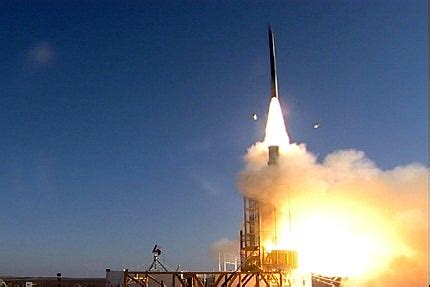
At the heart of David’s Sling lies the Stunner interceptor, a two-stage solid-propellant missile engineered for high-speed, precision engagement. Capable of reaching speeds up to Mach 7.5 (approximately 2.55 kilometers per second), the interceptor uses a hit-to-kill kinetic mechanism, meaning it destroys its target through direct impact rather than relying on fragmentation warheads.
Guidance is provided by the EL/M-2084 active electronically scanned array (AESA) radar, developed by Elta Systems, a subsidiary of Israel Aerospace Industries. The missile itself incorporates a sophisticated dual electro-optical seeker combining imaging infrared sensors and a charge-coupled device (CCD) camera capable of high-resolution target imaging during flight. An asymmetric 360-degree multi-seeker assembly enhances tracking from various approach angles.
The Stunner also features a three-way datalink that enables automatic and manual retargeting mid-flight, alongside advanced electronic and infrared counter-countermeasures. In practical terms, this means the interceptor can adjust course dynamically if the target maneuvers or if higher-priority threats emerge.
Operational Record and Battlefield Validation
David’s Sling first entered operational use in July 2018, when two interceptors were launched against Syrian OTR-21 Tochka ballistic missiles. Although the Syrian missiles ultimately fell within Syrian territory, the engagement marked the system’s initial real-world activation.
The system achieved its first confirmed successful interception on May 10, 2023, destroying a Badr-3 rocket aimed at Tel Aviv. During the October 2024 conflict, it intercepted long-range rockets such as the Ayyash-250 and ballistic missiles including the Qadr-1. In June 2025, David’s Sling shot down a ballistic missile during the Iran-Israel war—its first confirmed interception of that class of threat. Most recently, in February 2026, it intercepted a surface-to-air missile fired toward an Israeli UAV over Lebanon.
Each engagement has contributed to iterative refinement, transforming operational data into engineering upgrades.
International Demand and Strategic Partnerships
David’s Sling has drawn increasing international interest. In April 2023, Finland selected the system in a €316 million procurement that includes interceptors, launchers, and radar components. The Finnish configuration specifies a minimum flight altitude capability of 15,000 meters, underscoring its role in high-altitude missile defense.
The agreement comprises a €213 million main contract, €103 million in immediate options, and additional options valued at €216 million. The procurement structure includes a ministry-to-ministry arrangement to ensure supply security for critical components. Production and integration involve cooperation between Israeli, American, and Finnish contractors under Rafael and Raytheon leadership, pending U.S. export approval.
Expressions of interest have also emerged from India, Gulf Cooperation Council members, Switzerland, Australia, and Estonia—reflecting the system’s relevance in regions facing evolving missile threats.
Strategic Implications of Maritime Deployment
The successful naval trial signals a transition toward more distributed and adaptive missile defense. By placing medium-to-long-range interceptors at sea, Israel adds depth and maneuverability to its deterrent posture. Naval platforms can reposition rapidly in response to intelligence assessments, providing flexible coverage over shifting threat vectors.
In an era defined by proliferating cruise missiles, ballistic systems, and drone swarms, static defenses risk saturation. Mobility complicates adversary planning and increases interception opportunities earlier in the threat trajectory.
The February 2026 tests demonstrate that David’s Sling is evolving beyond its original land-based architecture into a multi-domain interceptor capable of integrating with maritime operations. As regional tensions persist and missile arsenals expand, the system’s adaptability may prove as strategically significant as its raw interception performance.
Israel’s latest trial underscores a broader reality: missile defense is no longer a fixed shield anchored to geography. It is becoming a dynamic network—layered, mobile, and continuously upgraded—designed to meet threats wherever they emerge.