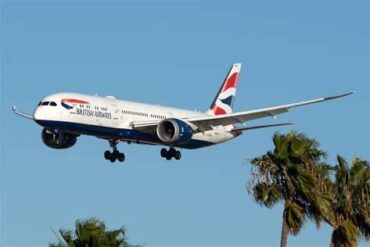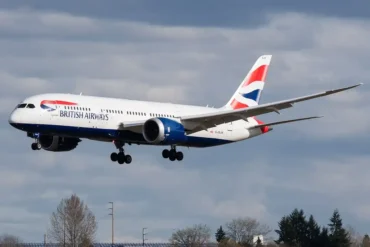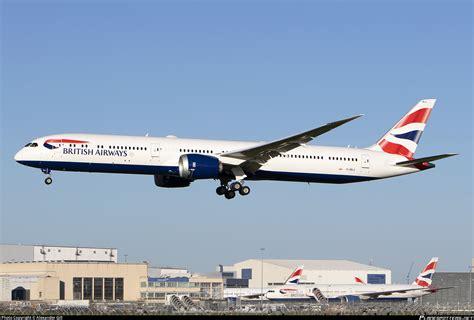
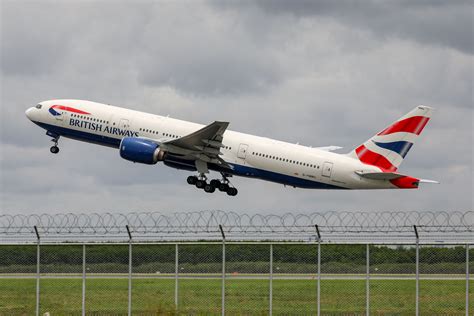
British Airways is entering 2026 with a sharpened long-haul strategy, and at the center of it sits the Boeing 787-10 Dreamliner—a stretched, premium-heavy widebody that thrives on dense transatlantic corridors. With 12 aircraft already in service and 38 more on order, the 787-10 is no niche experiment. It is becoming a structural pillar of the airline’s Heathrow-based long-haul network.
Unlike its smaller Dreamliner siblings, the 787-10 trades ultra-long range for higher capacity. That trade-off defines how British Airways deploys the jet. It is not the aircraft for Sydney or Santiago. It is the aircraft for thick, high-yield routes between London and North America, the Middle East, and select global hubs where premium demand is steady and predictable.
From London Heathrow, British Airways schedules multiple 787-10 routes exceeding 4,000 miles in 2026. Some approach 5,000 miles. The longest reaches nearly 4,914 miles. These are not marginal long-haul sectors. They are core arteries of the airline’s global network, carrying hundreds of thousands of passengers and generating hundreds of millions of available seat miles.
The Longest British Airways 787-10 Routes in 2026
Data drawn from scheduled operations in 2026 reveals how assertively British Airways uses its 787-10 fleet on long transatlantic missions. The standout is London Heathrow to Portland (PDX), stretching 4,914 miles westbound. That makes it the longest scheduled 787-10 sector in the carrier’s network.
Close behind is Houston’s George Bush Intercontinental Airport (IAH) at 4,834 miles. Then comes Seattle–Tacoma (SEA) at 4,801 miles, Dallas/Fort Worth (DFW) at 4,751 miles, and Vancouver (YVR) at 4,724 miles. These distances sit comfortably within the 787-10’s 6,330 nautical mile range capability, while maximizing its 336-seat potential.
What makes these routes remarkable is not only their length but their frequency. Seattle alone is scheduled 376 times in 2026 using the 787-10, generating more than 460 million available seat miles. Chicago, though slightly shorter at an average of 3,963 miles, leads in total flights with 500 scheduled operations on the type. Dubai, at 3,420 miles, may be shorter, but with 454 planned flights and nearly 400 million ASMs, it remains one of the most strategically significant deployments.
These numbers reveal a pattern. British Airways uses the 787-10 not sparingly, but aggressively, on routes where demand is both high and premium-weighted. The aircraft is not a novelty on these corridors; it is a workhorse.
Why Portland Became the 787-10 Flagship Long-Haul Route
The Heathrow–Portland story is a case study in strategic timing and fleet flexibility. When British Airways launched the route in June 2022, it initially used the Boeing 787-8. The pandemic had delayed the launch by two years, but when international travel resumed, the airline entered a market with a rare advantage.
Delta Air Lines had discontinued its seasonal Portland–Heathrow service in September 2019. During its final peak summer season, Delta operated daily flights and carried more than 110,000 round-trip passengers with a seat load factor nearing 79%. Once Delta exited, a significant capacity vacuum appeared.
British Airways stepped into that gap. What began as a five-times-weekly service using smaller Dreamliners has evolved into the longest 787-10 mission in the airline’s 2026 schedule. The route’s westbound block time hovers just under 10 hours, while eastbound returns average slightly over nine hours. That duration is ideal for a mid-size widebody optimized for premium comfort and fuel efficiency.
Portland now exemplifies what the 787-10 does best: long, high-demand routes that do not require ultra-long-haul range but benefit from expanded cabin capacity and modern premium products.
Inside the British Airways 787-10 Cabin Configuration
British Airways configures its 787-10 with four distinct cabins: First, Club World (business), World Traveller Plus (premium economy), and World Traveller (economy). The aircraft carries 165 economy seats, 35 premium economy seats, 46 business class seats, and eight First Class suites.
The presence of First Class is crucial. Many airlines have removed First from mid-size widebodies. British Airways has retained it on the 787-10, signaling confidence in premium transatlantic demand.
Club Suite and First Class both feature 79-inch fully flat beds in a 1-2-1 configuration, ensuring direct aisle access for every passenger. Privacy doors in Club Suite represent a significant upgrade from the older yin-yang business class layout that defined British Airways for years. First Class provides slightly wider seating, larger inflight entertainment screens, and greater personal space.
Behind these premium cabins sits World Traveller Plus in a 2-3-2 layout with 38 inches of pitch and 18.7 inches of width, offering a tangible step above economy. Economy itself is arranged primarily in a 3-3-3 configuration, with 31 inches of pitch. The cabin narrows toward the rear, where the final rows transition in layout as the fuselage tapers.
The overall balance reflects the aircraft’s mission. Compared to the 787-9, the -10 features more total seats but fewer premium economy seats proportionally, prioritizing business and first on dense corporate routes.
The Strategic Role of the Boeing 787-10 in the Fleet
The 787-10 occupies an intriguing middle ground. It is longer than the 787-8 and 787-9, measuring 224 feet in length, yet it has a shorter range than the -9. With a standard capacity of 336 seats, it bridges the gap between mid-size Dreamliners and larger aircraft like the Boeing 777 and Airbus A350.
This positioning shapes its deployment. The aircraft lacks the ultra-long-haul capability of the 787-9, which can fly up to 7,565 nautical miles. However, its operating economics are favorable on routes where range is sufficient and demand is strong. The composite airframe, advanced aerodynamics, and fuel-efficient engines keep per-seat costs competitive.
British Airways uses the 787-10 where the economics of a 777-300ER might be excessive, but a 787-8 would leave revenue on the table. It is the aircraft for “thicker” long-haul routes—dense markets with sustained premium demand but not extreme range requirements.
As the Boeing 777X prepares for eventual commercial service industry-wide, the capability gap between large widebodies and the 787-10 will widen. Yet that does not diminish the 787-10’s value. It sharpens it. The jet excels precisely because it is optimized for a specific band of mission profiles.
First Class on the 787-10: A Transatlantic Differentiator
British Airways’ decision to retain First Class on the 787-10 is more than branding. It is a competitive lever in the transatlantic market. On routes like Seattle, Dallas, and Houston, premium corporate traffic remains robust. The presence of just eight First Class seats creates exclusivity and a high crew-to-passenger ratio.
The premium experience begins at Heathrow with access to the First Wing security channel and the Concorde Room lounge, enabling a rapid landside-to-airside transition that can take minutes rather than half an hour. In-flight, passengers benefit from dine-on-demand service and enhanced privacy.
This is not the ultra-opulent First Class of certain Gulf carriers. It is calibrated for efficiency and sophistication rather than spectacle. That distinction matters. British Airways is investing billions in its broader transformation program, and doubling down on First signals a belief that refined premium experiences still command loyalty on transatlantic routes.

How the 787-10 Differs from British Airways’ Other Dreamliners
British Airways operates 42 Boeing 787 aircraft from Heathrow, including 787-8s, 787-9s, and 787-10s. Each variant has a defined role.
The 787-8, with as few as 204 seats in certain configurations, serves lower-demand long-haul markets. In early 2026, it operates routes across six nations, with India representing a significant share. Destinations such as Hyderabad, Chennai, and Mumbai rely on this smaller-capacity Dreamliner. Montreal and Toronto also see 787-8 operations, as does the new seasonal service to St. Louis.
The 787-9 occupies a premium-heavy niche with eight First Class seats and a balanced mix of business and premium economy. Its longer range allows deployment to destinations that stretch beyond the comfortable envelope of the 787-10.
The 787-10, by contrast, focuses squarely on high-demand transatlantic and select Middle Eastern routes. It is the largest Dreamliner in the fleet and, with 38 more on order, is poised to become even more prominent. British Airways stands out as the only operator of the 787 within International Airlines Group, underscoring its deep commitment to the type.
Available Seat Miles and Network Impact in 2026
Available seat miles (ASMs) quantify the scale of the 787-10’s contribution. Seattle’s 462 million ASMs illustrate how a single route can become a capacity backbone. Houston exceeds 250 million ASMs. Even the comparatively shorter Dubai route approaches 400 million ASMs due to high frequency.
These figures translate into strategic resilience. Concentrating capacity on strong-performing routes allows British Airways to optimize slot usage at Heathrow, one of the world’s most constrained hubs. Every takeoff must justify itself economically. The 787-10’s blend of capacity, efficiency, and premium configuration ensures that it does.
The aircraft’s lower operating costs relative to older widebodies enhance margins, particularly when fuel prices fluctuate. Its composite fuselage also enables higher cabin humidity and lower pressurization altitude, improving passenger comfort on long sectors nearing ten hours.
The Future of the 787-10 in British Airways’ Long-Haul Strategy
With 38 additional 787-10s on order, British Airways is signaling a long-term commitment to this platform. As older 777 variants age and sustainability pressures intensify, the Dreamliner’s fuel efficiency becomes increasingly valuable.
The 787-10 may not reach the ultra-long-haul destinations that capture headlines, but it quietly dominates the economically critical band between 3,500 and 5,000 miles. That band includes much of North America and key Middle Eastern hubs. It is here that British Airways extracts scale, frequency, and premium revenue.
In 2026, the longest nonstop 787-10 routes—from Portland and Houston to Seattle and Dallas—demonstrate how carefully calibrated fleet planning can align aircraft capability with market demand. The result is not merely long flights. It is a deliberate architecture of connectivity radiating from Heathrow.
British Airways’ 787-10 Dreamliner operations in 2026 are less about spectacle and more about precision. They reveal a network engineered for high-yield consistency, supported by modern cabin products and reinforced by frequency on transatlantic strongholds. In a competitive long-haul environment, that precision may prove more powerful than sheer range.