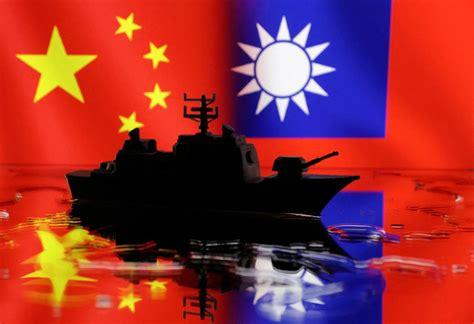
China’s latest 100-ship maritime surge across the East and South China Seas signals a sharp escalation in Beijing’s capacity to coordinate large-scale naval and coast guard operations with minimal warning. Intelligence summaries released on December 4, 2025, describe synchronized movements of more than one hundred vessels across multiple regions, forming the largest such deployment recorded to date. For Taiwan, Japan, the Philippines, and U.S. forces positioned throughout the Pacific, the operation marks a decisive demonstration of China’s increasingly mature theater-level maritime command capability.
The surge unfolded as Beijing’s naval expansion enters its most aggressive phase in modern history. China’s third aircraft carrier Fujian (Hull 18)—a technologically ambitious flat-top equipped with electromagnetic catapults—continues sea trials and validation tests that will soon extend the PLAN’s strike radius deep into contested airspace. Fujian’s commissioning represented not just symbolic progress but a functional leap that positions China to launch heavier, longer-range aircraft able to conduct precision strikes, electronic warfare, and persistent ISR across the Taiwan Strait.
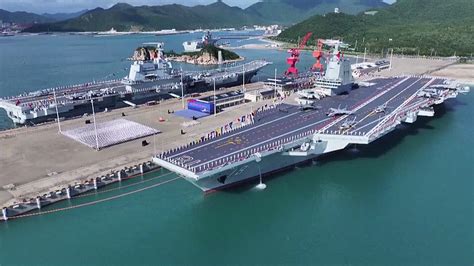
China’s carrier fleet is no longer an experimental policy initiative; it is an operational tool. Liaoning completed a full refit in 2024, while Shandong continued intensive flight operations in the Philippine Sea and around Taiwan. These dual-carrier activities—featuring sustained sorties and multi-day air operations—give China the ability to simulate blockades, air-denial zones, and encirclement scenarios designed to overwhelm Taiwan’s defenses. The pace of training shows a military steadily rehearsing for contingencies that once seemed theoretical.
Rumors of a fourth, larger Chinese carrier under construction underscore Beijing’s ambitions to maintain a multi-carrier force capable of applying pressure from several maritime axes at once. For any Taiwan contingency, the ability to rotate carriers and sustain round-the-clock pressure is a decisive advantage that reduces the island’s response window and complicates allied planning.
China’s naval modernization is not confined to its carriers. The PLAN’s amphibious forces have expanded at a speed unmatched by any regional navy. Large-deck Type-075 amphibious assault ships already form the backbone of China’s expeditionary capability, while new construction of the Type-076 class hints at a future where amphibious ships double as drone carriers. Satellite analysis suggests the Type-076 may feature electromagnetic systems to launch fixed-wing drones—an innovation that would merge amphibious assault, airpower projection, and swarm warfare into a single platform.
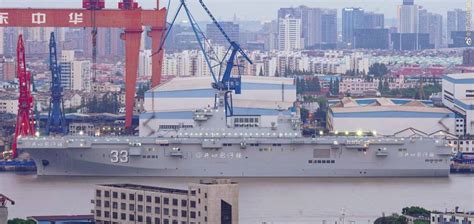
If verified, these ships would serve as optimized tools for rapid island seizure and coastal suppression missions—scenarios directly relevant to Taiwan’s defensive calculus. Such capabilities also extend into the South China Sea, where China continues to fortify its presence around strategic maritime chokepoints.
Cruisers, Destroyers, and the Growth of China’s Strike Envelope
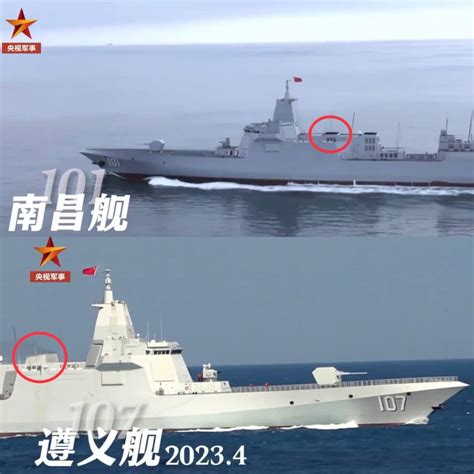
As China adds new carriers and amphibious platforms, it is simultaneously expanding the escort forces needed to protect them. Large Type-055 cruisers now accompany carrier strike groups as command-and-air-defense hubs, while Type-052D destroyers enhance anti-submarine and anti-air warfare capabilities. These modern surface combatants incorporate advanced radars, long-range missile systems, and integrated battle-management technologies.
Together, they enable China to impose localized air and maritime exclusion zones around Taiwan or shield its carrier and amphibious formations during high-intensity operations. For regional militaries, each step in China’s modernization widens the gap between warning time and Chinese force arrival.
Submarine Expansion Adds a Stealth Layer to China’s Strategy
China’s undersea modernization complicates defense planning even further. The forthcoming Type-096 ballistic missile submarines and Type-095 attack submarines will add stealth, range, and firepower to China’s strategic deterrent and regional strike options. New variants equipped with vertical launch systems strengthen Beijing’s ability to target Taiwan’s ports, key infrastructure, and U.S. naval reinforcements approaching from the Philippine Sea.
Reports of an unconfirmed submarine incident in Wuhan have not slowed construction. China’s continuing investment in undersea power reveals long-term planning aimed at controlling or denying access across East Asia’s most critical waterways.
The 100-Ship Surge and the Strategic Pressure on Taiwan
For Taiwan, the recent deployment of more than 100 naval and coast guard vessels forms a practical demonstration of the coercive maritime tactics China has spent years refining. Massed formations can simulate blockade patterns, saturate approaches to Taiwan’s harbors, and force continuous readiness cycles. China’s large coast guard presence provides additional tools for gray-zone pressure—activity designed to provoke responses while staying below thresholds that justify kinetic retaliation.
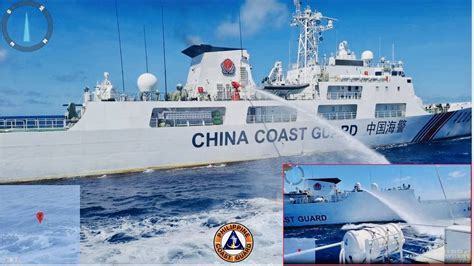
These operations normalize a constant Chinese presence around the island, constraining Taiwan’s maneuver space and gradually eroding its freedom of action. For a country whose defense depends on rapid mobilization and early warning, such sustained pressure is strategically corrosive.
Regional Fallout: Japan, the Philippines, and U.S. Forces Face New Risks
The United States now faces greater operational risks in key maritime corridors used to support Taiwan during a crisis. Chinese vessel shadowing, aggressive surveillance sorties, and saturation maneuvers could delay or disrupt early U.S. force deployments. Japan faces similar constraints along the Ryukyu Islands, where China’s expanding presence threatens air and sea routes vital to collective defense.
The Philippines is exposed as well. Chinese flotillas operating in the Bashi Channel or the northern Luzon corridor could impede allied reinforcement routes to Taiwan while simultaneously amplifying tensions in the South China Sea. These chokepoints form the arteries of any Taiwan contingency, and China’s ability to flood them with coordinated naval and coast guard units marks a significant strategic shift.
Conclusion: A New Era of Persistent Maritime Pressure
China’s 100-ship surge is more than a show of force; it is a demonstration of a rapidly maturing navy preparing for multi-theater operations. With new carriers nearing operational readiness, amphibious and drone-capable platforms under construction, advanced cruisers and destroyers escorting strike groups, and stealthier submarines entering the fleet, China is moving toward a persistent maritime presence capable of shaping regional choices and contesting U.S. operational planning.
The message is unmistakable: Beijing now wields the scale, coordination, and capability to pressure Taiwan continuously while forcing East Asian allies and the United States to rethink their assumptions about escalation, access, and response time.