Class G airspace is a unique category within the National Airspace System, distinguished by its uncontrolled nature. This type of airspace does not require clearance from Air Traffic Control (ATC) for either Visual Flight Rules (VFR) or Instrument Flight Rules (IFR) aircraft to operate. While it is the only form of uncontrolled airspace in the United States, understanding its boundaries, weather requirements, and operational guidelines is critical for pilots and aviation enthusiasts alike. In this article, we will explore Class G airspace in detail, discussing its structure, operational rules, and how pilots can safely navigate it.
What is Class G Airspace?
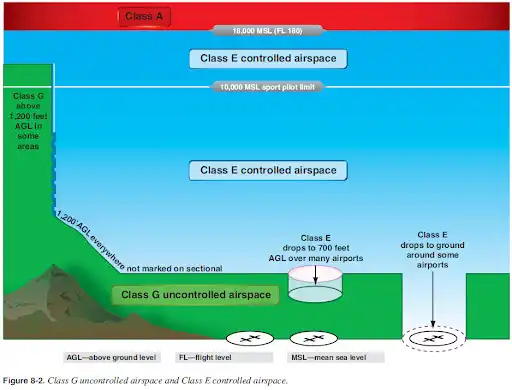
Class G airspace is the lowest level of airspace in the United States, typically existing below Class A, B, C, D, and E airspace. It is referred to as “uncontrolled” because aircraft operating in this airspace do not need ATC clearance to depart or navigate. Unlike controlled airspace, where communication with ATC is required, Class G allows pilots to operate without receiving instructions or clearances unless necessary. However, while Class G airspace does not impose mandatory communication requirements, it is crucial for pilots to remain vigilant and follow other regulations to ensure safety.
How to Identify Class G Airspace
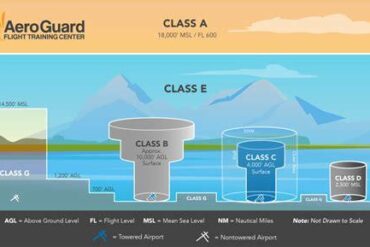
Class G airspace is typically found where Class A, B, C, D, or E airspace is not present. It starts at the surface and extends up until it meets the ceiling of Class E airspace, which typically begins at 700 feet AGL (Above Ground Level) or 1,200 feet AGL. The boundary between Class G and Class E is marked clearly on sectional charts. In areas where Class E airspace starts at 1,200 feet AGL, the Class G airspace extends from the surface up to, but not including, 1,200 feet AGL.
It is particularly easy to find Class G airspace in the western United States, although the East Coast is less likely to have such airspace markings. For example, Class E/G boundaries are marked with a fading blue line, which indicates the transition from Class G to Class E airspace at 1,200 feet AGL. Understanding these markings is crucial for pilots navigating in such regions.
Weather Minimums in Class G Airspace
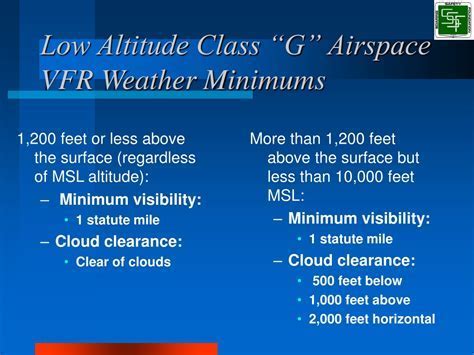
Weather minimums in Class G airspace are defined to ensure safe operations. These minimums differ depending on the altitude at which a pilot is flying, and they are divided into three categories:
- 1,200 feet AGL and below: Pilots must maintain visibility of 1 statute mile and stay clear of clouds.
- Above 1,200 feet AGL but below 10,000 feet MSL (Mean Sea Level): Visibility requirements increase to 3 statute miles, with a cloud clearance of 500 feet below, 1,000 feet above, and 2,000 feet horizontally.
- Above 10,000 feet MSL: Visibility increases to 5 statute miles, with a cloud clearance of 1,000 feet below, 1,000 feet above, and 1 statute mile horizontally.
These varying visibility requirements are crucial for see and avoid operations, ensuring that pilots can spot other aircraft and avoid potential mid-air collisions.
Communications in Class G Airspace
Unlike controlled airspace, pilots flying in Class G airspace are not required to communicate with ATC. However, when approaching uncontrolled airports located within Class G airspace, it is strongly recommended to announce your position to ensure safety. The Aeronautical Information Manual (AIM) suggests making position calls at specific points:
- 10 miles from the airport
- 5 miles from the airport
- Overhead the airport (if necessary)
- 45-degree entry into the downwind leg
These position calls help maintain situational awareness and ensure other pilots are aware of each other’s positions, reducing the risk of conflicts, especially when multiple aircraft are in the vicinity.
Restrictions and Speed Limits in Class G Airspace
One of the primary restrictions in Class G airspace involves speed limits. Below 10,000 feet MSL, aircraft are not permitted to fly faster than 250 knots. This limitation is in place to improve visibility and reduce the likelihood of accidents, as faster aircraft are harder to spot, especially in uncontrolled environments.
Equipment Requirements
There are no mandatory equipment requirements for aircraft flying below 10,000 feet MSL in Class G airspace. However, if a pilot operates at or above 10,000 feet MSL and more than 2,500 feet AGL, a Mode-C transponder is required. This equipment is necessary to allow ATC to identify and track aircraft in the vicinity, enhancing overall safety.
Navigating Class G Airspace: Best Practices
Although Class G airspace offers the freedom to operate without direct ATC oversight, pilots must remain cautious and follow best practices to ensure safety:
- Preflight planning is crucial. Always check your sectional charts for Class G boundaries and weather conditions.
- Ensure compliance with weather minimums for visibility and cloud clearance at your specific altitude.
- Use proper position reporting when approaching uncontrolled airports to maintain situational awareness.
While Class G airspace provides flexibility, pilots must exercise due diligence, ensuring they can always see and avoid other aircraft, remain out of restricted airspace, and follow relevant guidelines for each specific situation.
Conclusion
Class G airspace is a vital part of the aviation ecosystem, providing pilots with flexibility and freedom to operate without direct ATC supervision. While it is the only uncontrolled airspace category, it still requires careful adherence to weather minimums, speed limits, and situational awareness to ensure safety. Understanding the layout and regulations of Class G airspace is crucial for both VFR and IFR pilots, as it allows for more efficient and safe flying in areas where ATC oversight is not provided. By understanding how to navigate and communicate effectively within Class G airspace, pilots can ensure their flights are safe, efficient, and compliant with all necessary aviation guidelines.