The idea of a machine that can compress time and space sounds like science fiction dressed in laboratory steel. Yet that phrase, provocative as it is, has become attached to a very real piece of infrastructure now operating in China. Hypergravity centrifuges do not warp spacetime in the relativistic sense, but they do something almost as unsettling to intuition: they make small things behave like enormous ones and allow years of physical processes to unfold in days. That capability alone reshapes how engineers and scientists test the limits of the physical world.
For nearly three decades, the world’s most powerful hypergravity centrifuge lived quietly in the United States at the U.S. Army Engineer Research and Development Center in Vicksburg, Mississippi. Its dominance ended abruptly in 2025 when China switched on the CHIEF1300, a machine that immediately reset the global benchmark. That reign was short-lived. By December 2025, China commissioned an even more powerful successor, the CHIEF1900, instantly claiming undisputed leadership in hypergravity research.
Behind the headlines is a deeper story about why hypergravity matters. These machines are not about spectacle. They are about scaling reality—condensing massive structures, geological forces, and long-term environmental processes into controlled experiments that can be observed, measured, and repeated. In a world increasingly defined by megastructures, climate stress, and offshore engineering, that ability is quietly revolutionary.
How Hypergravity Centrifuges Turn Speed Into Artificial Gravity
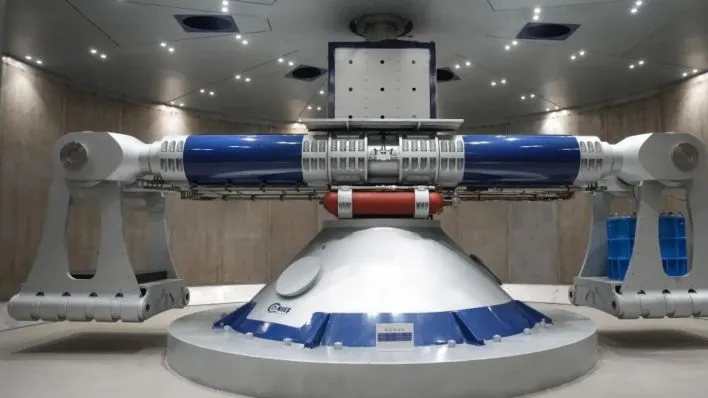
A hypergravity centrifuge works by spinning an arm at extremely high speeds, generating artificial gravity thousands of times stronger than Earth’s. Objects mounted at the end of the rotating arm experience intense centrifugal force, which effectively mimics gravity on an exaggerated scale. While a household washing machine might briefly generate around 2 g·tonnes, advanced research centrifuges operate in an entirely different universe of force.
The unit used to describe this capability, g·tonnes, combines gravitational acceleration with mass capacity. It reflects not only how strong the artificial gravity is, but how much material can be subjected to it at once. The former U.S. record holder at Vicksburg was rated at 1,200 g·tonnes, already an extreme engineering achievement. China’s CHIEF1300 raised that to 1,300 g·tonnes, and the CHIEF1900 now pushes the ceiling to a staggering 1,900 g·tonnes, making it the most powerful centrifuge ever built.
The CHIEF Facility Beneath Hangzhou
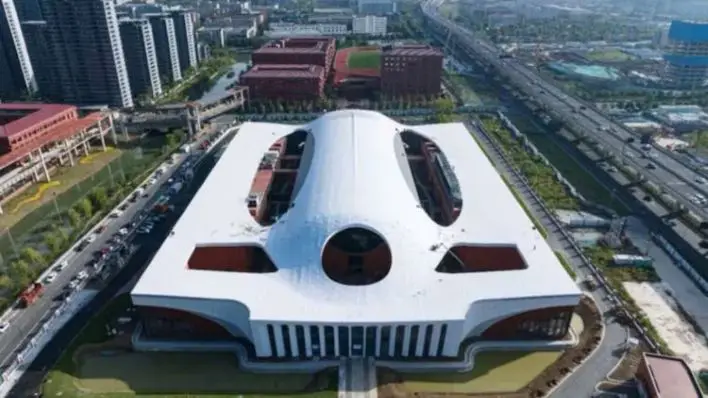
Both record-breaking machines are housed at the Centrifugal Hypergravity and Interdisciplinary Experiment Facility, known simply as CHIEF, located on the campus of Zhejiang University in Hangzhou. Construction began in 2019, with a design choice that speaks volumes about precision engineering: the entire facility sits 49 feet underground. This depth minimizes vibration, ensuring that experimental data is not corrupted by external interference when the centrifuges are operating at full power.
The underground setting also reflects the seriousness of the research conducted there. These are not demonstration machines. They are instruments designed to push materials, structures, and geological models to their breaking points under meticulously controlled conditions.
Compressing Time and Space Without Breaking Physics
Claims that the CHIEF1900 can compress time and space are technically true, though not in the cosmic sense the phrase suggests. Under extreme gravity, physical processes accelerate. Soil consolidates faster. Water flows through sediment more quickly. Structural stresses that would take years to manifest in the real world appear in days or weeks inside the centrifuge.
At the same time, space is compressed through scale modeling. A small model of a dam foundation, when subjected to hypergravity, experiences forces equivalent to those acting on a full-sized structure. The model behaves as if it were enormous, allowing engineers to observe real-world behavior without building at real-world scale. In this way, kilometers become centimeters, and decades collapse into afternoons.
Real Experiments With Global Implications
Even before the CHIEF1900 came online, its predecessor was already producing consequential data. Researchers used the CHIEF1300 to test how much seismic energy hydropower dam foundations can absorb before failure. Other experiments recreated extreme marine conditions, including 13-foot wind-driven waves and simulated 65-foot tsunamis, to study seabed stability for offshore wind farms.
One particularly striking capability is the machine’s ability to reproduce the pressure found at ocean depths of 2,000 meters. That opens doors to safer deep-sea infrastructure design, from energy installations to undersea cables, without ever leaving the laboratory.
Why the CHIEF1900 Signals a Shift in Global Research Power
The CHIEF1900 is more than a record-setting machine. It is a signal that large-scale experimental infrastructure is becoming a strategic asset. Hypergravity research directly informs civil engineering resilience, disaster mitigation, energy security, and environmental planning. By compressing time and space into something engineers can interrogate directly, China has given itself a powerful lens into the future behavior of the built world.
This is not about bending the universe. It is about bending experiments to human timescales—and that may be just as transformative.