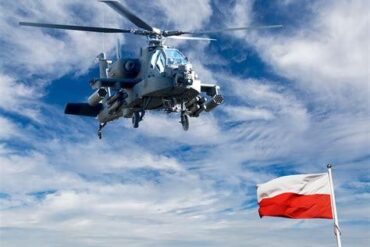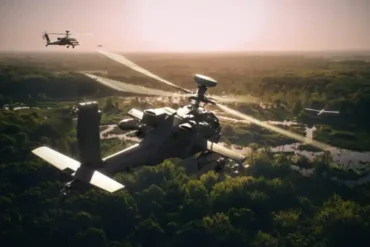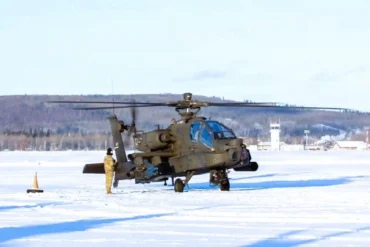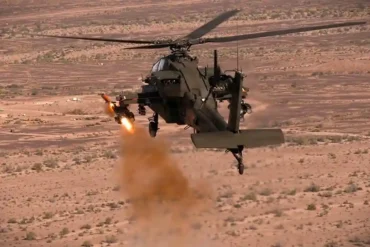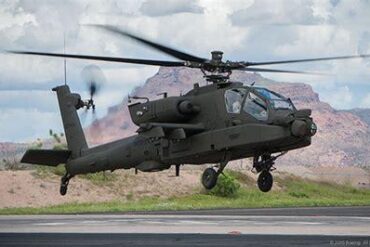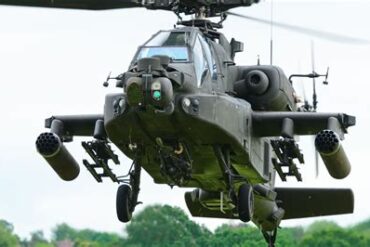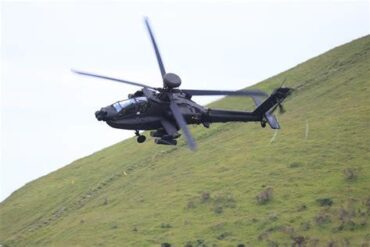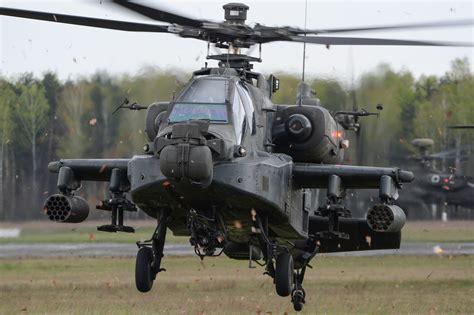
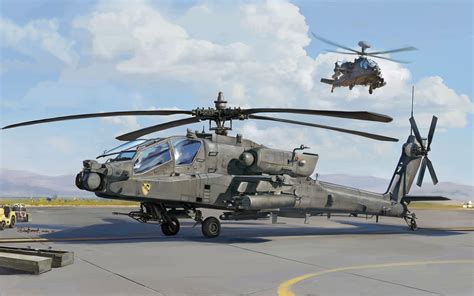
The Boeing AH-64 Apache is a symbol of unmatched endurance and technological innovation in the arena of modern military aviation. Introduced over four decades ago, this fearsome attack helicopter continues to be a critical asset to armed forces around the world. First flown in September 1975 under the designation YAH-64, the Apache’s origin story began with the Hughes Helicopter Company as part of the U.S. Army’s ambitious Advanced Attack Helicopter (AAH) program. The objective was clear: create a lethal, versatile machine to outperform the AH-1 Cobra and dominate future battlefields.
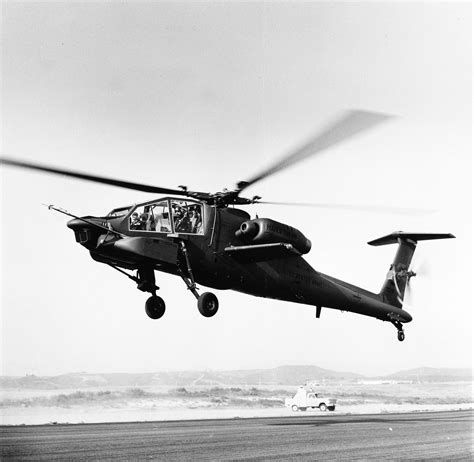
Origins in a New Era of Warfare
The early 1970s marked a critical pivot in the U.S. military’s approach to combat aviation. Vietnam had highlighted both the promise and limitations of rotorcraft in frontline engagements. Thus, in mid-1972, the Pentagon launched the AAH program, demanding a next-generation aircraft with more survivability, precision strike capabilities, and night-vision operational flexibility.
After competing head-to-head with Bell’s Model 409, Hughes’s YAH-64 won the contract. By 1984, the first production model—AH-64A—was delivered to the U.S. Army, officially ushering in a new era. General John A. Wickham Jr., then Chief of Staff of the Army, heralded its introduction as revolutionary, praising the Apache’s ability to destroy enemy tanks and vehicles in day, night, and adverse weather conditions.
Engineering for Lethality and Precision
Beyond its iconic twin-turbine design and four-blade main rotor, the Apache was packed with firepower that redefined attack helicopter doctrine. The original AH-64A carried:
- 16 AGM-114 Hellfire missiles, effective at distances up to 8,000 meters
- A 30 mm M230A1 chain gun, capable of firing 650 rounds per minute
- Advanced thermal imaging, GPS navigation, and night vision systems
These capabilities allowed it to strike targets with clinical precision. In the words of General Carl Stiner, who led Operation Just Cause in Panama, the Apache “could fire that Hellfire missile through a window from four miles away at night.”
The AH-64’s agility, combined with its brutal arsenal, gave it a unique battlefield advantage. At roughly 57 feet long and capable of speeds up to 164 knots, it was fast, maneuverable, and deadly—especially when paired with real-time intelligence from troops on the ground.
Operational History: From Panama to Global Skies
The Apache’s combat debut occurred during Operation Just Cause in Panama in 1989. Shortly after, it cemented its fearsome reputation during the 1991 Gulf War, where it was deployed to great effect in the opening salvos of Desert Storm. Throughout the 1990s and into the 2000s, the Apache became a linchpin of U.S. and allied military operations.
With over 937 AH-64A models initially built, the platform’s success prompted Boeing—having acquired McDonnell Douglas (which had absorbed Hughes)—to launch iterative upgrades. By 2000, the Apache had matured into a force to be reckoned with. Boeing celebrated the helicopter’s 25th anniversary with executive Martin Stieglitz noting, “We’ve been following a roadmap for technological growth that is designed to let us incorporate new systems as they emerge.”
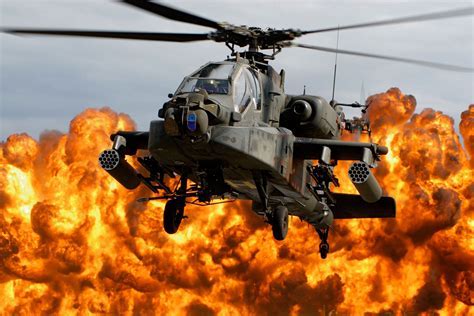
Technological Evolution: AH-64D and AH-64E
The dawn of the 21st century brought the AH-64D Apache Longbow, a game-changing variant equipped with:
- Fire-and-forget Hellfire II missiles
- Millimeter-wave radar (Longbow Radar), enabling targeting behind obstacles
- Enhanced digital communications and network-centric warfare capability
This model allowed pilots to engage multiple threats quickly and from relative safety. It marked a transition from traditional targeting to data-driven battlefield dominance.
By the 2010s, the Apache had evolved into its latest iteration—the AH-64E Guardian. Incorporating composite rotor blades, upgraded engines, and enhanced flight performance, the AH-64E also supports integration with unmanned aerial systems (UAS) and real-time data sharing. It’s not just stronger; it’s smarter, more cost-efficient, and globally scalable.
A Global Legacy: International Adoption and Exports
The Apache’s impact extends far beyond the U.S. military. Boeing has delivered over 2,700 Apaches worldwide. As of 2025, 16 allied nations operate the AH-64 in their armed forces, including:
- United Kingdom
- Japan
- Greece
- Morocco
- Saudi Arabia
- Australia
Each country adapts the Apache to its strategic needs. The U.K., for instance, has fielded its Apache AH1 with custom British avionics and communications systems. Japan, meanwhile, deploys the AH-64DJP, a licensed and tailored version manufactured by Fuji Heavy Industries.
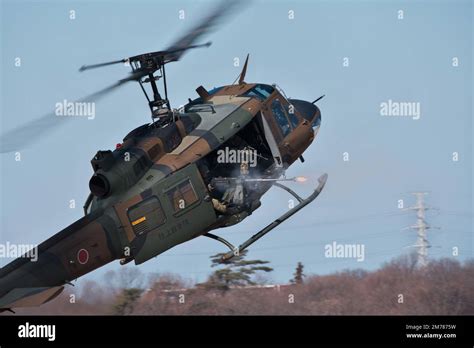
This global usage speaks to the Apache’s modularity and reliability. With frequent upgrades and support from Boeing, international operators ensure their fleets remain mission-ready for decades.
The Road Ahead: Apache’s Future Into the 2060s
Despite its age, the Apache’s future is far from over. According to Boeing, the Version 6 architecture of the AH-64E allows seamless software and hardware upgrades, ensuring continued relevance on the battlefield. The platform is now being aligned with future joint all-domain operations (JADO), promising tighter integration with air, land, cyber, and space warfare environments.
Key upcoming enhancements include:
- Improved autonomous navigation and AI-assisted targeting
- Advanced data fusion for battlefield situational awareness
- Greater fuel efficiency and survivability enhancements
The U.S. Army has committed to sustaining the Apache until at least 2060, an unprecedented service lifespan for a rotary-wing combat aircraft. This level of endurance highlights Boeing’s foresight in creating an upgradable, future-proof framework—one that was initially envisioned in 1975 and still proving itself 50 years later.
A Timeless Icon of Aerial Warfare
The Boeing AH-64 Apache isn’t just a helicopter—it’s a flying arsenal, an intelligence node, and a battle-hardened veteran of countless missions. From its prototype phase in the Cold War to its current deployment in multi-domain, digital-age conflicts, the Apache continues to represent the pinnacle of aerial lethality.
Its evolution—from YAH-64 test flights in the California desert to advanced AH-64E operations over global hotspots—demonstrates how engineering excellence, foresight, and adaptability can create a platform that doesn’t just survive history but shapes it. As it approaches the half-century mark, the Apache remains not only relevant but irreplaceable.
In the shifting sands of military technology, few machines last long enough to become legends. The Apache didn’t just last—it excelled. And by all indications, its rotor blades will still be slicing through the skies long after many of its contemporaries are retired to museums.
With its roots planted in a transformative era of U.S. military strategy and its branches extending into the warfare theaters of the future, the AH-64 Apache continues to be a testament to American military innovation and combat engineering mastery.