Composite materials have revolutionized modern engineering across industries such as aerospace, automotive, marine, and civil infrastructure, offering a unique blend of lightweight strength, corrosion resistance, and thermal stability. However, these benefits must be validated through rigorous mechanical testing protocols to ensure composites meet performance expectations under various operational conditions. Unlike isotropic metals, composites exhibit orthotropic behavior, meaning their material properties vary with direction. This directional dependence necessitates a comprehensive suite of tests to fully characterize the material’s behavior under different loads and stress orientations.
To address the intricate nature of composite structures and their laminate configurations, manufacturers rely on a range of standardized tests, each targeting specific performance criteria. These procedures, developed by international bodies such as ASTM and ISO, help engineers determine whether a composite system is suitable for critical applications ranging from pressure vessels to aircraft fuselages.
Tensile Testing: Understanding Material Elongation and Failure Limits
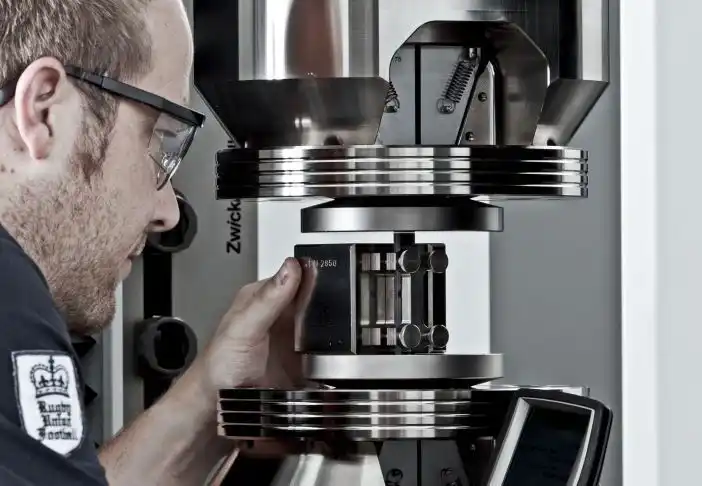
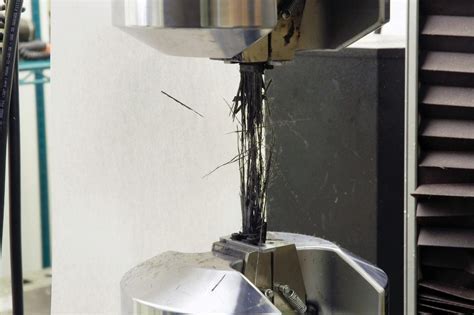
Tensile testing is a foundational technique in composite characterization. It determines how a material responds to a pulling force applied along its axis, offering insights into its yield strength, ultimate tensile strength, and Poisson’s ratio. In these tests, a composite specimen is clamped at both ends and stretched until failure. The stress-strain response is recorded, highlighting both the elastic region (where the material returns to its original shape) and the plastic region (where permanent deformation occurs).
Tensile behavior varies significantly based on the fiber orientation and matrix composition of the composite. For unidirectional laminates, maximum strength typically aligns with the fiber direction, while off-axis tests reveal interlaminar weaknesses. These insights help engineers tailor fiber angles in multilayer laminates for optimal performance.
Compression Testing: Evaluating Stability Under Crushing Loads
While tensile testing evaluates stretching behavior, compression testing investigates how composites withstand axial compressive forces. This test is particularly important for components subjected to buckling or column-like stresses, such as aerospace wing spars or automotive chassis frames.
In compression tests, specimens are loaded until they fail due to crushing, buckling, or delamination. Engineers extract metrics such as compressive strength, yield point, and elastic limit. Unlike metals, composites often fail by micro-buckling of fibers or interlaminar shear, making it critical to monitor internal structural behaviors during loading.
Shear Testing: Measuring Resistance to Sliding Forces
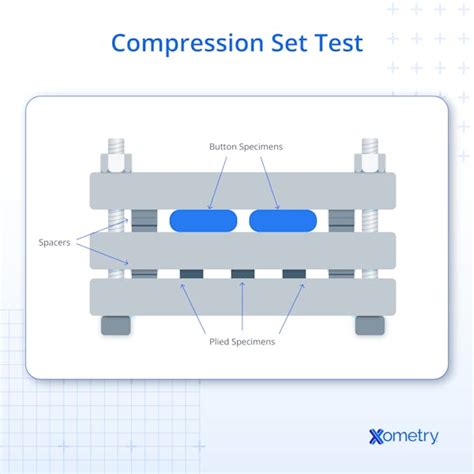
Shear testing applies forces parallel to the composite’s surface, producing a sliding motion between adjacent planes within the material. This form of loading is common in adhesive joints, bolted connections, and laminate interfaces.
There are several shear test configurations, such as short beam shear, V-notched rail shear, and Iosipescu shear tests. Each technique provides data on in-plane and interlaminar shear strength, both critical to understanding how a composite responds to out-of-plane stresses and load transfers between plies.
Compression After Impact (CAI) Testing: Gauging Damage Tolerance
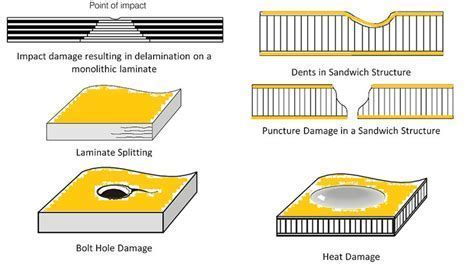
In real-world applications, composite components frequently experience impacts from tool drops, bird strikes, or in-flight debris. These incidents may cause barely visible impact damage (BVID), compromising structural integrity beneath the surface. CAI testing evaluates a composite’s residual strength following an impact event, simulating post-damage compressive loads.
The testing process typically involves striking a panel with a controlled weight or energy, followed by axial compression until failure. By comparing pre- and post-impact strength, engineers assess damage tolerance—a critical metric for flight-critical structures like fuselages and pressure hulls. Materials with higher CAI values ensure safer, longer-lasting components.
Fatigue Testing: Simulating Cyclic Load Durability
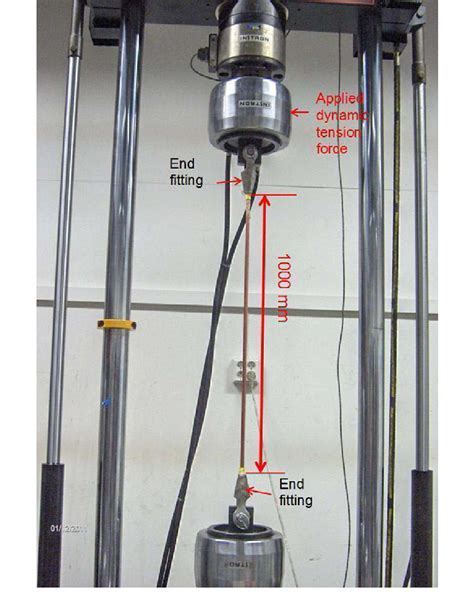
Fatigue describes the degradation of material properties under repeated cyclic loads. In composites, fatigue often initiates delaminations, matrix cracking, or fiber breakage, leading to catastrophic failure if undetected. Fatigue testing is especially important in industries like aerospace, where components endure thousands of pressure cycles during their operational life.
Test setups apply cyclic stresses—tension, compression, or bending—over millions of cycles at sub-yield magnitudes. The test outputs an S-N curve (stress vs. number of cycles to failure), revealing how well a composite endures repetitive stress. Engineers use this data to design structures that remain functional throughout their intended lifespan, even under fluctuating loads.
High Strain-Rate Testing: Assessing Crash and Impact Responses
Unlike quasi-static tests, high strain-rate testing evaluates how composites behave under rapid loading, such as crashes or explosions. At high velocities, materials exhibit significantly different mechanical responses due to rate-dependent deformation mechanisms.
The Split Hopkinson Pressure Bar (SHPB) is a widely used device for this purpose. In an SHPB setup, a stress wave is generated by a striker bar and propagated through a specimen at high speed. Sensors measure strain, stress, and strain rate, allowing for accurate characterization of dynamic material properties such as dynamic modulus, failure strain, and rate sensitivity.
These insights are vital in designing automotive crash structures, military armor, and aerospace energy-absorbing systems, where speed of impact dictates material performance.
Expanding the Testing Toolbox: Custom Protocols and Emerging Techniques
While the six testing methods outlined are industry standards, advanced composite development increasingly calls for application-specific testing protocols. Hybrid materials, multi-functional composites, and nano-engineered laminates introduce variables that necessitate new testing approaches.
Additional techniques include:
- Thermomechanical analysis (TMA) to evaluate dimensional stability across temperature variations
- Dynamic mechanical analysis (DMA) to study viscoelastic behavior under oscillatory loads
- Ultrasonic C-scan and X-ray CT imaging for non-destructive evaluation (NDE) of internal defects
- Interlaminar fracture toughness tests for understanding delamination growth under fatigue
Collaborations between composite manufacturers, testing labs, and standardization bodies are key to refining existing standards and embracing new testing frontiers.
Conclusion: Precision Testing Drives Composite Innovation
In an era where lightweight, high-performance materials are critical to advancing engineering, composite testing serves as the backbone of material validation. Each testing methodology—from tensile to high-rate impact—offers unique insights into a material’s behavior under specific conditions, helping engineers craft solutions with confidence and precision.
Understanding the subtle interplay between fiber architecture, matrix chemistry, and manufacturing technique is only possible through rigorous mechanical testing. As composite applications evolve toward higher complexity and demanding environments, the continued advancement of testing techniques ensures that innovation is always grounded in reliability.