Brazilian aerospace manufacturer Embraer is positioning itself to play a more dominant role in the global aviation market by announcing a bold plan to ramp up its commercial aircraft production and exploring the development of a clean-sheet narrow-body jet that could directly rival the long-standing dominance of Boeing and Airbus.
Currently the world’s third-largest aircraft maker, Embraer aims to increase its annual production rate from 73 aircraft to between 110 and 120 units. This comes at a time when major airlines across the globe are struggling with supply chain bottlenecks and mounting delays from the two largest aircraft suppliers, prompting urgent calls for credible alternatives.
Embraer’s Strategic Move: Scaling Production to Meet Demand
In a recent interview, Francisco Gomes Neto, CEO of Embraer, revealed the company’s production ambitions for the next several years. “This year, we plan to deliver between 75 and 80 aircraft in the commercial segment. We aim to ramp up to 110 to 120 annually,” he stated.
This ambitious scaling effort is not simply about numbers. It reflects Embraer’s assessment of a growing window of opportunity in a landscape where airlines are increasingly dissatisfied with the lack of alternatives and the manufacturing backlogs from Boeing and Airbus. By expanding output, Embraer seeks to reinforce its reputation as a reliable player and fulfill market demand more consistently.
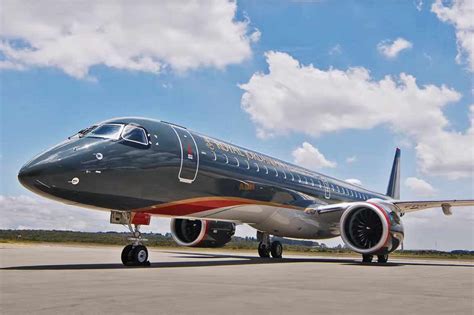
The Potential Game-Changer: A Clean-Sheet Narrow-Body Aircraft
The most significant signal of Embraer’s long-term ambitions lies in its exploration of a clean-sheet aircraft design. While still in conceptual stages, such a design would not be a mere update of an existing platform but rather a fully reimagined aircraft built with modern aerodynamics, propulsion systems, and next-generation materials.
Although Embraer has not officially categorized the aircraft, all signs point toward a next-gen narrow-body jet aimed squarely at the Airbus A320 and Boeing 737 families. If successful, this would mark a historic shift in the global aircraft market—challenging a duopoly that has remained unthreatened for decades.
“It could be a new commercial or executive jet… larger or smaller than what we have today,” Gomes Neto said. “We’re talking with engine manufacturers and exploring different wing designs. If we build a new product, we want it to be relevant for the next two or three decades.”
The Market Vacuum: Airlines Demand More Than Two Choices
A wave of airline dissatisfaction has helped set the stage for Embraer’s strategic play. Carriers are growing impatient with Boeing and Airbus, particularly due to extended delivery delays, unstable supply chains, and a lack of new competition.
Tim Clark, the outspoken CEO of Emirates, summed up this sentiment, remarking, “I’m tired of hearing complaints about the supply chain—you are the supply chain.” He, like many of his industry peers, supports the rise of a third competitor but remains pragmatic about the entrenched nature of the duopoly.
Similarly, Scott Kirby, CEO of United Airlines, has been vocal about the need for more viable suppliers in the aerospace sector. For Embraer, these frustrations represent an opening—a clear signal that the industry is ready for disruption.

Engineering the Future: Embracing Innovation for Competitive Edge
A clean-sheet aircraft offers Embraer the chance to integrate cutting-edge innovations from the ground up, including:
- Lighter composite materials for enhanced fuel efficiency
- Advanced winglets and aerodynamic improvements
- High-bypass turbofan engines or even hybrid-electric propulsion concepts
- Next-gen avionics for improved cockpit operations and safety
Such a program will likely be capital-intensive and stretch over a decade or more. However, Embraer’s track record with the E-Jets and the newer E2 family suggests it has both the engineering depth and market credibility to undertake the challenge.
India: A Strategic Pillar in Embraer’s Global Expansion
Alongside its manufacturing plans, Embraer is also exploring India as a potential industrial hub. Gomes Neto indicated that the company is open to establishing a Final Assembly Line (FAL) in the country, provided it secures a scalable volume of orders from Indian carriers.
“We’re very open to discussions, but we need a scalable delivery program in India to make it commercially viable,” he stated. The Indian aviation market, projected to be one of the fastest-growing in the world, is a natural fit for Embraer’s regional and narrow-body aircraft.

India’s demand for new routes and regional connectivity aligns well with Embraer’s E2 jet family, which is optimized for short- to medium-haul operations. With the right partnerships and volume commitments, India could become both a customer and a manufacturing base—further cementing Embraer’s global footprint.
The Competitive Equation: Can Embraer Disrupt the Duopoly?
Displacing or even meaningfully disrupting the Airbus-Boeing duopoly will not be easy. These two aerospace giants benefit from decades of scale, established airline relationships, and significant political backing. But recent stumbles—especially Boeing’s quality control issues and Airbus’s delays—have created credibility gaps that Embraer is poised to exploit.
Moreover, Embraer is not entirely alone. COMAC in China and Mitsubishi’s SpaceJet (currently shelved) are also examples of industry efforts to diversify the airframe market. However, Embraer holds a key advantage: it has already succeeded in global certification, production, and support, with thousands of aircraft operating worldwide.
Should the new aircraft materialize, the strategic implications would be enormous. Not only would it provide airlines with a much-needed third option, but it could also prompt Boeing and Airbus to accelerate their own next-gen programs.
Timing the Launch: Market Entry and Technology Maturity
Airbus is reportedly planning to debut its own next-generation narrow-body aircraft in the late 2030s. This timeline gives Embraer a potential window to launch earlier, especially if it can fast-track design and development through partnerships with engine makers and tier-1 suppliers.
However, this window also comes with risks. Premature launches with immature technology could jeopardize performance, while long timelines might erode first-mover advantage. The challenge lies in balancing innovation with realistic engineering milestones.
Conclusion: A Pivotal Moment for Global Aerospace
Embraer’s simultaneous push to boost production and explore a new, next-generation narrow-body jet signals one of the most consequential strategic shifts in the aviation sector in recent years. With airlines openly seeking alternatives and existing manufacturers struggling with reliability, the Brazilian firm may be in the right place at the right time.
If Embraer can secure enough airline interest, execute its clean-sheet program effectively, and possibly tap into emerging markets like India for industrial and commercial support, it may finally transform from a strong regional player to a global force in large commercial aviation.
This moment could well be remembered as the start of a new competitive era in commercial aerospace—where innovation, reliability, and responsiveness define the future, and Embraer steps up not as a challenger, but as a serious contender.