Global aviation has entered a new era where passengers expect more than simple transportation between cities. They want comfort without extravagance, refinement without financial shock, and consistency across continents. Emirates has responded with a sweeping transformation of its inflight product, centered on one of the most talked-about developments in modern commercial aviation: Premium Economy. The new inflight additions that Emirates passengers are raving about are not superficial upgrades. They represent a deliberate recalibration of long-haul travel, balancing luxury and practicality with the precision of a carrier that understands its global clientele.
For decades, Emirates has been synonymous with opulence in the sky. From private First Class suites to onboard lounges on the Airbus A380, the airline built a reputation around spectacle and service. Yet the aviation landscape shifted. Travelers became more discerning, more value-driven, and increasingly unwilling to choose between cramped affordability and flat-bed extravagance. The introduction and rapid expansion of Emirates Premium Economy is a strategic response to that shift.
The brilliance of the move lies not simply in adding another cabin, but in reimagining how space, service, and scale can coexist. Emirates is not dipping a toe into Premium Economy; it is embedding the product across its long-haul fleet with an intensity that signals permanence. The result is a cabin experience that feels carefully engineered rather than improvised.
Emirates: A Global Connector Built for Long-Haul Dominance
Since launching operations in 1985, Emirates has grown into one of the most recognizable long-haul carriers in the world. Operating from Dubai International Airport, the airline leveraged geography as a competitive advantage. Positioned between Europe, Asia, Africa, Oceania, and the Americas, Dubai became a natural crossroads. Emirates turned that crossroads into a global super-connector.
Unlike many airlines that rely on narrowbody fleets for regional density, Emirates built its empire on widebody aircraft. The Airbus A380 and Boeing 777 form the backbone of its operations, enabling the airline to move vast numbers of passengers across continents efficiently. This widebody strategy supports a hub-and-spoke model in which travelers from dozens of cities funnel through Dubai before dispersing to onward destinations.
This scale has always required consistency. When passengers spend 10, 12, or even 16 hours in the air, the cabin experience matters as much as punctuality. Emirates recognized that the growing demand for an elevated mid-tier experience was not a temporary trend. It was structural change.
Why Premium Economy Has Become Aviation’s Sweet Spot
Premium Economy has evolved from a niche experiment into one of the most commercially significant cabin classes in aviation. The value proposition is straightforward but powerful: offer tangible comfort improvements without approaching business class pricing.
Long-haul passengers increasingly prioritize personal space, especially on overnight flights. A few extra inches of seat width and pitch can transform sleep quality. A deeper recline can mean the difference between arriving refreshed and arriving fatigued. Enhanced dining presentation elevates the psychological experience of travel, signaling that the passenger is valued.
Emirates embraced this reality with a clear objective: create a cabin that feels purpose-built, not like an economy seat with decorative upgrades. The emphasis is on differentiation. Wider seats, premium materials, refined lighting, and upgraded service collectively create a distinct product tier rather than a cosmetic enhancement.
The surge in global demand for Premium Economy after the pandemic accelerated industry investment. Emirates responded not cautiously but assertively, integrating the cabin across both new deliveries and retrofitted aircraft.
Inside Emirates Premium Economy: Design, Materials, and Passenger Comfort
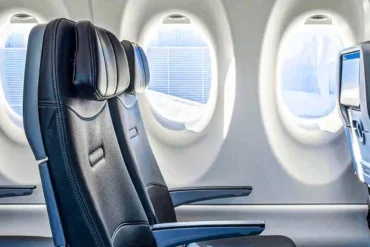
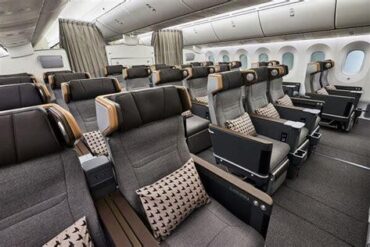
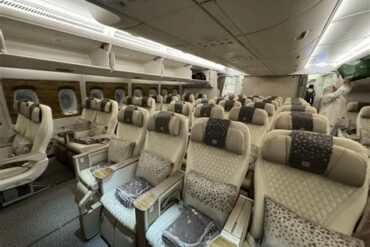
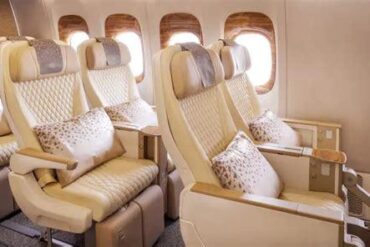
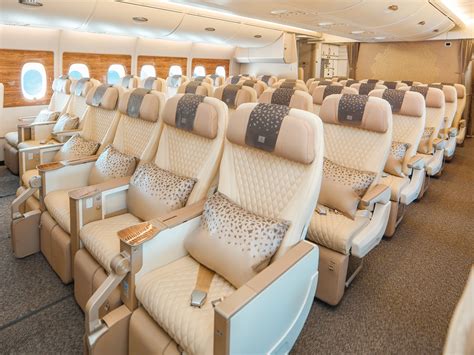
The physical environment of Emirates Premium Economy is intentionally calming. Cream-colored leather seats immediately distinguish the cabin from the darker tones often found in standard economy. The visual effect is subtle yet sophisticated, evoking the ambiance of a boutique hotel lounge rather than a mass-transport cabin.
Seats are engineered for endurance. Wider cushions distribute pressure more evenly during extended flights. A deeper recline allows for meaningful rest without intruding excessively into the space behind. Raised padded leg rests and supportive footrests reduce lower-body fatigue, especially critical on ultra-long-haul sectors linking North America and Asia via Dubai.
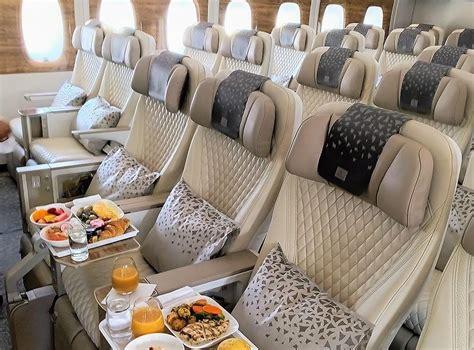
Six-way adjustable headrests provide customized support for sleeping or relaxing upright. This feature, often overlooked, is vital for neck stability during long flights. The inclusion of spacious woodgrain tray tables and side tables enhances practicality for both dining and productivity. Travelers working mid-flight benefit from stable surfaces that do not feel compromised by space limitations.
A 13.3-inch high-definition entertainment screen anchors each seat. Powered by Emirates’ renowned ICE inflight entertainment system, passengers access an extensive library of films, television series, music, and live channels. Bluetooth connectivity allows pairing with personal headphones, a modern touch that reflects changing passenger habits.
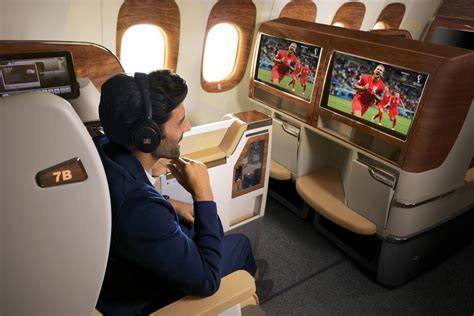
Mood lighting integrated into the cabin ceiling subtly shifts tones during overnight segments, promoting relaxation and circadian comfort. Lighting science is increasingly recognized as a critical component of long-haul wellbeing, and Emirates integrates it with deliberate intent.
Elevated Dining and Refined Service Details
The transformation extends well beyond the seat. Dining in Emirates Premium Economy reflects a commitment to presentation and substance. Meals are served on Royal Doulton china with stainless steel cutlery wrapped in linen, replacing disposable service ware typical of economy cabins. The tactile sensation of real cutlery and ceramic plating creates an immediate psychological upgrade.
Menus rotate monthly and reflect regional influences tied to route networks. Passengers may encounter dishes inspired by Middle Eastern flavors, European classics, or Asian cuisine, depending on origin and destination. Sparkling wine is included, alongside expanded beverage options that draw from premium cabin selections. After-meal chocolates and liqueurs complete the experience with understated elegance.
Large pillows and reusable amenity kits reinforce the sustainability narrative while enhancing comfort. Upgraded Wi-Fi availability on newer aircraft ensures that connectivity expectations are met, particularly for business travelers choosing Premium Economy over traditional corporate class policies.
Service tone plays an equally important role. Crew interactions in Premium Economy are calibrated to feel attentive without theatricality. The cabin’s smaller size compared to economy allows for more personalized engagement, strengthening the perception of exclusivity.
Fleet Retrofit Strategy: Expanding Premium Economy at Scale
Emirates’ expansion of Premium Economy is not confined to isolated routes. It is a systematic fleet-wide initiative driven by an ambitious retrofit program. One of the most notable milestones is the reconfiguration of former two-class Airbus A380 aircraft into three-class layouts incorporating Premium Economy.
Previously configured with 58 Business Class seats and 557 Economy seats, these high-density aircraft carried approximately 615 passengers. While efficient for high-volume leisure markets, they lacked mid-tier flexibility. The retrofit transforms them into aircraft featuring 76 Business Class seats, 56 Premium Economy seats, and 437 Economy seats.
The first retrofitted high-density A380 enters service between Dubai and Amman, later transitioning to Prague. By November, all 15 former two-class A380s are scheduled for conversion. This represents a substantial injection of Premium Economy capacity without requiring new aircraft deliveries.
Boeing 777 aircraft are also undergoing similar upgrades. Retrofitted 777-200LRs are being deployed to destinations including Milan and Dublin, progressively standardizing the inflight experience across continents.
Rapid Network Expansion Across Key Global Markets
Premium Economy availability is expanding aggressively across Europe, North America, Asia, Africa, and the Middle East. New York JFK gains additional retrofitted A380 service, moving toward daily operations. Zurich benefits from enhanced capacity delivering over 1,500 weekly Premium Economy seats. Dublin will eventually feature the cabin across all weekly flights.
Asian destinations such as Ho Chi Minh City and Hong Kong are receiving upgraded aircraft, while Basra and Mauritius join the expansion list. The objective is consistency. Passengers booking Emirates long-haul itineraries increasingly expect uniform cabin offerings, regardless of departure city.
This coordinated rollout underscores that Premium Economy is no longer experimental. It is a core pillar of Emirates’ long-haul strategy. The airline recognizes that travelers are willing to pay a premium for space, but not necessarily for full business class pricing. Aligning fleet configuration with this demand ensures revenue optimization and passenger satisfaction.
The Strategic Significance of Retrofitting the 615-Seat A380
The retirement or transformation of the densest A380 configurations signals a broader strategic recalibration. The original 615-seat layout maximized throughput on high-demand routes but sacrificed cabin diversity. In a market now defined by segmentation, flexibility is currency.
By converting these aircraft to include Premium Economy, Emirates enhances yield potential. Each Premium Economy seat commands higher fares than economy while occupying less space than business class. This balance allows the airline to maintain capacity while improving revenue per flight.
The A380 itself remains central to Emirates’ identity. While many global carriers have retired the type, Emirates continues to operate the world’s largest fleet of the aircraft. Integrating Premium Economy into the A380 reinforces the jet’s viability in a post-pandemic environment characterized by selective demand recovery.
Passenger Response: Why Travelers Are Raving
The enthusiasm surrounding Emirates’ new inflight additions stems from tangible experience. Passengers frequently highlight the noticeable seat width, the genuine leg support, and the sense of breathing room absent in standard economy. Overnight flights feel less punishing. Arrival fatigue diminishes.
Dining presentation leaves a lasting impression. The use of proper china and linen signals care, not cost-cutting. Entertainment system enhancements, especially Bluetooth connectivity, align with contemporary passenger behavior. Small details accumulate into a coherent narrative of value.
Perhaps most importantly, Premium Economy offers psychological satisfaction. Travelers perceive themselves as choosing smartly rather than splurging excessively. That emotional calculus matters. Aviation is not only about transport efficiency; it is about perception and personal comfort during liminal hours above oceans and deserts.
Emirates’ Long-Term Vision for Balanced Cabin Economics
The rapid growth of Premium Economy capacity suggests a durable shift in airline economics. Emirates is aligning fleet architecture with evolving passenger expectations. By combining retrofits, network deployment, and service refinement, the airline is building resilience into its long-haul model.
The expansion reflects confidence in sustained demand for mid-tier comfort. It also highlights Emirates’ ability to adapt without abandoning its luxury DNA. First Class suites and onboard lounges continue to define the brand’s upper echelon, yet the democratization of comfort through Premium Economy broadens appeal.
In a competitive global aviation market, differentiation is subtle but decisive. Emirates’ new inflight additions demonstrate that innovation does not always require radical reinvention. Sometimes it requires thoughtful recalibration of space, service, and scale.
Premium Economy is no longer a compromise cabin. Under Emirates’ execution, it has become a strategic centerpiece—an offering that merges practicality with refinement and transforms long-haul travel into a more humane experience.