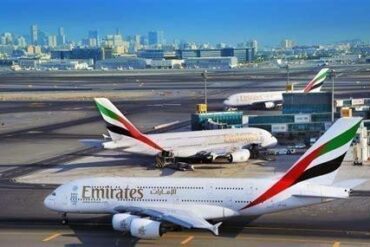
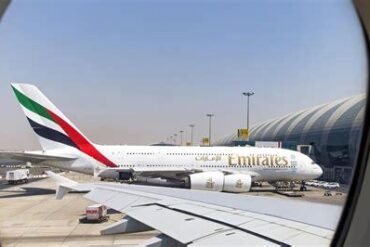
Emirates, the Dubai-based aviation powerhouse, is set to significantly reduce its Airbus A380 operations to Brisbane, replacing one of its two daily superjumbo flights with a Boeing 777-300ER. This strategic decision, which cuts capacity between Brisbane and Dubai by approximately 14%, underscores a broader network recalibration as the carrier optimizes aircraft deployment across its global operations.
Strategic Reduction: Emirates Cuts A380 Flights to Brisbane
From October 2025, Emirates will halve its Airbus A380 services to Brisbane International Airport (BNE). Since October 2024, the airline has consistently operated double daily A380 flights to the Queensland capital, making this adjustment particularly significant for Australia’s long-haul air connectivity. The upcoming change will see one daily A380 service replaced with a Boeing 777-300ER, marking a pivot towards more flexible, cost-effective operations on this critical route.
According to aviation analytics firm Cirium, Emirates currently offers 30,507 seats monthly on flights from Brisbane to Dubai. This number will drop to 28,992 seats in October 2025, representing a 2.3% reduction, before plummeting further to 24,660 seats in November 2025, a substantial 14.1% decrease. Throughout the Southern Hemisphere summer season, the carrier’s capacity will fluctuate between 23,016 and 25,482 seats, a stark contrast to previous years of consistent A380-driven volume.
Route Adjustments: Impact on Brisbane-Dubai Scheduling
Brisbane’s two daily departures to Dubai — EK435 and EK431 — have long been mainstays of Emirates’ Australian schedule. EK435 departs Brisbane at 21:00, arriving in Dubai at 05:25, facilitating seamless onward connections to Europe and Africa. EK431, departing at 01:55 and landing in Dubai at 10:05, is the flight transitioning to the Boeing 777-300ER.
While Emirates has yet to confirm whether this change is temporary or permanent, the lack of a published schedule beyond early 2026 suggests the airline remains open to re-adjusting capacity based on market demand.
Emirates’ Australian Network Faces Wider Cuts
This Brisbane adjustment follows Emirates’ recent decision to scale back its Perth services. From October 25, 2025, Emirates will reduce its Perth operations to a single daily A380 flight, ending the current mix of A380 and Boeing 777-300ER services. This comes in the wake of support received under the Western Australian Government’s Aviation Recovery Fund, aimed at maintaining essential air connectivity amid fluctuating demand.
Currently, Emirates maintains services to all five major Australian cities:
- Sydney
- Melbourne
- Brisbane
- Perth
- Adelaide (limited to a single daily service)
However, these latest adjustments indicate a network optimization strategy prioritizing profitability and efficient aircraft utilization over sheer capacity.
Competition Heats Up in Australian-Middle East Aviation Corridor
Emirates’ reduced presence coincides with increasing competition from other Middle Eastern carriers. Notably, Virgin Australia, via a wet lease partnership with Qatar Airways, has recently launched direct flights connecting Brisbane, Sydney, and Perth to Doha, utilizing Qatar Airways’ Boeing 777-300ERs. The partnership expanded in June 2025, with Brisbane flights commencing on June 19.
Meanwhile, Etihad Airways continues to operate regular flights from Abu Dhabi’s Zayed International Airport (AUH) to both Sydney and Melbourne, further saturating the Middle East-Australia corridor.
Implications for Passengers: Reduced Capacity, Possible Fare Increases
For passengers traveling between Brisbane and Dubai, the reduction in A380 services could translate to tighter seat availability, particularly during peak travel seasons. Historically, Emirates’ A380s have offered superior in-flight amenities, including the airline’s iconic onboard lounge and showers, features not present on the 777-300ER. This downgrade in aircraft type may influence premium passengers seeking a higher-end onboard experience.
With capacity shrinking by nearly one-sixth, fare prices on the Brisbane-Dubai sector may rise, especially during holiday seasons and major events, as seat scarcity combines with sustained demand.
Emirates’ Strategic Realignment: Redeploying Aircraft for Greater Efficiency
Emirates’ decision to curtail its A380 operations on Australian routes reflects the airline’s broader fleet optimization strategy. Facing growing pressure to maintain profitability amidst volatile fuel prices and dynamic global travel patterns, Emirates is redeploying its high-capacity A380s to more lucrative or congested routes, where the aircraft’s high seat count and premium amenities generate maximum yield.
The Boeing 777-300ER, while offering fewer seats, provides Emirates with greater operational flexibility, lower operating costs per sector, and more manageable load factors. This flexibility becomes critical as the airline assesses route profitability post-pandemic recovery.
A Legacy of Australian Operations: Emirates’ Role in Connecting Australia to the World
Since 1996, Emirates has played a pivotal role in linking Australia with the Middle East and Europe. A longstanding strategic alliance with Qantas has strengthened the airline’s footprint in the region, enabling reciprocal frequent flyer benefits, codeshare flights, and a combined global network for Australian travelers. Emirates’ presence at major Australian airports — including dedicated lounges in Brisbane, Melbourne, Sydney, and Perth — further cements its premium brand image in the Australian market.
However, these latest cuts highlight a shift in Emirates’ Australian strategy, moving from aggressive capacity expansion towards sustainable, demand-driven operations.
Looking Ahead: Will Emirates Restore Brisbane A380 Flights?
While current schedules suggest no imminent restoration of double daily A380 flights to Brisbane, Emirates has not ruled out capacity increases in the medium term. With forward booking trends remaining volatile and competitor activities intensifying, Emirates may yet adjust its strategy should market conditions improve.
The airline’s long-term commitment to Australia remains strong, yet its operational approach is clearly evolving. For Brisbane — and Australia as a whole — the golden age of ubiquitous A380 services may be drawing to a close, replaced by more pragmatic, efficiency-driven operations focused on profitability and resilience.
Conclusion: A Transforming Aviation Landscape for Brisbane Travelers
Emirates’ halving of its A380 flights to Brisbane marks a significant pivot in how the airline serves the Australian market. Passengers accustomed to the luxury and capacity of the superjumbo will now experience a shift, as the Boeing 777-300ER becomes the mainstay of one of Brisbane’s key international services. As airlines globally adapt to a new aviation era, capacity cuts, aircraft realignment, and strategic adjustments are set to redefine long-haul travel between Australia and the Middle East.