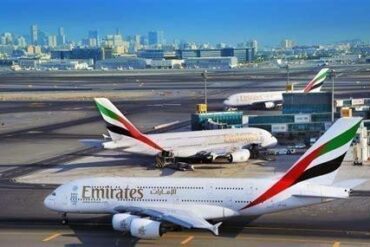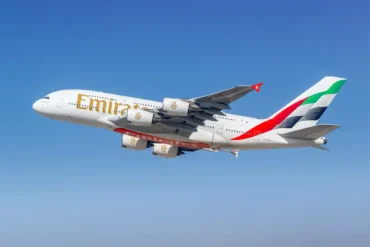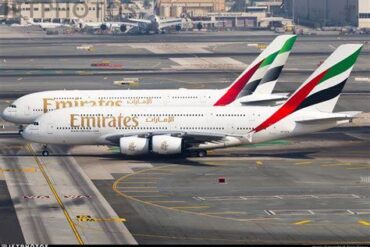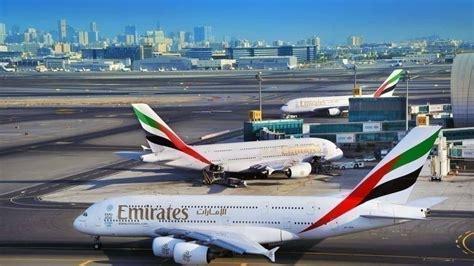
The global aviation network often behaves like a living organism. When geopolitical pressure hits one region, the ripple spreads through flight schedules, aircraft deployments, and route strategies across continents. That reality is unfolding now as Emirates, the Dubai-based long-haul powerhouse, dramatically reduces its Airbus A380 operations to the United States by 51%.
The move comes amid ongoing instability in the Middle East, which has forced airlines to operate under constrained airspace and irregular schedules. Although flights in and out of Dubai International Airport (DXB) have gradually resumed, operations remain far from normal. For Emirates, a carrier that built its reputation on high-frequency ultra-long-haul connectivity, the disruptions have forced temporary but significant adjustments—especially on routes to the United States where the double-deck Airbus A380 superjumbo has long been a flagship aircraft.
The scale of the reduction is striking. In a typical schedule, Emirates operates 49 weekly Airbus A380 departures between Dubai and multiple American destinations. Under the revised schedule for the second half of March 2026, that figure has dropped to just 24 flights per week, effectively cutting the airline’s A380 presence in the U.S. market in half.
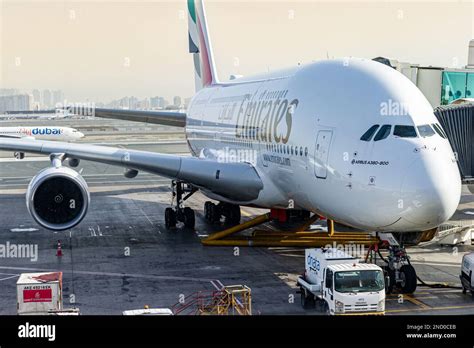
Emirates’ A380 Presence in the US Is Now Concentrated on Two Routes
With the reduced schedule in place, Emirates has consolidated its A380 operations to only two American gateways. The majority of remaining flights are focused on New York’s John F. Kennedy International Airport (JFK), which continues to serve as the airline’s primary U.S. hub for the superjumbo.
Out of the 24 weekly A380 flights that remain, 17 operate to New York JFK. The structure of those flights reveals how Emirates is maintaining connectivity while adapting to operational constraints.
Ten of the weekly departures operate as nonstop services between Dubai and New York, preserving one of the airline’s most important transcontinental links. The remaining seven flights follow Emirates’ unique Dubai–Milan–New York routing, where the aircraft stops at Milan Malpensa Airport (MXP) before continuing across the Atlantic.
The second U.S. destination still receiving A380 service is San Francisco International Airport (SFO). Emirates continues to operate one daily A380 flight between Dubai and San Francisco, maintaining its presence in the key West Coast market.
Despite the reduced footprint, these routes remain strategically important. They connect major financial and technology centers directly with Dubai, reinforcing Emirates’ long-standing strategy of linking global hubs through high-capacity aircraft.
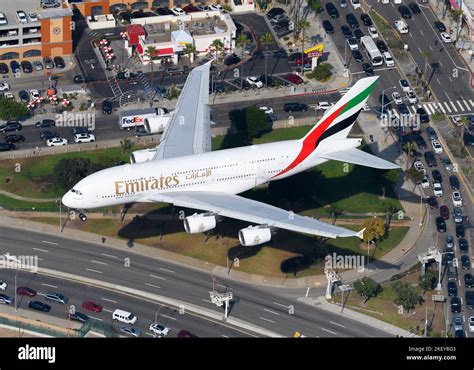
What the Emirates US A380 Network Normally Looks Like
Under standard conditions, the airline’s A380 operation in the United States is significantly broader. Emirates typically deploys the aircraft across five American destinations, providing high-capacity connections between Dubai and some of the country’s largest aviation markets.
Normally, the carrier operates:
- Two daily Airbus A380 flights to New York JFK
- Daily A380 flights to San Francisco
- Daily A380 service to Los Angeles
- Daily A380 flights to Houston
- Daily A380 operations to Washington Dulles
This structure allows Emirates to run seven A380 flights to the United States each day, forming one of the largest long-haul deployments of the aircraft anywhere in the world.
However, the temporary operational restrictions have forced Emirates to withdraw the A380 entirely from three major U.S. airports. Routes to Los Angeles International Airport (LAX), Houston George Bush Intercontinental Airport (IAH), and Washington Dulles International Airport (IAD) are currently operating without the superjumbo.
These suspensions highlight how airlines prioritize their most strategic routes when capacity must be reduced. New York and San Francisco remain essential links for business travel and cargo demand, making them the logical destinations to retain the A380.
Boeing 777 Aircraft Step In to Maintain US Connectivity
Even as A380 capacity shrinks, Emirates has not abandoned its broader U.S. network. Instead, the airline has shifted several routes to its Boeing 777 fleet, which offers slightly smaller capacity but greater scheduling flexibility.
For example, Newark Liberty International Airport (EWR) continues to receive Emirates service through a Dubai–Athens–Newark routing using the Boeing 777-300ER. Meanwhile, the same aircraft type now handles multiple other American destinations, ensuring connectivity remains intact despite the temporary A380 pullback.
The Boeing 777 aircraft currently serve routes to:
- Boston Logan International Airport
- Chicago O’Hare International Airport
- Dallas/Fort Worth International Airport
- Seattle-Tacoma International Airport
This fleet substitution illustrates a common airline strategy during disruptions: maintain the route but adjust aircraft size. The approach allows airlines to protect market presence while adapting to operational realities.
Emirates Plans to Restore Full A380 Operations Soon
Despite the dramatic reduction, Emirates has made clear that the cuts are temporary rather than structural. According to the airline’s latest schedule guidance, full operations are expected to resume by March 29, 2026.
That timeline suggests the airline anticipates improved operational stability as regional airspace gradually returns to normal. Once conditions stabilize, the airline intends to restore its full A380 schedule to the United States, bringing back services to Los Angeles, Houston, and Washington.
Until then, passengers transiting through Dubai face tighter travel conditions. Emirates has stated that connecting passengers are only accepted when their onward flights are confirmed to be operating, reflecting the complexity of managing global routes during geopolitical disruption.
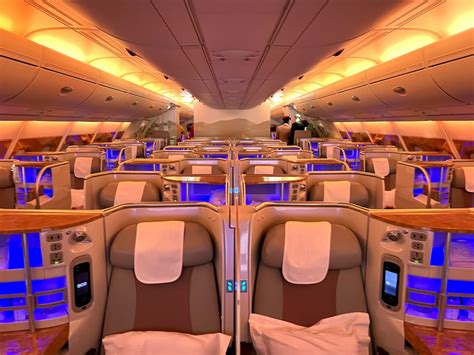
The Airbus A380 Remains Central to Emirates’ Global Network
Even with reduced U.S. operations, the Airbus A380 remains the backbone of Emirates’ long-haul strategy. Across the broader network, the airline continues to deploy the superjumbo to dozens of destinations worldwide.
Cities still receiving A380 service include London Heathrow, Paris Charles de Gaulle, Singapore, Sydney, Melbourne, Amsterdam, Zurich, and Toronto, among many others. London Heathrow stands out as the most prominent hub, with up to six daily A380 flights linking the British capital with Dubai.
In Asia and the Pacific, destinations such as Tokyo Narita, Hong Kong, Kuala Lumpur, and Auckland also remain key A380 markets. Meanwhile, European cities like Munich, Vienna, Prague, and Copenhagen continue to receive the aircraft on a regular schedule.
This global deployment underscores a central truth about Emirates’ strategy: no airline relies on the A380 more heavily. Even as other carriers retire or scale back the aircraft, Emirates continues to leverage its massive capacity and premium cabins to dominate long-haul travel flows through Dubai.
The current reduction in U.S. flights is therefore best understood as a short-term operational adjustment rather than a strategic retreat. Once conditions stabilize, the familiar sight of the four-engine A380 towering over American airport gates is expected to return to full strength.