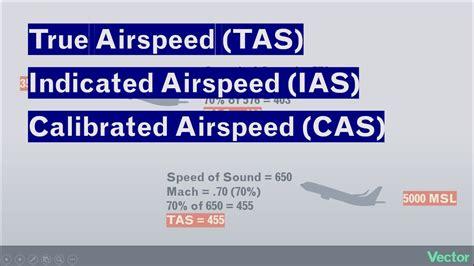
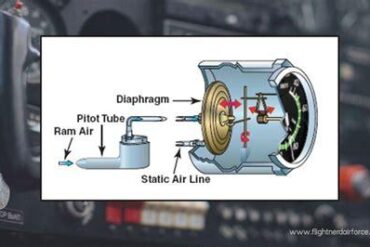
Equivalent airspeed (EAS) refers to the speed at sea level, under International Standard Atmosphere (ISA) conditions, that creates the same incompressible dynamic pressure as the true airspeed at a specific altitude. Simply put, EAS can be viewed in relation to true airspeed, but it is also linked to calibrated airspeed (CAS) adjusted for compressible flow at the flying altitude. At sea level with ISA conditions, EAS and CAS match. However, at other altitudes, EAS is typically lower than CAS. For speeds under approximately 200 knots CAS and below 10,000 feet, the difference between CAS and EAS is minimal. Yet, at higher speeds and altitudes, CAS needs adjustments for compressibility errors to accurately find EAS. The importance of equivalent airspeed lies in its relationship to aerodynamic forces; at Mach numbers below wave drag onset, all aerodynamic forces and moments acting on an aircraft are proportional to the square of the equivalent airspeed.