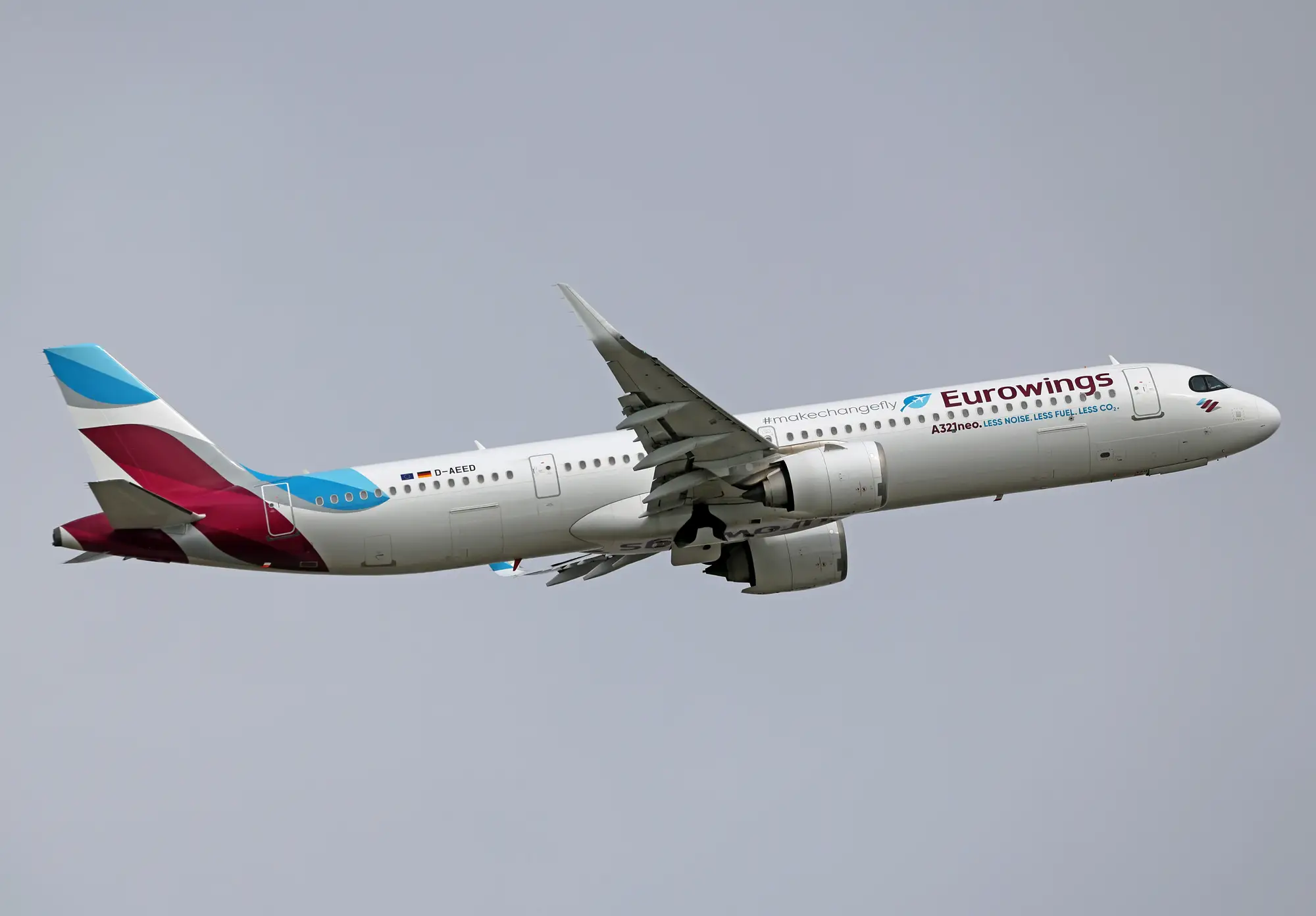
Commercial aviation’s fragile relationship with geopolitics was thrust back into sharp relief when Eurowings Flight EW1153 arrived in Germany 11 hours late after a cascading series of diversions triggered by the sudden closure of Iranian airspace. What should have been a routine overnight flight from Dubai to Stuttgart instead became a case study in how regional military tension can upend tightly optimized airline operations within hours.
The Airbus A320neo, operating the January 24, 2026 service, departed Dubai International Airport (DXB) on schedule, carrying passengers expecting a direct journey into southern Germany. That expectation dissolved quickly as airlines across the region reacted to escalating warnings from aviation safety authorities, all pointing to a rapidly deteriorating security environment over Iran and Iraq. The decision to reroute EW1153 set off a chain reaction that exposed the thin margins under which short- and medium-haul aircraft operate on ultra-long sectors.
At the heart of the disruption was a familiar but chilling precedent. The geopolitical atmosphere increasingly resembled the conditions that preceded the 2020 shoot-down of Ukraine International Airlines Flight 752, an event that permanently reshaped how airlines assess risk over conflict zones. With American military forces massing in Jordan, a US carrier strike group moving into the Arabian Sea, and Iranian airspace closures occurring with little notice, risk tolerance across the industry dropped sharply.
A Short-Haul Aircraft Pushed Beyond Its Comfort Zone
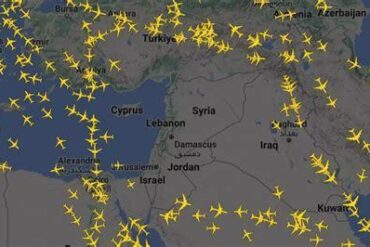
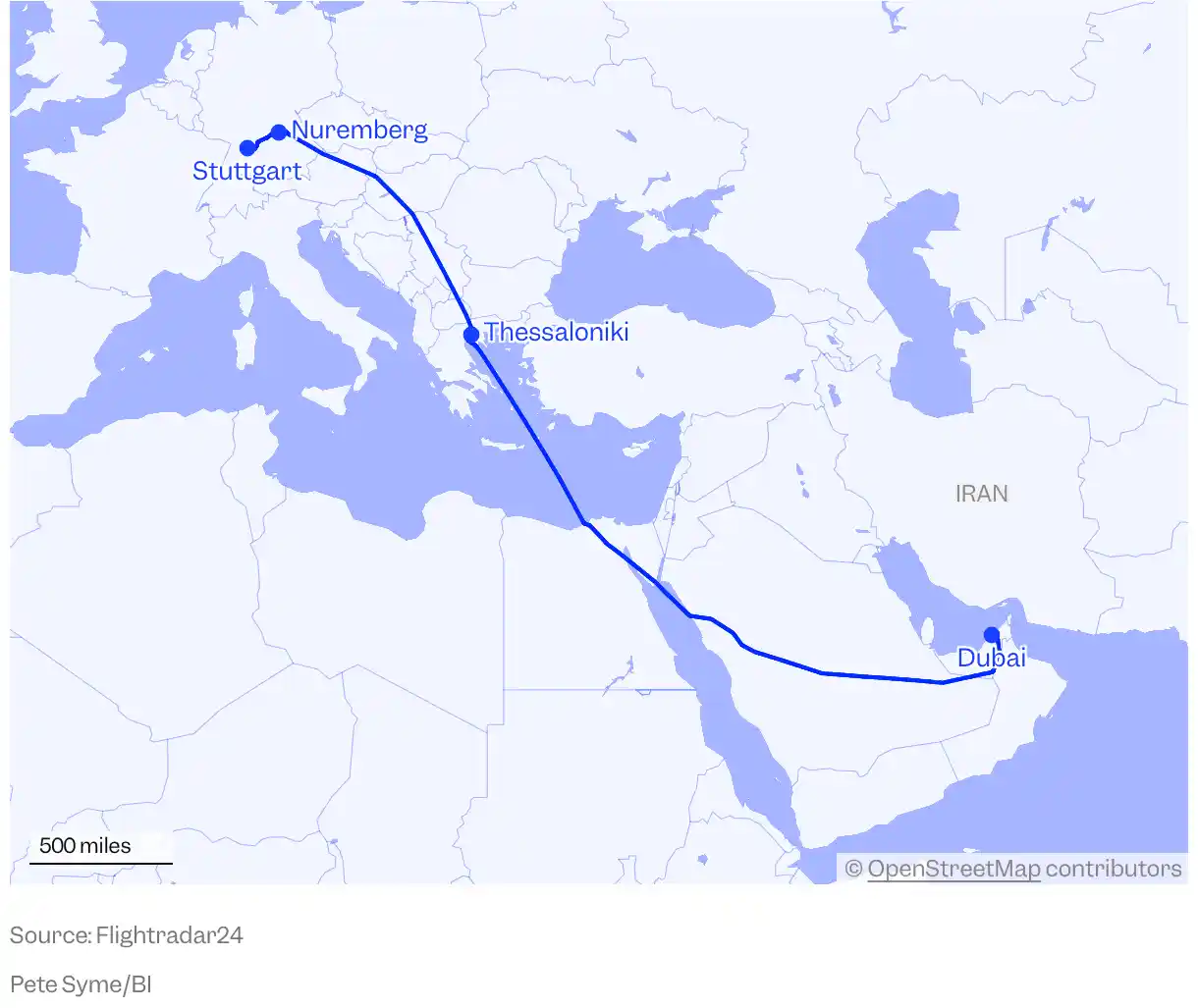
The A320neo is an efficient workhorse, but it is not designed to absorb unlimited detours. With Iranian and Iraqi airspace effectively off-limits, EW1153 was forced onto a lengthy southern and western routing that dramatically increased distance and fuel burn. Unlike widebody aircraft operated by network carriers, the A320neo simply could not complete the revised journey in one leg.
This constraint necessitated an unplanned refueling stop at Thessaloniki Airport (SKG) in Greece. While technically straightforward, the stop consumed precious time on the ground, adding delay to an already stretched schedule. By the time the aircraft was airborne again, the knock-on effects were unavoidable. What began as a fuel calculation problem soon became an airport curfew problem.
Curfews Turn a Delay Into a Second Diversion
Stuttgart Airport (STR) enforces a strict nighttime landing curfew, a regulatory reality designed to protect surrounding communities from overnight noise. The accumulated delay from rerouting and refueling pushed EW1153’s estimated arrival beyond the permissible window. With no regulatory flexibility available, the crew was forced to make a second diversion, this time to Nuremberg Airport (NUE).
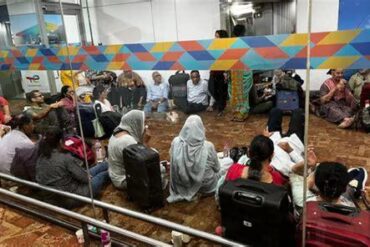
Nuremberg, lacking the same curfew constraints, became the unintended final destination for a flight that had already crossed continents and time zones. For passengers, the experience was exhausting and disorienting. For the airline, it was an expensive reminder that airspace closures rarely produce isolated consequences.
Why Airlines Are Steering Clear of Iran and Iraq
The rerouting of EW1153 was not an isolated judgment call. The European Union Aviation Safety Agency (EASA) issued a Conflict Zone Information Bulletin (CZIB) advising all commercial operators to avoid Iranian and Iraqi airspace entirely. Similar guidance emerged from other aviation authorities, reflecting deep concern over unpredictable airspace management, rapid military escalation, and electronic warfare risks.
One particularly insidious threat is GPS spoofing, which has been repeatedly reported around Iran. By feeding aircraft false positional data, spoofing can compromise navigation systems and crew situational awareness. In a region already saturated with military radar and missile systems, such interference elevates risk beyond acceptable commercial thresholds.
Iran’s brief but complete airspace closure on January 14, 2026, implemented without prior notice, further undermined confidence. In global aviation, predictability is safety. Sudden closures break that contract.
A Region Shaped by Memory and Missiles
Aviation’s caution is rooted in memory as much as intelligence. In January 2020, Ukraine International Airlines Flight 752, a Boeing 737-800, was mistakenly shot down minutes after departing Tehran. Two Tor SA-15 surface-to-air missiles, fired by Iran’s Islamic Revolutionary Guard Corps, killed all 176 people on board. The aircraft was misidentified as a hostile target during a period of extreme military alert following Iranian missile strikes against US bases in Iraq.
The tragedy forced regulators to confront an uncomfortable truth: civilian aircraft can become collateral damage in moments of geopolitical panic. The FAA’s ban on US carriers flying over Iran, now extended through at least October 2027, remains one of the longest-lasting regulatory responses to a single incident.
Airlines Reroute, Costs Rise, Passengers Absorb the Shock
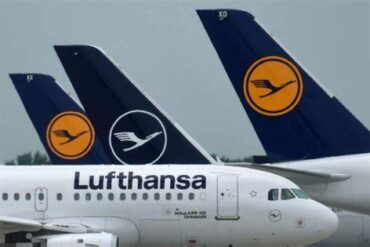
Eurowings is far from alone. Wizz Air has added technical stops in Cyprus and Greece, while legacy carriers including Lufthansa, Air France–KLM, and British Airways have suspended or heavily modified services to the region. Many flights now arc over Saudi Arabia or Afghanistan, adding flight time, fuel consumption, crew duty complexity, and operational cost.
Security analysts are blunt about the outlook. Eric Schouten, director of security intelligence firm Dyami, warned that travelers should expect sudden disruptions as the situation evolves, noting that real-time monitoring is now essential rather than optional. The modern airline network, optimized for efficiency, has little slack when geopolitics intrudes.
A Fragile Balance Between Safety and Connectivity
The 11-hour delay of Eurowings Flight EW1153 illustrates how quickly global aviation can be reshaped by events far from the cabin. Safety agencies are doing what they were created to do: err on the side of caution when the risk picture darkens. Airlines are adapting with reroutes and refueling stops. Passengers, inevitably, feel the friction.
This is the price of flying through a world where airspace is no longer just geography, but strategy. As long as military posturing and rapid escalation define the Middle East’s skies, journeys like EW1153’s will remain a stark reminder that in aviation, the shortest path is not always the safest one.